


Asset Sale vs. Stock Sale: Why the Structure Matters as Much as the Price
An asset sale and a stock sale can lead to very different outcomes for a business owner. In most Tennessee business transactions, buyers prefer asset...
15 min read
Joe Steigman is the Founder of Legacy Entrepreneurs, a boutique business brokerage and exit advisory firm focused on helping business owners maximize value and transition their companies with confidence. With a background that combines operational leadership, corporate consulting, finance, and entrepreneurship, Joe brings a practical, owner-focused perspective to business sales and acquisitions. Joe is a Certified Business Intermediary (CBI), a designation awarded by the International Business B...
Joseph Steigman
June 26, 2026
An asset sale and a stock sale can lead to very different outcomes for a business owner. In most Tennessee business transactions, buyers prefer asset sales because they limit exposure to unknown liabilities, while sellers may favor stock sales for tax or transferability reasons.
The structure of a deal affects far more than the purchase agreement. It can influence taxes, liability, financing, due diligence, contract transfers, and ultimately how much a seller keeps after closing. A higher offer is not always the better deal if the structure creates additional risk or tax burden.
Most owners only sell a business once. According to the Q1 2025 Market Pulse Report from the International Business Brokers Association and M&A Source, 90% of recent sell-side clients were first-time sellers, and more than 80% of advisors reported that fewer than 5% of their clients had a written exit strategy before their initial meeting. As a result, many owners focus on price while overlooking deal structure, which is one of the biggest drivers of risk and after-tax proceeds.
• Core Challenge: Buyers and sellers often prefer different deal structures because taxes, liability exposure, and risk allocation are rarely aligned.
• Business Impact: The structure of a transaction can affect financing, due diligence, negotiations, taxes, and how much a seller ultimately keeps after closing.
• Common Mistake: Many owners focus on purchase price without understanding how an asset sale or stock sale affects after-tax proceeds, liability exposure, and deal complexity.
• What to Evaluate: Tax implications, liability transfer, contract assignments, lender requirements, and whether the business can transfer smoothly to a new owner.
• Key Consideration: Buyers generally prefer asset sales because they reduce risk, while sellers may favor stock sales for tax, transferability, or simplicity reasons.
• Recommended Next Step: Understand why buyers, sellers, and lenders evaluate deal structure differently before negotiating a letter of intent or purchase agreement.
An asset sale occurs when a buyer purchases specific assets of a business rather than acquiring ownership of the business entity itself. Instead of buying the company, the buyer acquires the assets needed to operate the business, which often include equipment, inventory, customer relationships, intellectual property, and goodwill.
For most Tennessee Main Street and lower-middle-market transactions, this is the most common deal structure. The seller typically retains the legal entity after closing, while the buyer acquires the operating assets and assumes only those liabilities defined in the purchase agreement.
The purchase agreement identifies which assets will transfer and which liabilities, if any, the buyer will assume. This distinction is important because the buyer is not purchasing the company's ownership interests. They are purchasing selected parts of the business.
As a result, asset sales give buyers more control over the risks they take on after closing. Rather than inheriting the company's entire history, they can focus on acquiring the assets that generate revenue while limiting exposure to certain obligations and liabilities.
Most buyers prefer asset sales because they reduce uncertainty.
When evaluating an acquisition, buyers are not just purchasing cash flow. They are evaluating potential risks tied to taxes, legal issues, employee matters, compliance concerns, customer contracts, and other obligations that could affect future profitability.
| Buyer Concern | How an Asset Sale Can Help |
|---|---|
| Unknown Liabilities | Buyers can often limit which liabilities they assume. |
| Tax Planning | Acquired assets may receive a new tax basis for depreciation and amortization purposes. |
| Legal Exposure | Certain historical obligations may remain with the seller's entity. |
| Due Diligence Risk | Buyers gain greater clarity around what is being acquired. |
| Financing Considerations | Asset sales are commonly used in SBA-financed acquisitions. |
From a buyer's perspective, an asset sale creates a clearer picture of both opportunity and risk. That matters because risk directly affects value. Buyers are generally willing to pay more when they understand what they are acquiring and have confidence that unexpected liabilities will not emerge after closing.
Read Next: How to Sell a Business in Tennessee
A stock sale occurs when a buyer acquires ownership of the business entity itself rather than purchasing individual assets. Instead of buying selected assets, the buyer purchases the company's stock, membership interests, or partnership interests and assumes control of the existing entity.
Unlike an asset sale, the business continues operating under the same legal structure after closing. Contracts, licenses, customer relationships, and other assets generally remain with the company, which can make the transition appear simpler on the surface.
In a stock purchase, ownership changes, but the legal entity remains intact. The buyer effectively steps into the shoes of the previous owner and assumes responsibility for operating the business going forward.
That continuity can be valuable when a business relies heavily on contracts, licenses, permits, or other relationships that may be difficult to transfer through an asset sale. In some industries, preserving those relationships is one of the primary reasons a stock sale is considered.
The tradeoff is that buyers are acquiring more than just the company's assets. They are also acquiring their history.
From a buyer's perspective, stock sales often involve greater risk because the legal entity remains unchanged. Any unresolved tax issues, compliance concerns, contract disputes, employee claims, or other liabilities generally remain attached to the company after closing.
This does not mean stock sales are inherently bad transactions. It simply means buyers typically conduct broader due diligence and may negotiate additional protections before agreeing to a stock purchase.
| Buyer Concern | Why It Matters in a Stock Sale |
|---|---|
| Historical Liabilities | The entity's obligations generally remain with the company. |
| Tax Exposure | Buyers may inherit tax-related risks from prior periods. |
| Legal Disputes | Existing claims can continue after the acquisition. |
| Compliance Issues | Regulatory problems may remain attached to the entity. |
| Unknown Risks | Buyers often have less ability to isolate specific liabilities. |
Because of these risks, buyers frequently prefer asset sales unless there is a compelling reason to acquire the entire entity.
Sellers often view stock sales differently.
In some situations, a stock sale can simplify the transaction by transferring ownership of the company without requiring individual assets and contracts to be reassigned. Certain contracts, permits, licenses, or customer relationships may also be easier to preserve when the legal entity remains intact.
Tax considerations can be another factor. Depending on the business structure and the seller's circumstances, a stock sale may produce a more favorable tax outcome than an asset sale. However, those benefits vary significantly based on the entity type, purchase price allocation, state and federal tax rules, and the specifics of the transaction.
For that reason, sellers should evaluate the economic impact of both structures before entering negotiations. The structure that appears simpler on the surface is not always the one that produces the best outcome after taxes, liabilities, and closing terms are considered.
Both asset sales and stock sales result in a change of ownership, but they allocate risk, taxes, and responsibilities differently. Understanding those differences helps explain why buyers often prefer one structure while sellers may advocate for another.
| Factor | Asset Sale | Stock Sale |
|---|---|---|
| What Transfers | Selected assets and agreed-upon liabilities | Ownership of the business entity |
| Liability Exposure | Generally lower | Generally higher |
| Contact Transfer | Often requires assignment | Usually remains intact |
| Tax Basis | Potential step-up to fair market value | The existing basis generally remains |
| Due Diligence Focus | Assets and operations | Entire company history |
| SBA Financing | Common | Often more complex |
| Buyer Preference | More common | Less common |
| Seller Preference | Depends on circumstances | Often preferred when tax advantages exist |
Most negotiations around deal structure ultimately come down to three issues: liability exposure, transferability, and tax consequences.
Liability is often the primary reason buyers prefer asset purchases.
In an asset sale, buyers typically acquire selected assets and assume only the liabilities identified in the purchase agreement. In a stock sale, the legal entity remains intact, meaning historical obligations generally remain with the company after closing.
That distinction can affect exposure to tax issues, employee claims, compliance concerns, contract disputes, and other liabilities uncovered during due diligence. Because unknown risks are difficult to quantify, many buyers view asset sales as a safer structure.
One advantage of a stock sale is continuity.
Because the legal entity remains unchanged, contracts, permits, licenses, and customer agreements often stay in place after closing. Asset sales can require contracts to be reassigned or approved by third parties, creating additional complexity.
This issue tends to matter most for businesses that rely heavily on long-term customer contracts, franchise agreements, government contracts, specialized licenses, or commercial leases.
Tax basis is one of the most overlooked aspects of deal structure. In many asset purchases, buyers may be able to step up the tax basis of acquired assets to fair market value, creating future depreciation and amortization deductions. Stock purchases generally do not provide the same immediate benefit.
As a result, buyers may view an asset purchase as economically more attractive than a stock purchase, even when the purchase price is identical.
This is where buyer and seller interests often diverge. Buyers typically prioritize liability protection, tax basis advantages, and risk reduction. Sellers may prioritize tax treatment, simplicity, and preserving existing contracts or licenses.
For business owners, understanding those competing priorities is often more important than understanding the legal mechanics of either structure. Deal structure can influence value, risk, financing, and after-tax proceeds long before a purchase agreement is signed.
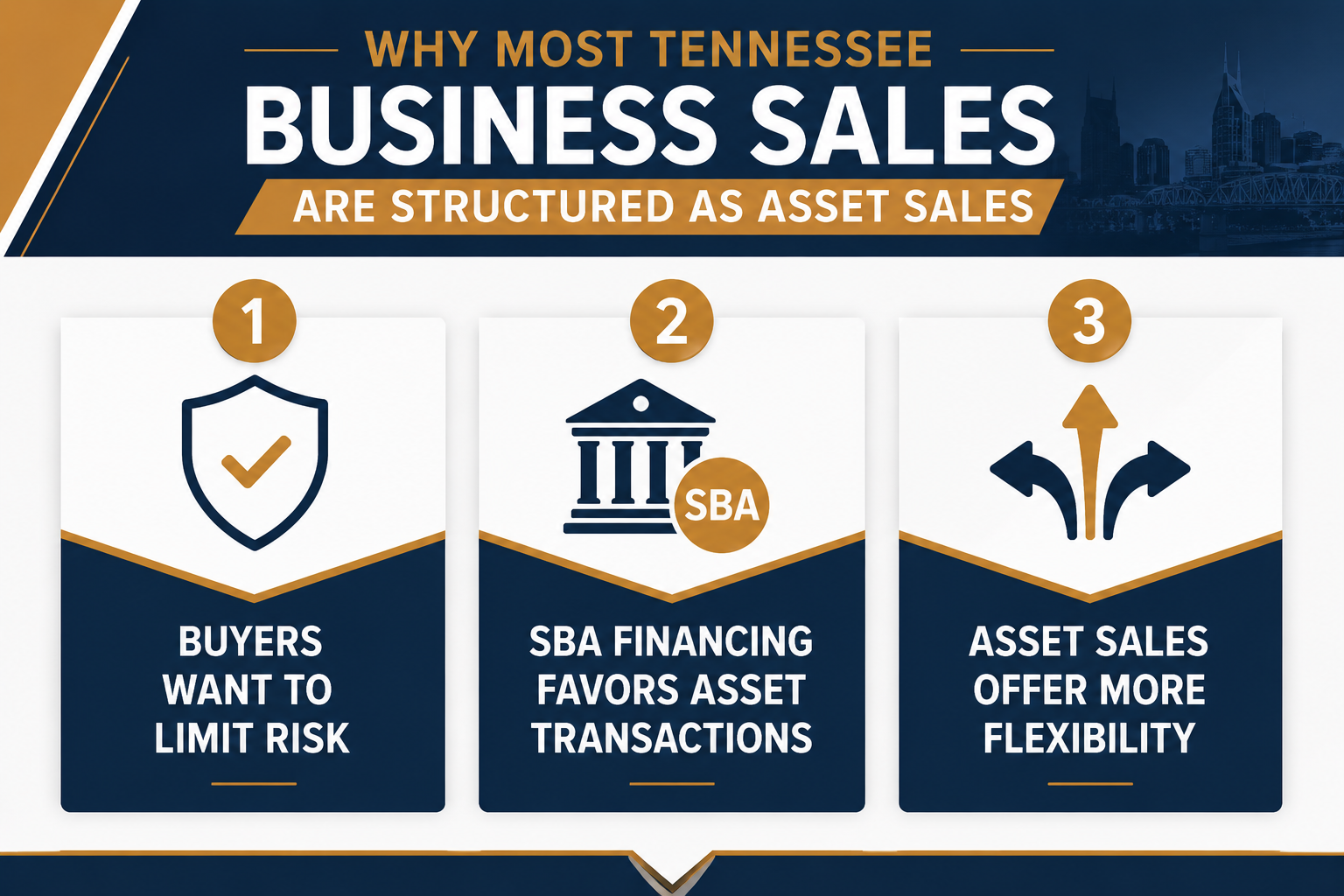
Most Tennessee Main Street and lower-middle-market transactions are structured as asset sales rather than stock sales. While every deal is unique, buyers, lenders, and advisors often view asset purchases as the lower-risk option.
That preference is driven by three factors: risk reduction, financing considerations, and flexibility. Together, those factors make asset sales the default structure for many founder-led businesses.

At its core, an acquisition is a transfer of future cash flow. Buyers are not just evaluating what a business earns today—they are evaluating the risks that could affect those earnings after closing.
An asset sale allows buyers to acquire the parts of the business they want while limiting exposure to certain historical liabilities. That often includes tax issues, legal disputes, compliance concerns, employee claims, and other obligations that may not become apparent until after the transaction closes.
Because asset sales generally create more certainty, buyers often view them as a safer structure.
Many Tennessee business acquisitions rely on SBA financing, particularly in the Main Street market.
Lenders typically prefer transactions where the assets being acquired can be clearly identified and valued. Asset purchases often make that process easier by defining exactly what is being transferred and what liabilities remain with the seller.
As a result, lender requirements frequently reinforce buyer preferences, making asset sales more common in SBA-backed transactions.
Asset sales also give buyers greater flexibility in how a transaction is structured.
Rather than acquiring an entire legal entity, buyers can focus on the assets that generate revenue and negotiate which liabilities, if any, they are willing to assume. That flexibility can make it easier to structure deals, address due diligence concerns, and allocate risk between the parties. For founder-led businesses, buyers are often most interested in acquiring:
Customer relationships
Goodwill
Equipment and inventory
Intellectual property
Operating systems and processes
The legal entity itself is often less important than the cash-flow-producing assets inside it.
While asset sales are more common, there are situations where a stock sale may make sense.
Businesses with difficult-to-transfer contracts, specialized licenses, regulatory requirements, or unique operating structures may benefit from keeping the legal entity intact. In those cases, the advantages of continuity may outweigh the additional risks buyers typically associate with stock purchases.
The key takeaway is that asset sales are not necessarily better than stock sales. They are simply the structure that most often aligns with buyer preferences, lender requirements, and risk management objectives in Tennessee business transactions.
Read Next: The Ultimate Guide to Choosing a Business Broker in Tennessee
Many business owners assume valuation and deal structure are separate conversations. In practice, buyers evaluate them together.
An asset sale or stock sale does not automatically make a business worth more or less. However, the structure can affect taxes, financing, risk, and the overall economics of the transaction. Those factors often influence what a buyer is willing to pay and how they structure an offer.
When owners think about value, they often focus on the purchase price. Buyers typically look beyond the headline number.
In an asset sale, the purchase agreement allocates the purchase price across categories such as equipment, inventory, intellectual property, and goodwill. That allocation can affect taxes for both parties and influence the buyer's future depreciation and amortization deductions.
As a result, two offers with the same purchase price may produce different financial outcomes once taxes and deal terms are considered.
For many service-based businesses, a significant portion of value comes from goodwill rather than physical assets.
Goodwill includes customer relationships, reputation, brand recognition, workforce stability, and the systems that support day-to-day operations. Buyers want to know whether those advantages will remain after the owner leaves.
Consider two HVAC companies with similar revenue and earnings. One relies on the owner to handle estimating, sales, and key customer relationships. The other has a general manager, documented processes, and technicians who manage customer accounts independently. Most buyers will view the second business as less risky because the transition is easier and the future cash flow is more predictable.
That difference often has a greater impact on value than the transaction structure itself.
Regardless of whether a deal is structured as an asset sale or stock sale, buyers tend to favor businesses with the following characteristics:
| Buyers Tend to Pay More For | Buyers Tend to Discount |
|---|---|
| Strong Management Team |
Heavy Owner Dependence |
| Recurring Revenue | Customer Concentration |
| Clean Financials | Inconsistent Financial Records |
| Documented Systems and Processes | Undocumented Operations |
| Diversified Customer Base | Revenue Tied to a Few Key Relationships |
These factors influence how buyers assess risk, transferability, and the likelihood that earnings will continue after closing.
Deal structure can influence negotiations, taxes, financing, and how risk is allocated between the buyer and seller. Those considerations matter, but they do not replace the fundamentals that drive value.
Businesses with recurring revenue, clean financials, documented systems, and reduced owner dependence typically attract more buyers and stronger offers. Businesses with operational weaknesses often face greater scrutiny regardless of how the transaction is structured.
For most owners, improving transferability and reducing risk will have a larger impact on value than choosing between an asset sale and a stock sale.
Read Next: Business Valuation Multiples Tennessee Owners Should Understand
CTA: Before You Negotiate, Understand What Buyers Will See
Button: Schedule a Confidential Consultation | Speak with a Legacy ETA Advisor
Taxes are one of the primary reasons buyers and sellers disagree on deal structure.
An asset sale and a stock sale can produce very different outcomes after closing, even when the purchase price is identical. As a result, negotiations often involve more than price. They also involve determining how the transaction will be structured and how the purchase price will be allocated.
In an asset sale, the purchase price is typically allocated across categories such as inventory, equipment, real estate, intellectual property, and goodwill.
Because those asset categories may receive different tax treatment, allocation can have a meaningful impact on both parties. Buyers often seek allocations that increase future depreciation and amortization deductions, while sellers may prefer allocations that reduce their overall tax burden.
For that reason, purchase price allocation is often a significant part of transaction negotiations.
In a stock sale, the buyer acquires ownership interests in the business rather than individual assets.
Many sellers favor stock sales because they may allow a larger portion of the proceeds to receive capital gains treatment, depending on the entity structure and the seller's circumstances. Stock sales can also eliminate some of the complexity associated with allocating value across multiple asset categories.
From the buyer's perspective, a stock purchase may be less attractive because it often does not provide the same tax basis adjustments available in an asset acquisition.
Entity structure can significantly influence the tax consequences of a transaction.
LLCs, S corporations, and C corporations are subject to different tax rules. In some situations, two businesses with identical sale prices can produce substantially different after-tax proceeds because of how they are organized.
Understanding those implications before entering negotiations can help owners avoid surprises later in the process.
Many owners focus on purchase price while overlooking allocation.
In practice, two transactions with the same purchase price can generate very different after-tax outcomes depending on how value is assigned to various asset categories and how the transaction is structured.
That is why buyers, sellers, attorneys, and tax advisors often spend considerable time negotiating allocation schedules before closing.
One of the most common mistakes sellers make is waiting until a letter of intent has been signed before evaluating tax consequences.
By that stage, the buyer may already have strong expectations regarding deal structure and purchase price allocation. Owners who evaluate those issues early are generally in a better position to understand the tradeoffs, negotiate effectively, and focus on net proceeds rather than headline purchase price alone.
Read Next: Structured Installment Sales: A Smarter Way to Sell Your Business and Reduce Capital Gains
Asset sales are more common in Tennessee business transactions, but there are situations where a stock sale may be the more practical option.
In most cases, the reason comes down to continuity. If transferring assets, contracts, licenses, or permits would create significant disruption, buyers and sellers may determine that acquiring the entire entity is the simpler path.
Some businesses rely on contracts that cannot be easily assigned to a new owner. Others require customer approval, vendor consent, or regulatory review before a transfer can occur.
Examples may include government contracts, franchise agreements, long-term customer agreements, and specialized vendor relationships.
In those situations, a stock sale can allow those relationships to remain in place because the legal entity itself does not change.
Certain industries operate under licensing or regulatory requirements that can complicate an asset sale.
Healthcare organizations are a common example, but similar challenges can arise in other regulated industries. Depending on the circumstances, maintaining the existing entity may reduce administrative hurdles and simplify the transition.
Strategic buyers sometimes view stock purchases differently than individual buyers or financial buyers.
If the target company has valuable contracts, permits, certifications, or operating relationships that would be difficult to recreate, acquiring the entire entity may be more attractive than purchasing selected assets.
In these situations, continuity can outweigh some of the risks that buyers typically associate with stock transactions.
A stock sale is not inherently better or worse than an asset sale. Each structure involves different tradeoffs involving taxes, liabilities, contracts, financing, and operational continuity.
The best structure depends on the business, the buyer, and the objectives of both parties. What works well for one transaction may be completely inappropriate for another.
That is why deal structure should be evaluated as part of the broader transaction strategy rather than treated as a standard formality.
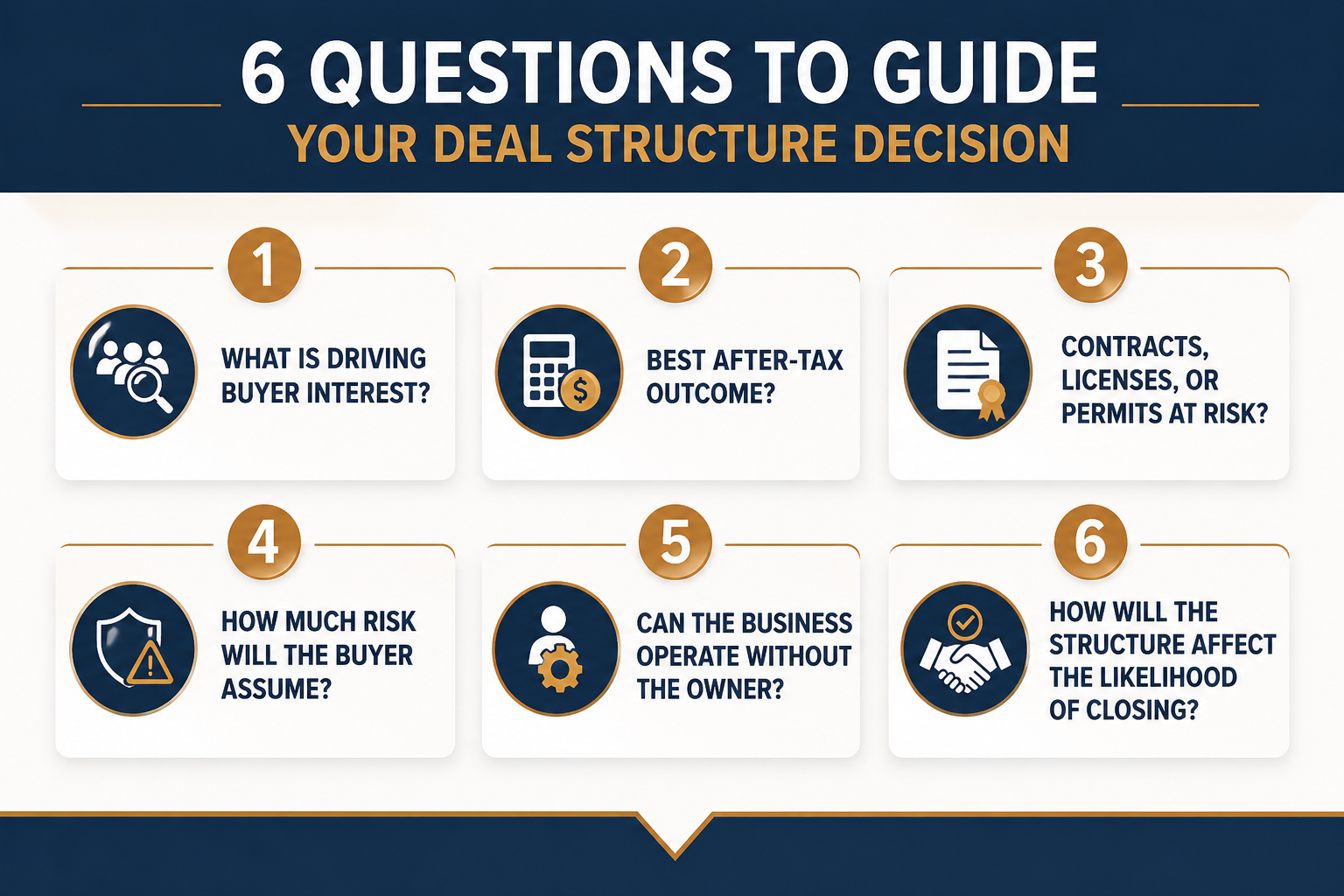
There is no universally correct answer when deciding between an asset sale and a stock sale. The right structure depends on the business, the buyer, and the goals of both parties. Before negotiating a letter of intent or purchase agreement, owners should consider the following questions.

Not all buyers approach acquisitions the same way. An individual buyer using SBA financing may view the deal structure differently than a strategic buyer acquiring a competitor. Understanding the buyer's objectives often helps explain why they prefer one structure over another.
Purchase price is important, but net proceeds are what ultimately matter. Owners should understand how different structures may affect taxes, purchase price allocation, and the amount they keep after closing before entering negotiations.
Some businesses rely on contracts, licenses, permits, or regulatory approvals that are difficult to transfer. Identifying those issues early can help determine whether an asset sale is practical or whether maintaining the existing entity may simplify the transition.
Buyers evaluate more than revenue and profitability. They also evaluate potential liabilities, compliance issues, legal exposure, and other risks that may remain after closing. The more risk a buyer perceives, the more likely they are to negotiate for an asset purchase or seek additional protections.
Transferability is often a larger issue than the deal structure itself. If customers, employees, vendors, and day-to-day operations depend heavily on the owner, buyers may view the business as riskier regardless of whether the transaction is structured as an asset sale or stock sale.
The best deal structure is not always the one that looks best on paper. It is the one that balances taxes, risk, financing requirements, and transaction complexity while still allowing the deal to move forward. For many owners, that means evaluating the entire transaction rather than focusing on any single issue in isolation.
Read Next: Business Sale Preparation Checklist — A 12-Point Plan to Prepare Your Business for Sale
Many owners spend years thinking about valuation and sale price, but the deal structure can have just as much impact on the outcome.
An asset purchase may reduce buyer risk, support financing, and create tax basis benefits for the buyer. A stock sale may simplify ownership transfer and create different tax outcomes for the seller. Neither structure is automatically better. The right answer depends on the business, the buyer, the liabilities involved, and the owner's goals.
Key Takeaways:
Asset sales are the most common structure for many Tennessee business acquisitions.
Buyers often prefer asset purchases because they reduce liability exposure.
Stock sales can make sense when contracts, licenses, or continuity issues matter.
Tax treatment depends heavily on entity structure and deal terms.
Transferability and buyer risk influence both valuation and structure.
Early planning creates better negotiating leverage than last-minute tax planning.
Before selling your business, evaluate both value and structure. A strong purchase price can look less attractive once taxes, liabilities, financing requirements, and closing terms are considered.
Legacy ETA's Selling a Business and Business Valuation Services help Tennessee business owners understand how buyers evaluate risk, structure transactions, and determine value before a business goes to market.
The primary difference between an asset sale and a stock sale is what the buyer acquires. In an asset purchase, the buyer acquires selected business assets and agreed-upon liabilities. In a stock sale, the buyer acquires ownership of the business entity itself, including its assets, contracts, and obligations.
Asset sales are generally more common because buyers can be more selective about the assets and liabilities they assume. Many buyers in an asset sale prefer this structure because it reduces risk, simplifies due diligence, and may provide future tax benefits through a step-up in asset basis.
There is no universally better type of sale for tax purposes. The tax implications depend on the business entity, purchase price allocation, ownership structure, and other transaction-specific factors. In some situations, a stock sale may result in more favorable capital gains treatment, while an asset sale may create a higher tax burden for the seller.
Sometimes. If a stock deal preserves valuable contracts, licenses, permits, or customer relationships that would be difficult to transfer in an asset purchase, a buyer may be willing to pay more for that continuity. However, a higher sale price does not always produce a better outcome after taxes and transaction costs are considered.
In an asset sale, contracts often need to be assigned or approved before they can be transferred to the buyer. In a stock sale, contracts typically remain with the existing entity because ownership changes while the business continues operating. The simplicity of a stock sale can be beneficial when key contracts, permits, or licenses are difficult to transfer.
Yes. Deal structure can affect taxes, liabilities, financing, and the overall economics of the acquisition. Before signing a letter of intent or purchase agreement, business owners should understand how an asset sale and a stock sale could affect after-tax proceeds, risk allocation, and long-term business goals.
An asset sale and a stock sale can lead to very different outcomes for a business owner. In most Tennessee business transactions, buyers prefer asset...
If you're thinking about selling a manufacturing business in Tennessee, valuation and buyer interest are largely driven by cash flow, customer...
A successful restaurant exit starts long before you put the business on the market. Whether you own an independent restaurant, a restaurant...