


9 min read

How to Sell a Business in Tennessee

How to Sell a Business in Tennessee

Selling a business in Tennessee is a major financial and personal decision. According to BizBuySell’s 2025 Market Recap, nearly 9,600 small businesses changed hands in the U.S. in 2025, and on average, businesses sold for about 94% of their asking price, reflecting active buyer demand for well-positioned companies.

The difference between businesses that sell and those that linger on the market comes down to preparation, documentation, and finding the right buyer. Owners who approach the process with a clear plan, an accurate valuation, and strict confidentiality are more likely to achieve a successful, smooth sale.

This guide covers:

  • How to position your business for a successful sale in the Tennessee market
  • Every step from valuation to closing, with local compliance and tax insights
  • How to protect sensitive information and avoid common mistakes
  • What to expect from professional business advisors and brokers

P.S. Legacy Entrepreneurs is a Nashville, Tennessee business brokerage firm specializing in confidential, one-on-one advisory for Main Street and mid-market business owners. Our process covers every step of the sale, from certified valuation to closing, with no handoffs and a focus on protecting your legacy. If you’re thinking about selling your business, schedule a confidential consultation to assess your readiness, clarify your options, and map out a step-by-step plan for a successful exit.

Every Step to Sell a Business in Tennessee at the Right Price

Decision Area What to Do and How to Verify
Valuation and Market Positioning Obtain a certified, market-based valuation using local comps and industry trends. Verify with a professional business advisor and compare to recent TN transactions.
Documentation and Financial Records Organize 2–3 years of financial statements, tax returns, leases, contracts, and permits. Build a secure data room and confirm all documents are current and signed.
Owner Dependency List all owner-led decisions, delegate to managers, and operate under a new structure for several months. Buyers will test this during diligence.
Confidential Marketing Use blind listings and broker networks. Require NDAs before sharing sensitive information. Track all buyer inquiries and document screening steps.
Buyer Vetting Screen for proof of funds, experience, and intent. Interview buyers and check references. Exclude unqualified or non-serious parties early.
Negotiation and Deal Structure Compare asset vs. stock sale, earnout, and seller financing options—document key terms and risks. Use a written LOI and confirm all terms before drafting the agreement.
Due Diligence and Closing Respond promptly to buyer requests, update any missing documents, and coordinate with legal and tax advisors. Prepare a detailed handover plan for operations and staff.
Legal, Regulatory, and Tax Verify all licenses, permits, and registrations are current. Consult with a CPA on sales tax, state tax, and income tax implications. Address any compliance gaps before closing.


Why Selling a Business in Tennessee Requires a Local Approach

Selling a business in Tennessee takes understanding the local market, regulatory environment, and buyer expectations unique to the state. Nashville, Chattanooga, and other Tennessee cities each have their own business ecosystems, industry trends, and buyer pools. Local buyers value community reputation, operational stability, and continuity for employees and customers.

Tennessee’s regulatory requirements, such as business licenses, sales tax registration, and state-specific permits, can impact both the sale timeline and the final agreement. Buyers expect clear documentation and proof that the business is compliant with all local and state regulations.

Owners who approach the sale with a local mindset, leveraging Tennessee market data, understanding buyer motivations, and preparing for state-specific diligence, are more likely to achieve a smooth transaction and the right sale price.

Step-by-Step Guide to Selling a Business in Tennessee

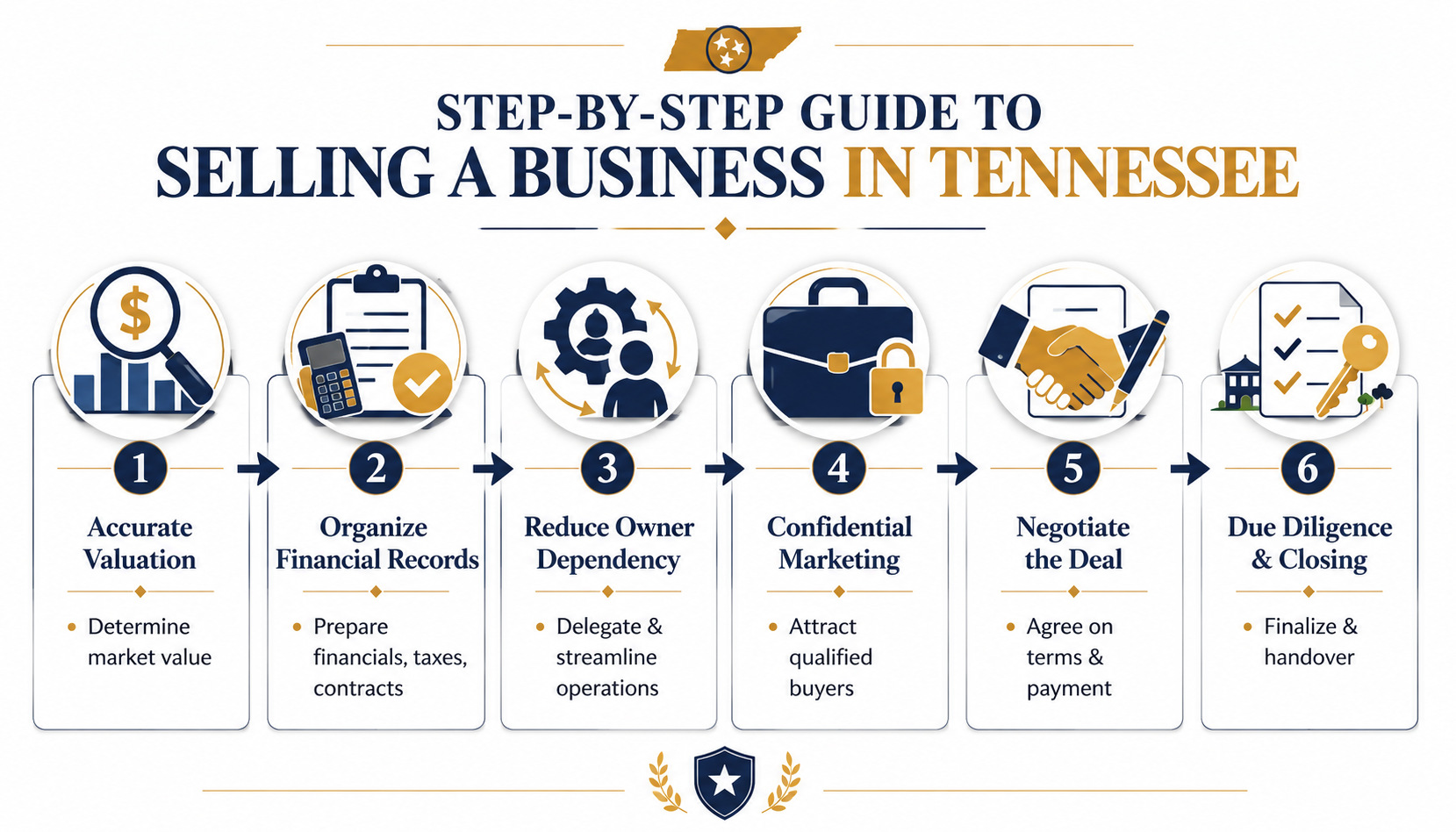
Step-by-Step Guide to Selling a Business in Tennessee3

A sequence of decisions shapes your leverage, timeline, and outcome. Each phase introduces new risks: valuation errors can anchor the wrong price, incomplete records can stall buyer interest, and weak confidentiality can erode trust with staff and customers.

The right approach means anticipating diligence questions, structuring negotiations around verified strengths, and preserving the value through closing and beyond. By following a disciplined, locally informed process, you can avoid common pitfalls, protect your legacy, and move forward with confidence—whether your goal is retirement, a new venture, or simply peace of mind.

Accurate Valuation and Market Positioning

A market-based valuation is the foundation of a successful sale. In Tennessee, buyers and their advisors will compare your business to recent local business sales, industry benchmarks, and current market trends. A certified valuation provides an authoritative assessment of your business’s worth, factoring in cash flow, growth potential, and risk.

Professional business advisors use real transaction data, not inflated formulas, to determine value. They analyze your financials, normalize earnings, and adjust for owner-specific expenses or one-time events. The right valuation sets realistic expectations, attracts serious buyers, and prevents losing time on unqualified offers. If you’re unsure about your business’s value, request a business valuation review to clarify your position before going to market.

Preparing Documentation and Financial Records

Buyers expect clear, organized documentation that proves the business’s financial health and operational stability. Missing or outdated records are a leading cause of delays, price reductions, and cancellations.

  • Financial statements and tax returns: Prepare at least two to three years of profit and loss statements, balance sheets, and filed tax returns. In Tennessee, sellers are required by law (Tennessee Code § 67-4-721) to file a final business tax return and settle all business taxes, including interest and penalties, within 15 days of closing. Failing to do so can delay the sale and expose both parties to tax liabilities.
  • Leases, contracts, and permits: Gather all current leases, supplier agreements, customer contracts, and required permits or licenses. Confirm that each document is signed, up to date, and transferable to a new owner.
  • Secure data: Build a digital database with organized folders for financials, legal documents, HR records, and intellectual property. Limit access to qualified buyers who have signed a confidentiality agreement.
  • Sensitive information protocols: Redact or restrict access to sensitive information (such as customer lists or proprietary processes) until buyers are fully vetted and under NDA.
  • Supporting schedules for add-backs: Prepare detailed schedules for any owner adjustments or add-backs to earnings, with written explanations and backup documentation. This allows buyers to verify normalized cash flow and reduces negotiation friction.

For a sample of what buyers expect, see the EXAMPLE: Confidential Information Memorandum.

Reducing Owner Dependency and Improving Transferability

Businesses that rely heavily on the owner for daily operations, customer relationships, or key decisions are harder to sell and often command lower prices. Buyers want proof that the business can run smoothly after the owner steps back.

  • Delegation and documentation: Identify all decisions and approvals that currently require owner involvement. Assign these responsibilities to managers or team leads, and document the new processes in writing.
  • Hiring a general manager: If the business cannot operate independently, consider hiring a general manager before going to market. This not only increases value but also reassures buyers about operational continuity. For guidance, see How to Hire a General Manager: Step-by-Step Guide for Small Business Owners.
  • Operational independence: Run the business under the new structure for several months before listing. Buyers will test this during diligence by interviewing staff and reviewing workflow documentation.
  • Diligence testing: Be prepared for buyers to ask for evidence of reduced owner involvement, such as meeting notes, process manuals, and staff feedback.

Confidential Marketing and Buyer Vetting

Maintaining confidentiality is critical to protect your business’s reputation, staff morale, and customer relationships. At the same time, you need to attract serious buyers and screen out unqualified or non-serious parties.

Confidential Marketing Methods

Blind listings and broker networks are the most effective ways to market a business for sale without revealing sensitive information. Listings should describe the business in general terms (industry, size, location) without disclosing the name or proprietary details. All marketing materials should be reviewed for confidentiality risks before distribution.

Buyer Qualification and Screening

Every interested party should sign a non-disclosure agreement (NDA) before receiving detailed information. Screen buyers for proof of funds, relevant experience, and intent to purchase. Conduct interviews and reference checks to confirm their background and seriousness. Exclude buyers who cannot demonstrate financial capacity or a clear plan for transition.

Managing Buyer Interest and Avoiding Delays

Track all buyer inquiries and document each step of the screening process. Limit access to sensitive information until buyers have cleared all qualification hurdles. If multiple buyers express interest, set clear timelines and communication protocols to avoid confusion and process bottlenecks. A structured approach keeps the process smoother and protects your leverage.

Negotiation, Deal Structure, and Agreement

Negotiating the sale of a business involves more than just price. Deal structure, payment terms, transition period, and liability allocation all impact the final outcome. The right structure depends on your goals, the buyer’s needs, and the business’s risk profile.

Deal Structure Type Key Terms Seller Risk Buyer Risk Verification Next Steps
Asset Sale Assets, liabilities, allocation Lower (retains entity) Higher (new entity) Asset list, allocation schedule Draft asset purchase agreement
Stock Sale Shares, entity, all assets/liabilities Higher (all liabilities transferred) Lower (existing entity) Share register, due diligence Draft stock purchase agreement
Earnout Contingent payments, milestones Delayed payment Uncertain payout Performance metrics, escrow Define milestones, escrow terms
Seller Financing Promissory note, interest, collateral Repayment risk Lower upfront cash Credit check, collateral review Draft financing agreement


Always use a written Letter of Intent (LOI) to outline key terms before drafting the final agreement. Confirm all deal points, including working capital, transition support, and non-compete clauses, before moving to closing.

Due Diligence, Closing, and Handover

Due diligence is the buyer’s opportunity to verify every aspect of the business. Delays or surprises at this stage can derail the transaction or lead to last-minute price cuts.

  • Responding to diligence requests: Provide requested documents promptly and transparently. Address any discrepancies or gaps before they become negotiation points.
  • Lease and permit transfers: Coordinate with landlords and regulatory agencies to ensure all leases, permits, and licenses can be transferred to the buyer without delay.
  • Preparing for closing day: Work with your attorney and CPA to review the closing statement, confirm all funds are in escrow, and finalize the agreement.
  • Handover checklist: Prepare a detailed plan for transitioning operations, staff, and customer relationships. Include introductions, training schedules, and a timeline for owner involvement post-closing.

Legal, Regulatory, and Tax Considerations for Tennessee Sellers

Tennessee business sales involve state-specific legal and tax requirements that can impact both the timeline and the net proceeds from the sale. Failing to address these issues early can result in costly delays or compliance problems.

  • Business licenses and permits: Verify that all required licenses, permits, and registrations are current and transferable. This includes state business licenses, sales tax permits, and any industry-specific certifications.
  • Entity structure and agreements: If the sale results in a change of ownership or management for an LLC or corporation, file the appropriate amendments to your Articles of Organization or Incorporation with the Tennessee Secretary of State. Update annual reports to reflect new management, registered agent, or business address after the transaction.
  • Sales tax and state tax: Consult with a CPA to determine if sales tax applies to the transaction and to plan for state and local tax obligations. Tennessee does not have a state income tax on wages, but business income and capital gains may be subject to other taxes.
  • Liability and indemnification: Address any outstanding liabilities, pending litigation, or compliance issues before closing. Negotiate indemnification terms in the purchase agreement to protect against future claims.
  • Intellectual property and contracts: Ensure all intellectual property, trademarks, and key contracts are properly registered and assignable to the buyer.

For more on regulatory changes, see Understanding SBA SOP 2005: Key Updates for Small Business Buyers and Sellers.

Common Mistakes Tennessee Business Owners Make When Selling

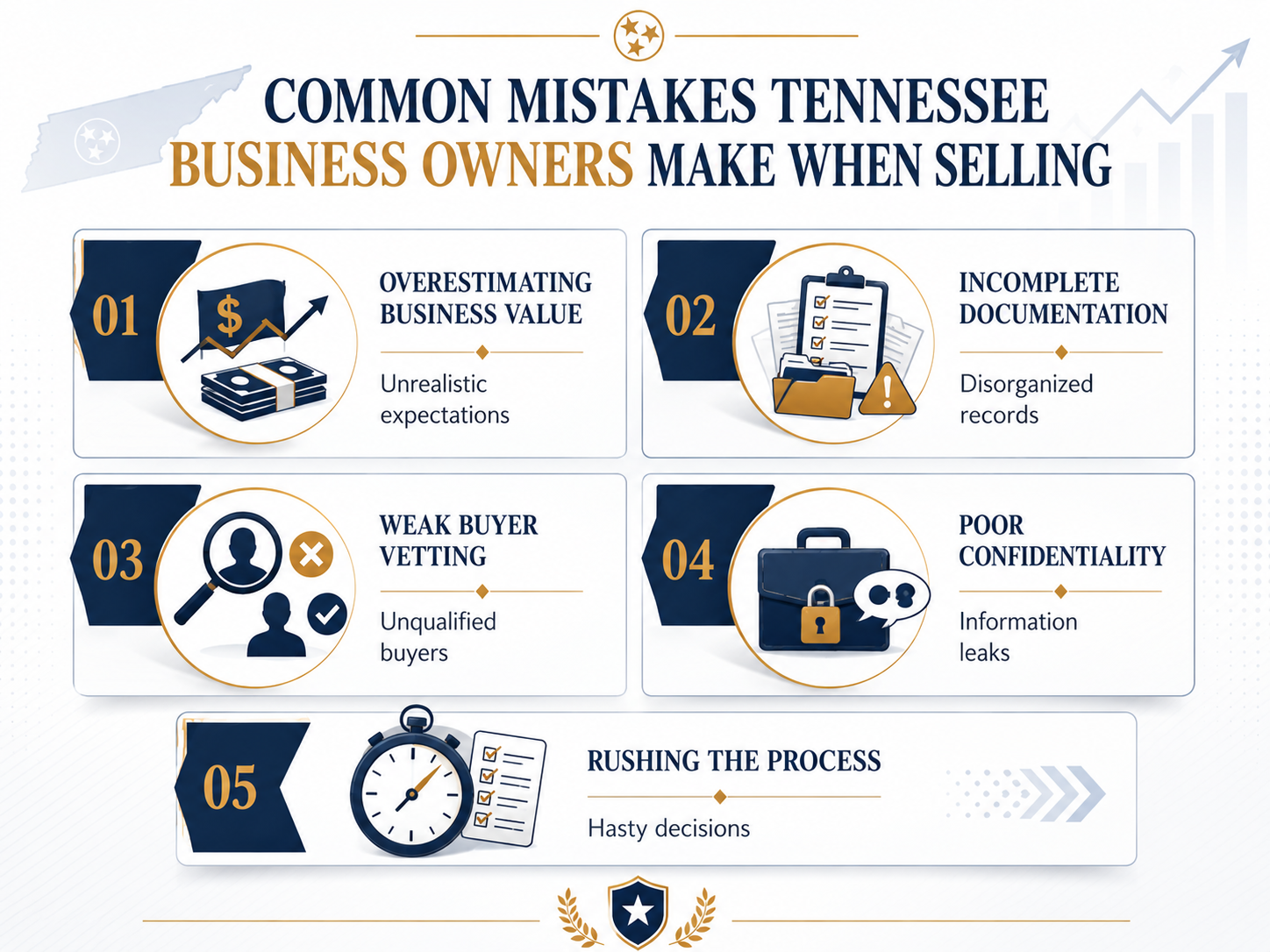
Common Mistakes Tennessee Business Owners Make When Selling-1

Mistakes in the sale process can cost business owners time, money, and leverage. Understanding these pitfalls helps you avoid them and keep your transaction on track.

Overestimating Business Value

Many sellers set unrealistic expectations based on hearsay or emotional attachment. This leads to wasted time, failed negotiations, and missed opportunities. A market-based valuation, grounded in real data, is essential to attract serious buyers and achieve the right price.

Incomplete Documentation

Missing or disorganized records are a leading cause of delays and price reductions. Buyers need clear, current financials, contracts, and compliance documents to proceed with confidence. Investing time in documentation upfront prevents last-minute surprises.

Weak Buyer Vetting

Engaging with unqualified or non-serious buyers exposes sensitive information and wastes valuable time. Effective screening—requiring proof of funds, experience, and intent—protects confidentiality and keeps the process focused on real opportunities.

Poor Confidentiality Practices

Leaks about the sale can damage employee morale, customer relationships, and supplier confidence. Strict confidentiality protocols, including NDAs and controlled information access, are critical at every stage.

Rushing the Process

Trying to sell too quickly often leads to skipped steps, overlooked risks, and regret after closing. A structured, step-by-step approach ensures that every detail is addressed and that the business is positioned for a successful transition.

Maximizing Sale Price and Attracting Qualified Buyers

Achieving the right sale price and finding the right buyer requires more than listing your business for sale. Strategic positioning, targeted marketing, and rigorous screening are key.

Targeted Marketing Strategies

Effective marketing reaches serious buyers through broker networks, industry contacts, and confidential listings. Tailor your outreach to buyers who understand your industry and have the resources to close.

Value Optimization Before Sale

Identify and implement improvements that increase business value without inflating numbers. This may include cleaning up financials, reducing owner dependency, renewing key contracts, or addressing operational bottlenecks.

Screening for Qualified Buyers

Not all interested parties are capable of closing a deal. Screen buyers for financial capacity, relevant experience, and a clear transition plan. Require NDAs and proof of funds before sharing sensitive information.

Negotiation Leverage and Deal Terms

Preparation is your best leverage in negotiations. When your documentation is complete, your operations are independent, and your buyer pool is well-vetted, you can negotiate from a position of strength and secure favorable terms.

Read Next: How to Sell Your Small Business: Free Webinar & Step-by-Step Guide

From Preparation to Peace of Mind: What a Professional Business Broker Delivers

Selling a business in Tennessee is a complex, high-stakes process that demands local expertise, rigorous preparation, and strict confidentiality. Owners who approach the sale with a clear plan, accurate valuation, and professional support are more likely to achieve a successful transaction and a smooth transition to their next chapter.

  • Preparation drives leverage and protects value: Owners who invest in accurate valuation, thorough documentation, and operational independence are positioned to attract serious buyers, avoid costly delays, and negotiate from a position of strength throughout the sale process.
  • Tennessee-specific compliance prevents costly surprises: Addressing state and local tax obligations, obtaining required clearance certificates, and updating Secretary of State filings are essential to avoid successor liability and ensure a clean, dispute-free closing.
  • Confidentiality and buyer vetting are non-negotiable: Protecting sensitive information and rigorously screening buyers at every stage preserves business stability, maintains staff and customer trust, and increases the likelihood of a successful, regret-free transition.

Legacy Entrepreneurs works directly with Tennessee business owners to guide every step of the sale process, from valuation to closing, with no handoffs and a focus on protecting your legacy. Schedule a Confidential Consultation to assess your readiness, clarify your options, and start the exit conversation today.

FAQs About Selling a Business in Tennessee

What are the first steps to sell a business in Tennessee?

Start with a certified, market-based valuation and a review of your financial records, contracts, and permits. Organize your documentation and consult with a professional business advisor to clarify your readiness and next steps.

How do I keep the sale confidential from employees and customers?

Use blind listings, broker networks, and strict NDAs. Limit information access to qualified buyers and communicate with staff only when a deal is imminent or required by law.

What documents do buyers expect to see during due diligence?

Buyers expect at least two to three years of financial statements, tax returns, leases, contracts, permits, and proof of compliance. Supporting schedules for add-backs and owner adjustments are also important.

How long does it take to sell a business in Tennessee?

The process typically takes 6–12 months, depending on business size, industry, documentation readiness, and buyer pool. Delays often result from incomplete records or weak buyer vetting.

What are the tax implications of selling my business?

Tax consequences depend on deal structure, entity type, and allocation of purchase price. Consult with a CPA to plan for sales tax, state tax, and potential capital gains.

Why should I use a professional business broker or advisor?

A broker provides market insight, confidential marketing, buyer screening, and negotiation support. They help avoid common mistakes, protect your interests, and streamline every step of the process.

Selling a Restaurant in Tennessee: A Practical Guide

Selling a Restaurant in Tennessee: A Practical Guide

Selling a restaurant is one of the most significant decisions an owner can make. Whether you’re ready to retire, pivot to a new business, or simply...

Read More
Structured Installment Sales: A Smarter Way to Sell Your Business and Reduce Capital Gains

Structured Installment Sales: A Smarter Way to Sell Your Business and Reduce Capital Gains

If you’re considering selling your business but concerned about the tax hit, you’re not alone. Many business owners hesitate to exit because of the...

Read More
Should You Hire a Manager or a Sales Leader? 6 Real Scenarios That Show the Right Move

Should You Hire a Manager or a Sales Leader? 6 Real Scenarios That Show the Right Move

When a business owner hits a turning point — whether that’s scaling up, stepping away, or preparing for a sale — the next hire can dramatically shape...

Read More