


6 min read

What Is SDE? The Number Buyers Actually Use to Price Your Small Business

Written by Updated July 14, 2026
Picture of Joseph Steigman
Joseph Steigman

Joe Steigman is the Founder of Legacy Entrepreneurs, a boutique business brokerage and exit advisory firm focused on helping business owners maximize value and transition their companies with confidence. With a background that combines operational leadership, corporate consulting, finance, and entrepreneurship, Joe brings a practical, owner-focused perspective to business sales and acquisitions. Joe is a Certified Business Intermediary (CBI), a designation awarded by the International Business B...

What Is SDE? The Number Buyers Actually Use to Price Your Small Business

SDE stands for Seller's Discretionary Earnings. It is the total financial benefit a single owner-operator receives from a business in a year. It starts with net profit, then adds back the owner's salary and certain personal, discretionary, and one-time expenses. For most small businesses, SDE is the number buyers use to determine value.

If you own an owner-operated business, whether it's a roofing company, restaurant, home services business, or another founder-led company, SDE is almost certainly the metric buyers will use. Not revenue. Not the net profit on your tax return. SDE.

The reason is simple. Tax returns are designed to minimize taxes, not show the full earning power of a business. SDE adjusts for those owner-specific decisions and gives buyers a clearer picture of what the business actually earns.

Get it right, and you can add tens or even hundreds of thousands of dollars to your sale price. Get it wrong, and you leave that money on the table.

💡 TL;DR: What SDE Is and Why It Matters

  • What it is: Seller's Discretionary Earnings (SDE) measures the total financial benefit a single owner receives from a business in one year.

  • How it's calculated: Net profit, plus the owner's salary, interest, taxes, depreciation, amortization, and legitimate discretionary or one-time expenses (known as add-backs).

  • Why buyers use it: SDE shows the true earning power of an owner-operated business after adjusting for tax-minimizing strategies and personal expenses that are unlikely to continue under new ownership.

  • Who uses it: SDE is the standard valuation metric for owner-operated businesses, typically those generating less than $1.5-2 million in annual earnings. Larger, professionally managed companies are generally valued using EBITDA instead.

  • Typical valuation range: Most small businesses sell for 2-4x SDE, depending on their industry, size, growth potential, and overall risk. Roofing companies often fall closer to the 2-3x SDE range.

  • The catch: Every add-back must be legitimate, well documented, and easy to support. Aggressive or unsubstantiated add-backs rarely survive due diligence and can quickly undermine a buyer's confidence.

How is SDE Calculated?

SDE starts with your bottom line and adds back the expenses that are specific to you as the owner.

SDE = Net Profit + Owner's Compensation + Interest + Taxes + Depreciation + Amortization + Discretionary & One-Time Expenses
Component What It Includes Why It's Added Back
Net Profit The business's reported earnings.  This is the starting point for calculating SDE. 
Owner's Compensation Your salary and payroll are paid to family members who would not remain after a sale.  A new owner may structure compensation differently. 
Interest, Taxes, Depreciation, & Amortization Financing and accounting expenses.  These depend on ownership and accounting decisions rather than day-to-day operations. 
Discretionary & One-Time Expenses (Add-Backs) Legitimate personal expenses and non-recurring costs.  These are unlikely to continue under new ownership and don't reflect the business's ongoing earning power. 

The goal is simple: show buyers what the business could earn for an owner-operator after removing expenses that are unique to the current owner.

What Counts as an Add-Back

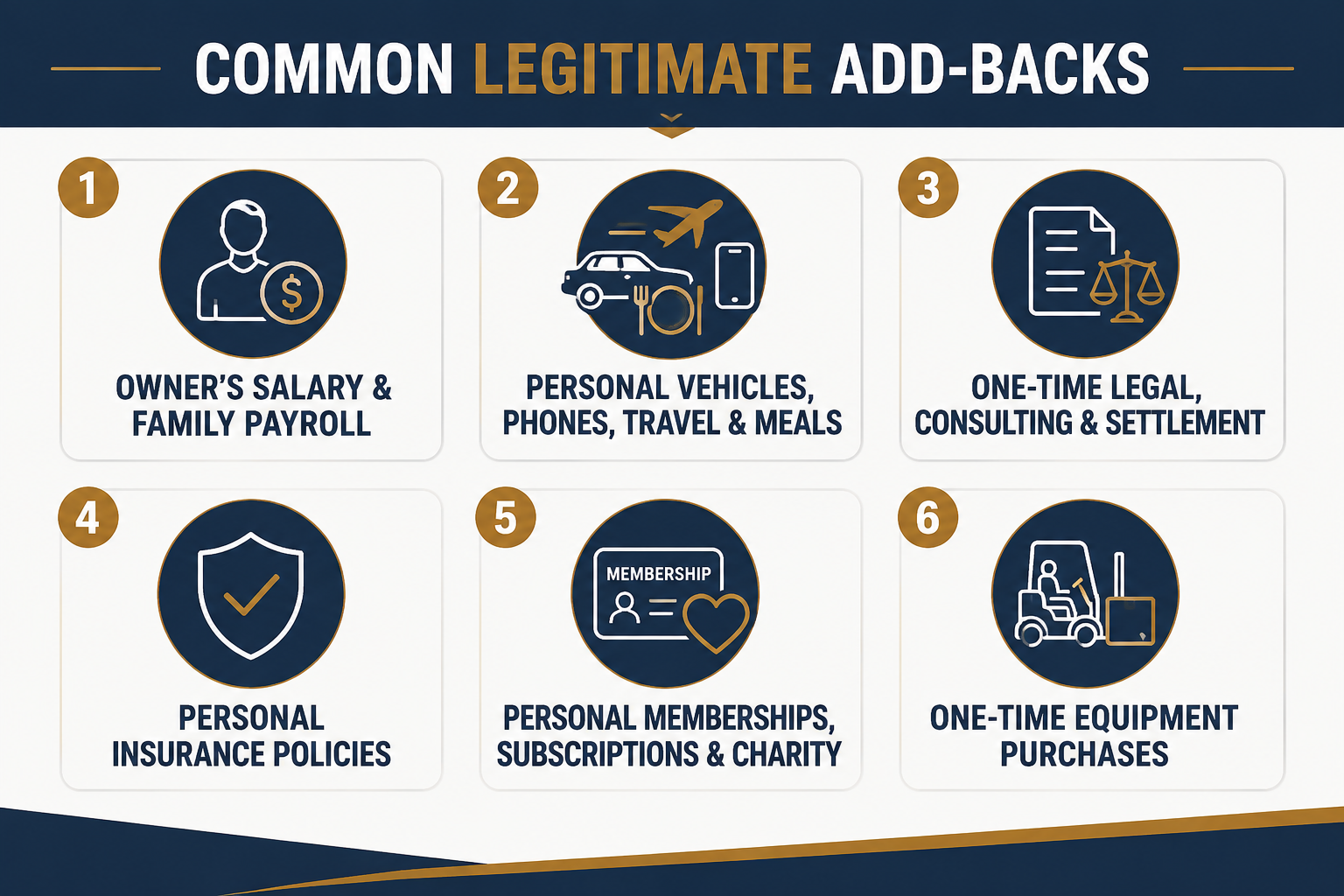
Add-backs are where SDE is often won or lost. They represent expenses that are unique to the current owner and unlikely to continue after the business is sold. When they're legitimate and properly documented, they increase SDE without overstating the business's earning power. Common examples include:

  • Owner's salary and above-market payroll paid to family members

  • Personal vehicles, phones, travel, or meals paid through the business

  • One-time legal, consulting, or settlement costs that won't recur

  • Personal insurance policies paid by the company

  • Personal memberships, subscriptions, or charitable contributions

  • One-time equipment purchases expensed in a single year

What doesn't qualify are expenses the next owner will still need to operate the business. If a cost is necessary and recurring, it stays in. Trying to add back legitimate operating expenses is one of the fastest ways to lose a buyer's confidence.

Every add-back should be supported with documentation. During due diligence, buyers and their accountants will review each adjustment carefully. Unsupported add-backs are usually removed, reducing your SDE and raising questions about the rest of your financials.


Read More: Add-Backs Explained: How Owner Expenses Affect Your Valuation

A Simple SDE Example

Say a roofing company reports $120,000 in net profit. On paper, that looks like a modest business. But:

Line Item Amount
Reported Net Profit $120,000
Owner's Salary + $95,000
Owner's Truck and Phone + $14,000
One-Time Legal Settlement + $20,000
Depreciation + $35,000
SDE $284,000

The business does not earn $120,000 for an owner. It earns $284,000. At a 2.5x multiple, that difference is the gap between a roughly $300,000 sale and a $710,000 sale. Same business — the SDE work is what separates the two numbers.

Read Next: Why Buyers and Sellers Don't Agree on Business Valuation — And What to Do About It

Wondering What Your SDE Translates To?

The earnings number is only half the equation. The multiple, which is set by your size, industry, and risk, is the other half.


SDE vs. EBITDA: What's the Difference?

SDE and EBITDA both measure earnings, but they answer different questions and apply to different sizes of business.

SDE EBITDA
Adds back the owner's salary? Yes No
Answers What does one owner-operator take home? What does the business earn as a standalone operation?
Typical Business Owner-operated, smaller Management-run, larger
Typical Buyer Individual buyers, SBA borrowers Private equity, strategic acquirers
Common Threshold Under ~ $1.5M to 2M earnings Above that

The key difference is the owner's salary. SDE adds it back because the buyer is the new owner-operator — they will replace your role. EBITDA does not add it back, because a larger company already pays a manager to do the owner's job, so that salary is a real, ongoing cost.

As a business grows and stops depending on the owner, buyers shift from SDE to EBITDA. The same company can be described both ways during that transition, and the multiple changes with the metric.

Read More: EBITDA Explained for Small Business Owners: What It Means and Why Buyers Care

Why Understanding SDE Matters Before You Sell

For most owner-operated businesses, SDE is the number buyers use to estimate value. If you don't understand how it's calculated, it's difficult to know whether an offer reflects what your business is actually worth.

Buyers, lenders, and business brokers use SDE because it shows the financial benefit available to the next owner after adjusting for owner-specific expenses and one-time costs. It provides a more consistent way to compare businesses than net profit alone.

That is why documentation matters. Every legitimate add-back should be supported with clear financial records and a reasonable explanation. Clean financials make due diligence easier, give buyers greater confidence in the numbers, and help support SBA financing. Unsupported add-backs often have the opposite effect. They reduce credibility and can lower the buyer's view of your earnings.

For most Main Street businesses, understanding SDE before you go to market helps you set realistic expectations and prepare financials that stand up to buyer scrutiny.

Key Takeaways

  • SDE (Seller's Discretionary Earnings) represents the total financial benefit a single owner receives from the business each year.

  • The calculation starts with net profit and adds back the owner's compensation, interest, taxes, depreciation, amortization, and legitimate discretionary or one-time expenses.

  • SDE is the primary valuation metric for most owner-operated businesses, while larger, management-run companies are typically valued using EBITDA.

  • Most small businesses are valued using a multiple of SDE, with the multiple depending on factors such as industry, size, growth prospects, and buyer risk.

  • Well-documented add-backs strengthen buyer confidence. Unsupported adjustments often become points of negotiation during due diligence.

Understanding SDE is the first step. The next is understanding how buyers apply it to your business. Every company is different, and factors like industry, owner dependence, customer concentration, and recurring revenue all influence the multiple buyers are willing to pay. That's where a market-based valuation becomes far more useful than relying on a simple formula.

If you own a roofing company, you can run a quick first-pass estimate with our FREE Roofing Valuation Calculator (2-Minute Walkthrough).

Read Next: If You Had to Sell Your Business in 8 Weeks, Here's What I'd Do

Want to Know What Your SDE Is Worth in a Sale?


Frequently Asked Questions About SDE

What does SDE stand for?

SDE stands for Seller's Discretionary Earnings. It is the total financial benefit a single owner-operator receives from a business in a year, including net profit, owner's salary, and discretionary or one-time expenses added back.

How do you calculate SDE?

Start with net profit, then add back the owner's compensation; interest, taxes, depreciation, and amortization; and discretionary or one-time expenses that a new owner would not incur. The result is the real cash the business generates for an owner-operator.

What's the difference between SDE and EBITDA?

SDE adds back the owner's salary; EBITDA does not. SDE is used for smaller, owner-operated businesses where the buyer will run the company themselves. EBITDA is used for larger, management-run companies that already pay someone to do the owner's job. The same business may switch from SDE to EBITDA as it grows.

What multiple of SDE do small businesses sell for?

Most small businesses sell for 2 to 4 times SDE, depending on industry, size, and risk. Roofing companies tend to cluster near 2 to 3 times SDE, with cleaner, larger, less owner-dependent businesses earning the higher end.

What is an add-back in SDE?

An add-back is an expense on the books that is not a true cost of running the business for the next owner — such as the owner's personal vehicle, one-time legal fees, or above-market family payroll. Legitimate, documented add-backs raise SDE. Add-backs for genuine operating costs are not allowed and get removed in due diligence.

Why do buyers use SDE instead of my tax return profit?

Your tax return is structured to minimize taxes, so it understates what the business actually earns for you. SDE corrects for that by adding your salary and personal expenses back in, showing a buyer the real earning power they would inherit.

What Is SDE? The Number Buyers Actually Use to Price Your Small Business

What Is SDE? The Number Buyers Actually Use to Price Your Small Business

SDE stands for Seller's Discretionary Earnings. It is the total financial benefit a single owner-operator receives from a business in a year. It...

Read More
Why Private Equity Is Buying Roofing Companies

Why Private Equity Is Buying Roofing Companies

Private equity is buying roofing companies because the industry has exactly what investors want: huge size, heavy fragmentation, and demand that does...

Read More
What is My Roofing Business Worth in 2026?

What is My Roofing Business Worth in 2026?

A roofing business in 2026 is generally worth 2 to 4 times Seller's Discretionary Earnings (SDE) or 3 to 7 times EBITDA, depending on its size,...

Read More