


What Is SDE? The Number Buyers Actually Use to Price Your Small Business
SDE stands for Seller's Discretionary Earnings. It is the total financial benefit a single owner-operator receives from a business in a year. It...
7 min read
Joe Steigman is the Founder of Legacy Entrepreneurs, a boutique business brokerage and exit advisory firm focused on helping business owners maximize value and transition their companies with confidence. With a background that combines operational leadership, corporate consulting, finance, and entrepreneurship, Joe brings a practical, owner-focused perspective to business sales and acquisitions. Joe is a Certified Business Intermediary (CBI), a designation awarded by the International Business B...
Joseph Steigman
Updated on July 14, 2026
A roofing business in 2026 is generally worth 2 to 4 times Seller's Discretionary Earnings (SDE) or 3 to 7 times EBITDA, depending on its size, quality, and risk profile. Most owner-operated roofing companies sell near the lower end of that range. The businesses that earn premium multiples tend to share the same characteristics, and revenue is rarely one of them.
Here's where many owners go wrong: a roofing company is not valued as a percentage of revenue. It is valued as a multiple of its earnings, adjusted for risk. Two roofing companies, each generating $3 million in annual revenue, can differ in value by hundreds of thousands of dollars because one depends on storm work and 1099 crews, while the other has recurring commercial revenue and a general manager running day-to-day operations.
Private equity has only added to the confusion. Headlines and social media often highlight 8x EBITDA transactions as though they represent the market. They don't. We analyzed more than 200 completed roofing and exterior services transactions and found median multiples of roughly 2.2x SDE and 3.3x EBITDA. The 8x deals are real, but they apply to a very specific type of business. This guide explains what buyers actually pay for roofing companies—and why.
The short answer: Most roofing companies sell for 2-4x SDE or 3-7x EBITDA. Median completed roofing transactions are around 2.2x SDE or 3.3x EBITDA.
What drives the multiple: Buyers look at earnings quality, revenue mix (retail, insurance, or recurring commercial), owner dependence, labor model (W-2 vs. 1099), and clean financials—not headline revenue.
The private equity gap: Private equity firms may pay 6-9x EBITDA, but usually only for businesses with $3 million or more in EBITDA, recurring or commercial revenue, and an established management team. Most roofing companies don't fit that profile.
The biggest mistake: Pricing your business based on revenue, industry rumors, or private equity headlines instead of your own earnings, transferability, and risk profile.
The local market: Buyer demand for roofing companies in Middle Tennessee remains strong, but premium valuations still depend on proving consistent, transferable cash flow.
Next step: Base your valuation on your actual SDE and the factors buyers use to assess risk. Start with our free Roofing Valuation Calculator or request a professional business valuation.
Buyers value a roofing company based on two things: its earning power and the risk that those earnings continue after the owner steps away. The earning power is measured in one of two ways.

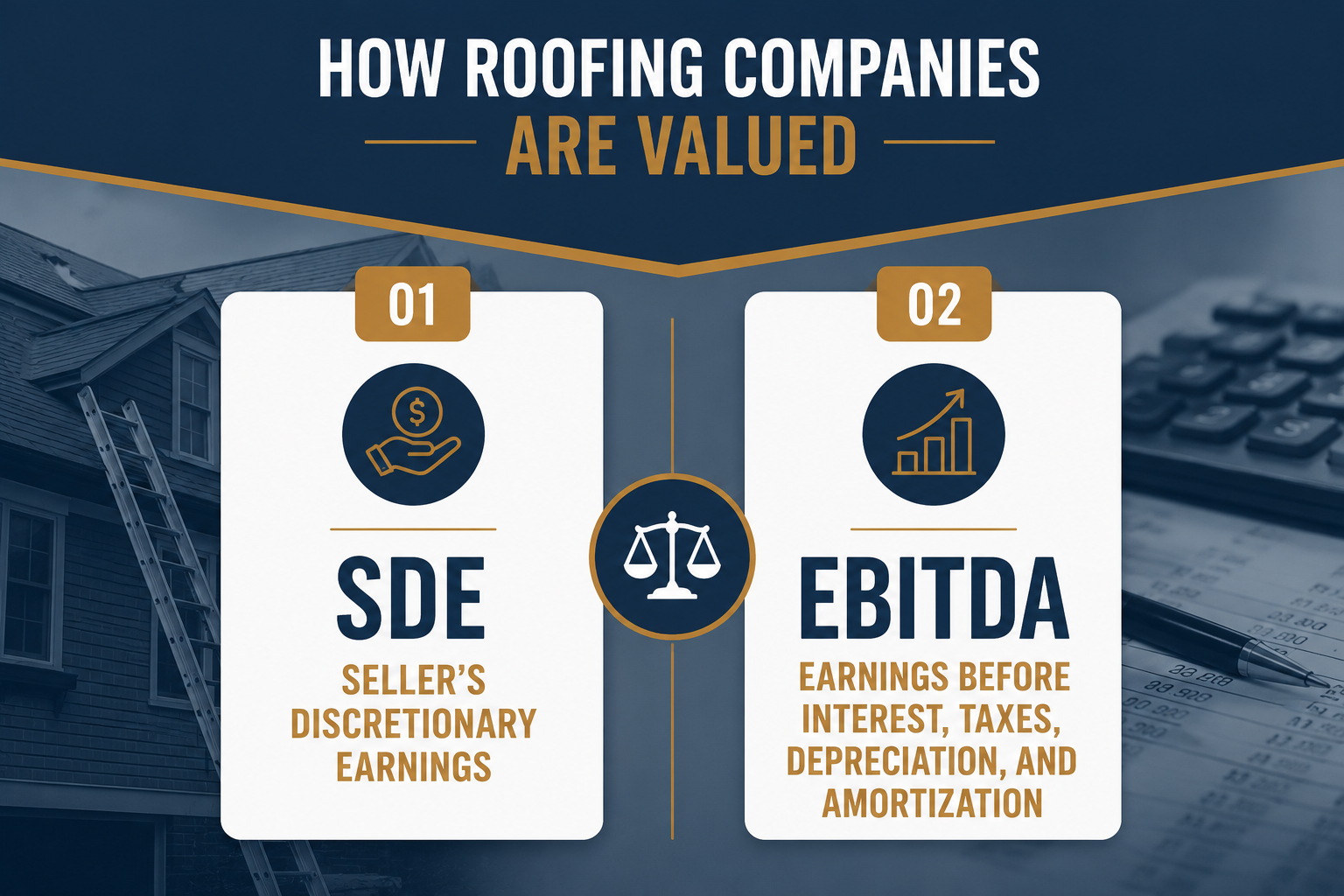
Seller's Discretionary Earnings (SDE) is used for most owner-operated roofing companies. It starts with net profit, then adds back the owner's compensation and certain personal or one-time expenses. For roofing businesses generating less than roughly $1.5 million in annual earnings, SDE is usually the metric that drives the valuation.
EBITDA (Earnings Before Interest, Taxes, Depreciation, and Amortization) is used for larger, professionally managed roofing companies. Once the business can operate without the owner handling sales, estimating, and day-to-day operations, buyers typically shift from SDE to EBITDA.
The second part of the equation is the multiple, and that's where buyers price risk. Roofing companies with clean financials, diversified revenue, transferable systems, and a capable management team generally earn higher multiples. Businesses that depend heavily on the owner, storm-driven revenue, or a handful of key relationships tend to receive lower scores.
Read More: What Is SDE? The Number Buyers Actually Use to Price Your Small Business
Here is what the completed-transaction data shows for roofing and exterior businesses. These are real closing multiples on the Market Value of Invested Capital (MVIC). The total deal value, not asking prices or pitch-deck math.
| Earnings Metric | Price ÷ SDE | Price ÷ EBITDA | Price ÷ Revenue |
|---|---|---|---|
| 25th Percentile | 1.6x | 2.2x | 0.26x |
| Median | 2.2x | 3.3x | 0.39x |
| 75th Percentile | 3.1x | 5.1x | 0.60x |
| 90th Percentile | 4.6x | 8.4x | 0.85x |
Source: Legacy ETA Analysis of 200+ Completed U.S. Roofing and Exteriors Transactions (DealStats/BVR).
A few things stand out. The median is lower than many owners expect. Half of the roofing companies in our data sold for 2.2x SDE or less. The typical Main Street roofing business, often owner-operated, heavily dependent on retail or storm work, and built around 1099 crews, falls squarely in that range. Most sell to individual buyers using SBA financing.
The range, however, is wide. The same data set includes distressed, owner-dependent businesses that sold for less than 1x, alongside larger, professionally managed companies that sold for well above 6x EBITDA. That gap isn't random. It reflects differences in earnings quality, transferability, and buyer risk.
The premium deals are real, but they follow a pattern. In our data, a Nashville-area siding and roofing company with approximately $24.8 million in revenue and $2.8 million in EBITDA sold for roughly 6.3x EBITDA. It wasn't rewarded simply because it was bigger. It earned a premium because it combined scale, an experienced management team, and earnings buyers could confidently underwrite without relying on the owner.
Prefer to run your own first pass? Use our free Roofing Valuation Calculator — here is a 2-Minute Walkthrough on how to use it.
Read More: How Much Can I Sell My Roofing Company For? What PE Buyers Are Actually Paying in 2026
Two roofers with identical revenue can be worth wildly different amounts. Here is what moves the number:
| Factor | Pushes Value Up | Pushes Value Down |
|---|---|---|
| Revenue Mix | Recurring commercial maintenance, diversified work. | Heavy storm/insurance dependence, one-time retail only |
| Earnings Scale | $1M+ EBITDA, room for a PE buyer | Sub-$500K SDE, individual-buyer territory |
| Owner Dependence | GM and managers run daily operations | The owner is the top salesperson, estimator, and decision-maker |
| Customer Base | Many accounts, no single customer over ~10% | One builder or one carrier drives most revenue |
| Financial Quality | Clean books, customer-level reporting, proof of cash | Commingled expenses, cash jobs, messy add-backs |
| Reputation Signals | Hundreds of 5-star reviews, manufacturer certifications | Thin online presence, no transferable warranties |
The biggest driver of valuation for most roofing companies is owner dependence. If the business cannot operate without you for 60 days, a buyer is not buying a company. They are buying a job, and they pay job prices.
The next major driver is revenue mix. Buyers pay more for revenue they can reasonably expect to continue. Recurring commercial maintenance contracts and a diversified customer base are generally more valuable than the same revenue generated from storm work because they provide greater predictability and reduce buyer risk.
Read More: How to Increase the Value of Your Roofing Company Before You Sell
Roofing owners often hear a rule of thumb at an industry event or online: "Roofing companies sell for 1x revenue." Anchoring to that number can lead to unrealistic expectations before a sale.
Revenue tells buyers how much work a company generates. It doesn't tell them how profitable, transferable, or risky the business is. A roofing company with $5 million in revenue, 6% margins, and an owner who handles every sale may be worth less than a company generating $3 million in revenue, 15% margins, recurring commercial contracts, and a general manager. The smaller business produces stronger, more predictable earnings, and that's what buyers pay for.
Price-to-revenue multiples do exist. In roofing, the median is around 0.39x revenue. But that multiple is the result of a company's earnings and risk profile, not the starting point for determining value. Revenue may grab attention, but earnings determine the price.
Nashville and the surrounding counties remain an active market for roofing business sales. Growth in Williamson and Rutherford counties continues to support residential and commercial demand, and buyers, from individual operators to regional consolidators and private equity platforms, are paying close attention to Tennessee.
But local demand does not change the fundamentals. A roofing company in Franklin, Murfreesboro, or Clarksville still has to prove transferable cash flow to earn a premium. What local market knowledge does change is positioning: pricing the business against comparable Tennessee transactions, knowing which regional and national buyers are active, and presenting the company to the right buyers.
Read More: Business Valuation Multiples Tennessee Owners Should Understand
Key Takeaways
Most roofing companies are worth 2-4x SDE or 3-7x EBITDA. The median completed transaction is around 2.2x SDE or 3.3x EBITDA.
Value is based on earnings and risk, not a percentage of revenue.
Owner dependence and revenue mix have a greater impact on value than most owners realize.
Private equity multiples of 6-9x EBITDA are real, but generally reserved for larger, professionally managed roofing companies.
A credible valuation starts with your actual SDE and the risk factors buyers use to assess the business, not industry rumors or headline multiples.
Understanding where your roofing company fits in today's market starts with reliable data. At Legacy ETA, we help owners evaluate their businesses using the same factors buyers consider during a sale.
For the underlying data on what roofing companies are actually selling for, download our Roofing Business Sales Report.
Most roofing businesses are worth between 2x and 4x SDE (Seller's Discretionary Earnings) or 3x to 7x EBITDA, with the median completed roofing deal landing near 2.2x SDE and 3.3x EBITDA. The exact number depends on your earnings, revenue mix, owner dependence, labor model, and financial quality. A professional valuation translates those factors into a defensible range.
Smaller, owner-operated roofers typically sell for 2–3x SDE to individual buyers using SBA financing. Mid-sized companies with $1M+ in EBITDA can reach 4–7x as private equity add-ons. Platform-quality businesses with $3M+ EBITDA, commercial or recurring revenue, and a management team can command 6–9x EBITDA.
Indirectly, yes — more buyers means more competition. But PE pays its highest multiples for businesses that fit its model: scale, recurring or commercial revenue, W-2 labor, and a management layer. If your company is owner-dependent and storm-driven, the PE wave raises interest more than it raises your specific multiple.
No. Revenue is the headline, not the value. Buyers price a multiple of earnings (SDE or EBITDA) adjusted for risk. A smaller, more profitable, less owner-dependent roofer can be worth more than a larger one with thin margins.
Start with clean financials and an honest measure of your SDE, including legitimate add-backs. From there, a valuation weighs your revenue mix, customer concentration, owner dependence, and labor model against what comparable roofing companies have actually sold for. You can run a free first-pass estimate with our roofing valuation calculator, or request a full valuation for a number you can take to market.
That depends on your earnings trend, your readiness to transition, and your personal goals — not on timing the market. What is clear is that buyer demand is high right now. The owners who do best are the ones who know their number and have addressed owner dependence before the call comes, not after.
SDE stands for Seller's Discretionary Earnings. It is the total financial benefit a single owner-operator receives from a business in a year. It...

Private equity is buying roofing companies because the industry has exactly what investors want: huge size, heavy fragmentation, and demand that does...
A roofing business in 2026 is generally worth 2 to 4 times Seller's Discretionary Earnings (SDE) or 3 to 7 times EBITDA, depending on its size,...