

5 Things That Actually Drive Your Roofing Company's Sale Price (and 3 That Don't)
Your roofing company's sale price comes down to one question a buyer is always asking: how much money will this business make me, and how confident...
6 min read
Joe Steigman is the Founder of Legacy Entrepreneurs, a boutique business brokerage and exit advisory firm focused on helping business owners maximize value and transition their companies with confidence. With a background that combines operational leadership, corporate consulting, finance, and entrepreneurship, Joe brings a practical, owner-focused perspective to business sales and acquisitions. Joe is a Certified Business Intermediary (CBI), a designation awarded by the International Business B...
Joseph Steigman
July 14, 2026
Your roofing company's sale price comes down to one question a buyer is always asking: how much money will this business make me, and how confident can I be that it keeps making it after the current owner leaves? Everything that raises your price answers that question well. Everything that lowers it raises doubt.
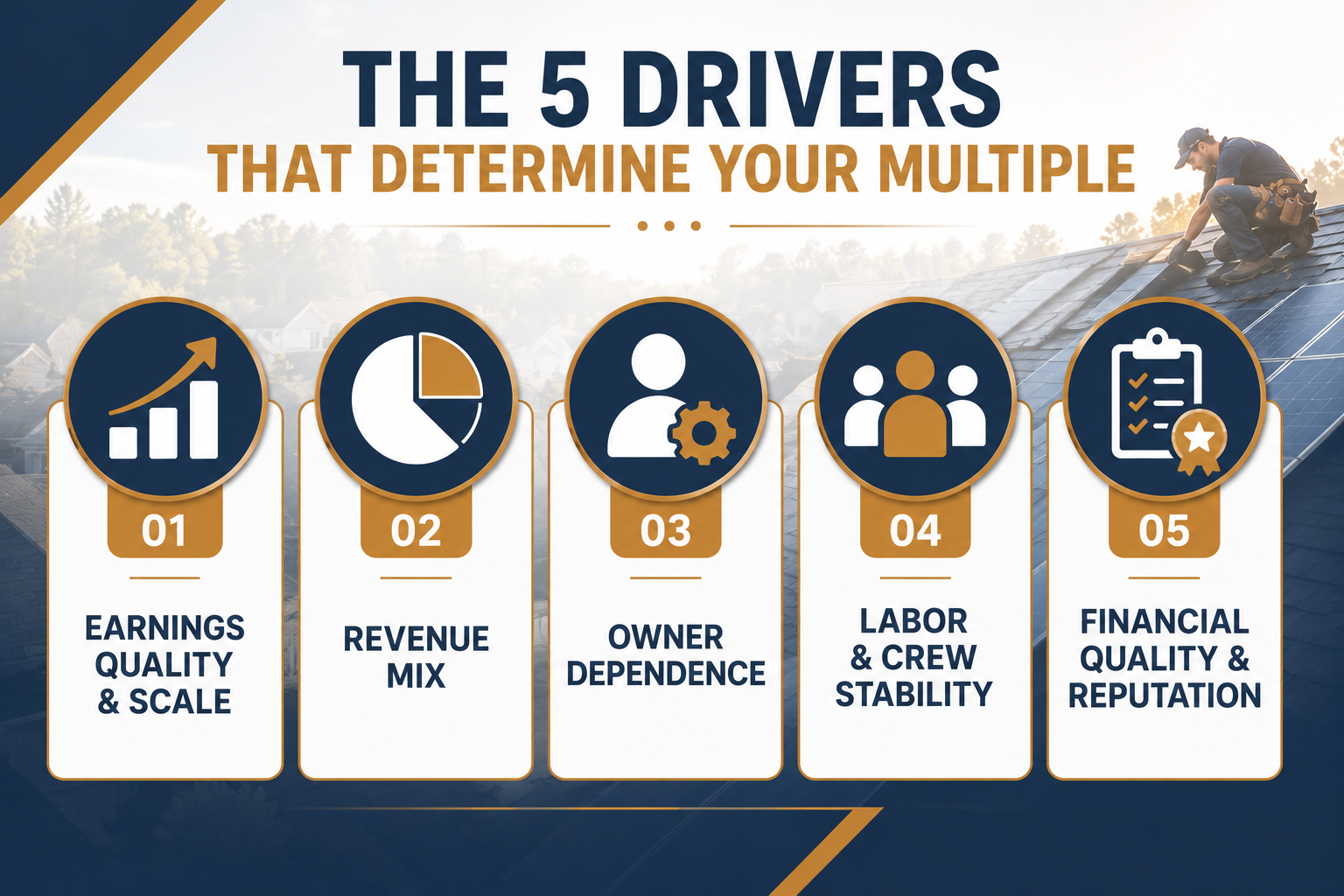
Most owners focus on the wrong things, such as revenue, trucks, and years in business. And then proceed to underinvest in the factors that actually move the number. The five drivers below are what buyers pay for. The three at the end are what owners overrate. If private equity has called, or you think an exit is somewhere on the horizon, read both lists before you do anything else.
β’ It's all about transferable cash flow: Buyers pay for earnings they can count on after you're gone. Risk is the discount.
β’ Driver 1 β Earnings quality and scale: Clean SDE/EBITDA and crossing $1M then $3M changes your buyers and your multiple.
β’ Driver 2 β Revenue mix: Recurring commercial and maintenance work beats one-time retail and storm chasing.
β’ Driver 3 β Owner dependence: A business that runs without you is a company. One that doesn't is a job.
β’ Driver 4 β Labor and crews: W-2 workforce with low turnover signals stability; all-1099 signals risk.
β’ Driver 5 β Financial quality and reputation: Clean books, diversified customers, and hundreds of reviews build buyer trust.
β’ What doesn't move it like you think: Top-line revenue, the value of your trucks and equipment, and your personal reputation.
A buyer is not paying for how hard you work or how long you've been in business. They are paying a multiple of your earnings, adjusted for risk. Strong, clean, transferable earnings earn a high multiple. Earnings that depend on you, on a good storm season, or on one big customer earn a low one.
Hold that idea while you read the five drivers. Each one either strengthens the earnings or lowers the risk.
Read More: Business Valuation Multiples Tennessee Owners Should Understand

The starting point is how much the business actually earns, measured as SDE (Seller's Discretionary Earnings) for smaller roofers or EBITDA for larger ones, and how clean those earnings are.
Two things matter here. First is quality. Well-documented earnings with provable add-backs are worth more than numbers a buyer has to question or discount. Second is scale. Multiples generally increase as a business grows. Crossing $1 million in EBITDA moves you from individual buyers into private equity add-on territory. Crossing $3 million puts you in platform range, where the strongest multiples are typically found.
You cannot create scale overnight. But you can make sure the earnings you already have are clean, documented, and presented in a way buyers can trust.
Read Next: EBITDA Explained for Small Business Owners: What It Means and Why Buyers Care
Not all roofing revenue is valued the same. This is where a lot of value is won or lost.
One-time residential retail and storm-chasing work generates real revenue, but it starts over every year, and buyers have to guess what the next storm season will bring. Recurring commercial maintenance, service agreements, and a diversified base of repeat customers are worth more because they produce more predictable cash flow.
If your revenue is heavily storm- or insurance-driven, every step toward recurring commercial work can strengthen your multiple. A roofer with a book of recurring maintenance contracts is selling a very different business from one that depends on the next hailstorm.
This is the big one. In many roofing companies, the owner is the lead salesperson, top estimator, the relationship every major customer trusts, and the final decision-maker on every bid. That may feel like the company's greatest strength. To a buyer, it is often the company's biggest risk.
If the business cannot run without you for 60 days, a buyer is not purchasing a company. They are purchasing a job, and they pay job prices.
Building a layer between you and the daily operation, whether that's a general manager, sales leader, or production manager, does two things. It increases your multiple and opens the door to a much broader buyer pool. Private equity platforms and regional consolidators rarely pursue businesses that leave with the founder.
Read More: Why Every Roofing Business Needs a General Manager, and the Right Hiring Sequence for Growth or Exit
Roofing runs on people, and buyers pay close attention to how your workforce is built. A team of W-2 employees with low turnover suggests stability and increases confidence that the business will continue operating after a sale. A workforce made up entirely of 1099 subcontractors can create additional diligence questions around labor continuity, worker classification, and tax exposure.
You do not have to convert your entire workforce overnight. But building a more stable team, documenting responsibilities, and showing that key employees are likely to remain after the transition all strengthen the business.
The final driver is trust. Buyers who trust your numbers and your ability to generate future demand are more willing to pay a premium because they apply a smaller discount for risk.
On the financial side, that means clean books, separated personal and business expenses, customer-level reporting, and a diversified customer base with no single account representing too much revenue. On the reputation side, it means evidence that demand continues without relying entirely on the owner, including strong online reviews, manufacturer certifications, and transferable workmanship warranties.
None of this is flashy. But all of it reduces buyer risk, and that is what ultimately supports a stronger valuation.
Read More: Bad Bookkeeping Kills Deals β Focus on These Fixes
Run a quick first pass with the free Roofing Valuation Calculator (2-Minute Walkthrough).
Top-Line Revenue: Tells buyers how busy you are, not how profitable or transferable the business is. A $5 million roofing company with thin margins and an owner doing all the selling is worth less than a $3 million company with stronger margins, recurring revenue, and an experienced general manager. Buyers pay for earnings and risk. Revenue is the headline, not the value.
The Value of Your Trucks and Equipment: Owners often anchor on the value of their fleet and equipment when estimating a sale price. Buyers care far more about the cash flow those assets produce than what they are worth on their own. A yard full of trucks cannot make up for weak earnings, because buyers are purchasing a business, not just its assets.
Your Personal Reputation and Relationships: This is the hardest one for many owners. The relationships you've built over decades are real and valuable, but they are often difficult to transfer to a new owner. If customers do business because of you personally, that is owner dependence, and buyers see it as a risk. Before selling, the goal is to transfer those relationships to the company through its brand, team, and systems so they continue long after you step away.
Read More: How to Increase Business Value Before Selling: 8 Proven Strategies
A roofing company's value is not determined by its trucks, its revenue, or the number the owner hopes to receive. It is determined by how confident buyers are that the business will continue producing strong earnings after the owner steps away.
That confidence is built over time through stronger financials, recurring revenue, capable management, lower owner dependence, and systems that make the business easier to operate and easier to transfer.
The owners who earn the strongest offers usually are not the ones who negotiate the hardest. They are the ones who spent years building a business buyers can understand, trust, and confidently grow.
Key Takeaways
Buyers pay for transferable cash flow; everything that raises your price either strengthens earnings or lowers risk.
The five real drivers: earnings quality and scale, revenue mix, owner dependence, crew stability, and financial/reputation quality.
Owner dependence is the single biggest lever for most roofers.
Revenue, equipment value, and your personal relationships matter less than owners assume.
A valuation grades you on these factors and shows you where the value is hiding.
See what roofing companies are really selling for in our Roofing Business Sales Report.
For most roofers, owner dependence is the biggest single factor. A business that can run, sell, and produce without the owner is far less risky, attracts more buyers, including private equity, and earns a higher multiple. A business that depends on the owner is priced like a job.
Not necessarily. Buyers pay a multiple of earnings adjusted for risk, not a percentage of revenue. A smaller, more profitable, less owner-dependent roofer can sell for more than a larger one with thin margins and heavy owner involvement.
Less than most owners expect. Buyers focus on the cash flow the business generates, not the standalone value of the fleet. Equipment matters for what it helps the company earn, not as a separate number added on top of the multiple.
Because relationships tied to you personally are owner dependence in disguise. They may not transfer to a new owner. The fix is to move those relationships into the company's brand, team, and systems before you sell, so the demand survives your exit and becomes an asset rather than a risk.
Recurring commercial and maintenance revenue is worth more per dollar than one-time retail or storm work because it is predictable and easier for a buyer to underwrite. Shifting even part of your revenue toward recurring and commercial work can raise your multiple.
Start with a valuation that grades your business on these drivers and compares it to what similar roofing companies have actually sold for. A free calculator gets you a first-pass estimate; a full valuation gives you a defensible number and a clear list of what to improve.
Your roofing company's sale price comes down to one question a buyer is always asking: how much money will this business make me, and how confident...

SDE stands for Seller's Discretionary Earnings. It is the total financial benefit a single owner-operator receives from a business in a year. It...
Private equity is buying roofing companies because the industry has exactly what investors want: huge size, heavy fragmentation, and demand that does...