


How to Sell a Restaurant in Tennessee: A Practical Guide for Owners
Selling a restaurant in Tennessee comes down to preparation. Buyers will look closely at your financials, lease terms, licenses, payroll, and...
16 min read
Joseph Steigman : Updated on March 26, 2026
According to the Raymond James 2025 Business Owner Report, 88% of business owners plan to transition some or all of their financial stake in their business within the next 10 years. For many owners, that means exit planning is already part of broader business planning.
Even when a sale is still years away, preparation often starts earlier than expected because buyers, lenders, and advisors will look closely at the business before serious offers move forward.
That is why preparation needs to go beyond basic cleanup. A seller should be able to show how the business performs, how much it depends on the owner, which obligations and relationships will carry over in a sale, and what a buyer will actually be acquiring at closing. Strong preparation can make diligence easier, reduce delays, and help the business present more clearly in the market.
This guide covers
P.S. Before you market a company, it helps to know whether the price, financials, and transferability will hold up under buyer review. At Legacy Entrepreneurs, we help Tennessee owners evaluate sale readiness and understand market value before going to market.
Request a business valuation to identify the issues most likely to affect buyer confidence, diligence, and closing before they narrow your options.
| Checklist Area | What Should Be Ready Before You Go To Market |
|---|---|
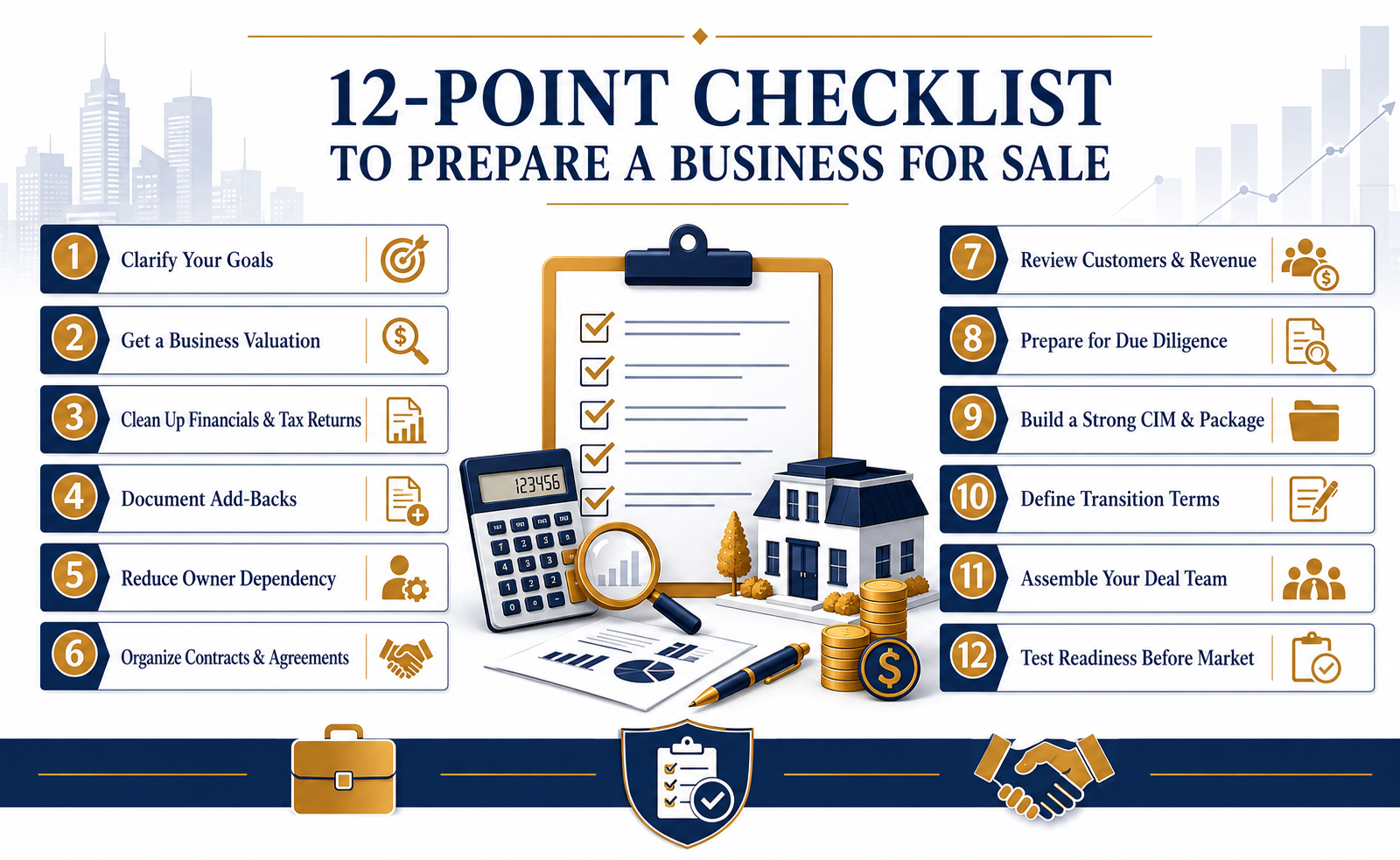
| Clarify Your Goals For The Sale | Define target timing, minimum proceeds, preferred buyer type, post-close role, and employee priorities so offer terms can be measured against real objectives instead of emotion. |
| Get A Business Valuation | Use a market-based valuation that shows adjusted earnings, add-backs support, risk factors, and a realistic range, so price expectations are grounded before buyer conversations begin. |
| Clean Up Financial Statements And Tax Returns | Prepare three years of filed tax returns, monthly P&Ls, balance sheets, trailing twelve-month results, and aging reports that reconcile cleanly, or buyers will question earnings quality immediately. |
| Document Add-Backs And Earnings Adjustments | Support each add-back with payroll records, invoices, ledger detail, or other source documents so the buyer can test whether the adjustment is truly non-recurring or owner-specific. |
| Reduce Owner Dependency | Shift customer relationships, pricing decisions, approvals, and daily workflows away from one person so the business can show transferable operations rather than owner-centered performance. |
| Organize Contracts, Licenses, And Legal Agreements | Pull leases, customer contracts, vendor terms, employment agreements, permits, and dispute records into one file so assignability, renewal risk, and hidden liability can be reviewed early. |
| Review Customer, Vendor, And Revenue Concentration | Show revenue by customer, vendor dependence, channel mix, and service-line margins so buyers can see whether earnings are diversified or vulnerable to a small number of relationships. |
| Prepare For Due Diligence Before You Market The Business | Build a diligence-ready file with financials, debt schedules, compliance records, payroll data, insurance, contracts, and capex history before the first buyer requests documents. |
| Build A Strong CIM And Marketing Package | Present a clear CIM with business model, adjusted earnings, customer mix, management structure, market position, and growth opportunities so qualified buyers can evaluate the opportunity properly. |
| Define Transition And Post-Sale Handover Terms | Set out the seller training period, key introductions, system transfer, employee communication timing, and support scope so handoff expectations do not become a late-stage negotiation problem. |
| Assemble The Right Deal Team | Identify the broker or advisor, CPA, transaction attorney, and any industry-specific specialists needed to support valuation, diligence responses, negotiation, and closing discipline. |
| Test Readiness Before Going To Market | Run a final readiness check against the full file to confirm numbers tie out, contracts are current, add-backs are supported, and the company can withstand buyer scrutiny without scrambling. |
A business sale gets easier to manage when the documents, numbers, and operational reality all tell the same story. Buyers are trying to decide whether the earnings are real, whether the operation can transfer to a new owner, and whether risks are already visible or still hidden.
This comprehensive checklist is built to help you prepare your business for sale in a way that supports pricing, shortens the due diligence process, and creates a better chance of a successful sale.

The first item on any checklist is the transaction outcome you actually want. Many owners say they want to sell their business, but that is still too broad to guide price, timing, buyer selection, or transition terms. A clean process starts with the practical questions that shape the rest of the deal.
You should decide whether the priority is maximum cash at closing, preserving employees, stepping out quickly, staying involved for a transition period, or protecting a local reputation.
These choices affect who the right buyer is, how the sale process is structured, and what terms matter beyond the headline sale price. A strategic buyer, first-time operator, family successor, or SBA-backed buyer will not evaluate the same business the same way.
This is also where valuation expectations need to align with your goals. If the timing is urgent, the structure may need to be more flexible. Similarly, if the target price is aggressive, the business may need proper preparation first. Therefore, the decision to sell should be tied to timing, personal constraints, and what a realistic market outcome looks like, not just what the owner hopes the business is worth.
A credible business valuation sets the tone for the entire business sale process. It helps you understand the current value of your business, the earnings profile buyers will focus on, and which risks are likely to pressure the purchase price. It also reduces one of the most common problems in selling a business, which is starting from unrealistic valuation expectations.
A thorough valuation should explain normalized earnings, the logic behind add-backs, industry risk, customer concentration, growth assumptions, and the market evidence supporting the range. If a number cannot be tied to real cash flow and comparable deal logic, it is not a useful pricing tool. It becomes a negotiation problem waiting to happen.
This is where a professional valuation also helps separate personal attachment from market evidence. A business owner may believe years of work, customer loyalty, and sacrifice should produce a certain result. However, buyers still underwrite based on transferable earnings, risk, and what the business requires to operate after closing. That gap is exactly why getting a valuation early can help you maximize value where possible and correct weak assumptions before the company is shown to potential buyers.
Financial cleanup is one of the most crucial parts of sale prep that tells buyers whether the earnings can be trusted and whether lender-backed financing has a realistic path. Weak bookkeeping changes how the buyer reads risk.
Adjusted earnings often drive valuation, so unsupported add-backs can become one of the fastest ways to lose credibility. Buyers will not simply accept that a cost is personal, temporary, or non-recurring because it was labeled that way in a spreadsheet.
Transferability is one of the clearest tests of whether a business for sale is truly ready for market. If the owner still controls the pricing, top customer relationships, vendor negotiations, employee decisions, and operational problem-solving, the buyer is not acquiring a stable company. The buyer is acquiring a job with elevated risk.
You should identify where the business still depends on judgment, access, or relationships. That may include quoting work, approving large purchases, resolving service issues, handling payroll questions, or being the only person customers trust. Each of those dependencies lowers confidence in the continuity of earnings after closing.
The fix is not always a complete management overhaul. Sometimes it is enough to document workflows, move approvals to managers, formalize customer communication processes, train team leads, and show that day-to-day execution can happen without constant owner intervention. In some businesses, hiring a general manager or strengthening existing leadership is one of the fastest ways to improve transferability and support a successful exit.
Deal risk often sits in the paperwork long before it appears in negotiation. Buyers want to know which obligations transfer cleanly, which ones require consent, and where hidden legal exposure may affect the economics of the sale of your business. This is one of the key steps to follow if you want to successfully sell your business without late-stage surprises.
Concentration changes how a buyer sees stability. A business with healthy earnings but fragile revenue sources can still trade at a discount because too much future performance depends on too few relationships. This is also where a company’s market position becomes more than a marketing phrase. Buyers need evidence that revenue is diversified enough to survive the ownership change.
| Concentration Area | What Buyers Verify | What Weakness Usually Means | What It Often Triggers |
|---|---|---|---|
| Top Customers | Revenue by customer for at least 24 to 36 months, margin by account, contract status, and whether the relationship depends on the owner personally | One customer loss could materially reduce earnings, which weakens the valuation case | Lower offer, earnout pressure, or deeper diligence into retention risk |
| Top Vendors | Spend concentration, substitute supplier options, contract terms, rebate structure, and dependency on informal relationships | Supply disruption or margin pressure could hit performance soon after closing | Requests for backup supplier plan or adjusted working capital assumptions |
| Revenue By Service Line Or Product | Gross profit by category, volatility, seasonality, and whether one line props up the whole company | The buyer may conclude that parts of the business are weaker than the summary financials suggest | Narrower valuation range or questions about what should really be marketed |
| Channel Mix | Lead source data, recurring versus project revenue, referral dependence, and channel acquisition costs | A lead pipeline tied to one source can reduce predictability after closing | Greater scrutiny of growth potential and future marketing spend |
| Geographic Mix | Revenue concentration by territory, facility, or route, and any regional dependency | Local concentration may create exposure to a specific economic or competitive shift | The buyer may challenge expansion assumptions or ask for location-specific data |
Buyers gain confidence when the evidence is ready before they ask for it. They lose confidence when the seller starts hunting for documents only after signing a letter of intent. That is why preparation for diligence should happen before you market your business, not after a buyer becomes interested in your business.
A confidential information memorandum is not just a general overview of the business. It is a core sale document that helps qualified buyers evaluate the company before they spend significant time on diligence, agree to tighter confidentiality terms, or submit indications of interest. A weak CIM can attract poorly matched buyers, leave important questions unanswered, and reduce confidence before management discussions begin.
| Marketing Material | What It Should Include | What Buyers Test |
|---|---|---|
| Executive Business Summary | Business model, revenue size, adjusted earnings, high-level buyer fit, and the reason the opportunity is attractive | Whether the company sounds transferable, stable, and worth a deeper review |
| Financial Presentation | Historical revenue, margins, adjusted cash flow, and explanations for unusual periods or one-time events | Whether the numbers are consistent with tax returns, monthly reporting, and expected normalization logic |
| Customer And Market Positioning | Customer mix, retention characteristics, competitive position, and key drivers of demand | Whether the company has a durable demand or just recent momentum with limited support |
| Growth Opportunities | Specific expansion paths such as pricing, territory, staffing, capacity use, or service mix changes | Whether the upside is evidence-based or just a list of ideas the owner never executed |
| Transition Narrative | Seller role after close, management depth, employee stability, and expected handover plan | Whether the business can operate with a smooth handover instead of owner dependence |
Read Next: Why a Strong Confidential Information Memorandum is Key to a Successful Business Sale
A deal can look clean on paper and still create tension if the handoff is vague. Buyers want to know what support they will receive, how long you will stay involved, who will handle introductions, and what knowledge must be transferred for the operation to continue without disruption. These details can shape buyer confidence just as much as the main terms of the purchase agreement.
The handover should cover training duration, key customer and vendor introductions, team communication timing, password and system transfer, open-project status, and any seller support after closing. If the buyer expects six months of involvement and the seller expects two weeks, the issue will surface either during the LOI stage or after signing. Neither outcome is good.
This also matters for employee stability and customer continuity. A weak handover plan creates uncertainty around key relationships, workflow continuity, and service quality. A strong one supports a smooth handover, improves the buyer’s willingness to proceed, and can make it easier to close the deal without overloading the legal documents with avoidable transition disputes.
The sale process moves faster when the right people are involved before problems surface. A strong deal team is not there to add unnecessary layers to the process. It exists to fix weak records, challenge assumptions, organize the file, and keep the process disciplined once buyers start asking questions. This is often where the difference between a stressful listing and a controlled selling process becomes visible.
This final review is where thorough preparation becomes clear. Before a company is presented as a business for sale, every major claim in the marketing material should be tested against supporting records. If claims about margins, growth, transferability, or valuation cannot be supported quickly, the process is not ready.
Run a mock diligence check against the full file. Make sure your monthly reports tie to filed returns, key agreements are signed and current, add-backs have backup, customer concentration is clearly understood, and transition expectations are not still vague. This is also the point where a broker or advisor can challenge whether the business is truly ready for market or whether one more round of cleanup will save months of friction later.
Timing should be evaluated here as well. Selling a business is rarely quick. Six months is fast, which is why some advisors ask for 12 months of exclusivity. If the seller has everything ready on day one, the process may look like one month of marketing preparation, one month to find buyers and get offers, and one month of diligence. More often, it looks like one month of preparation, two months of sourcing buyers and letting them complete pre-LOI screening, followed by another month of diligence.
Even in a well-run process, diligence can fail and put the business back on the market. In other cases, the preparation period begins much earlier and lasts much longer because owner dependence, weak reporting, or legal and operational cleanup still need to be addressed before the business can be marketed credibly.
Read Next: Why Buyers and Sellers Don’t Agree on Business Valuation — And What to Do About It
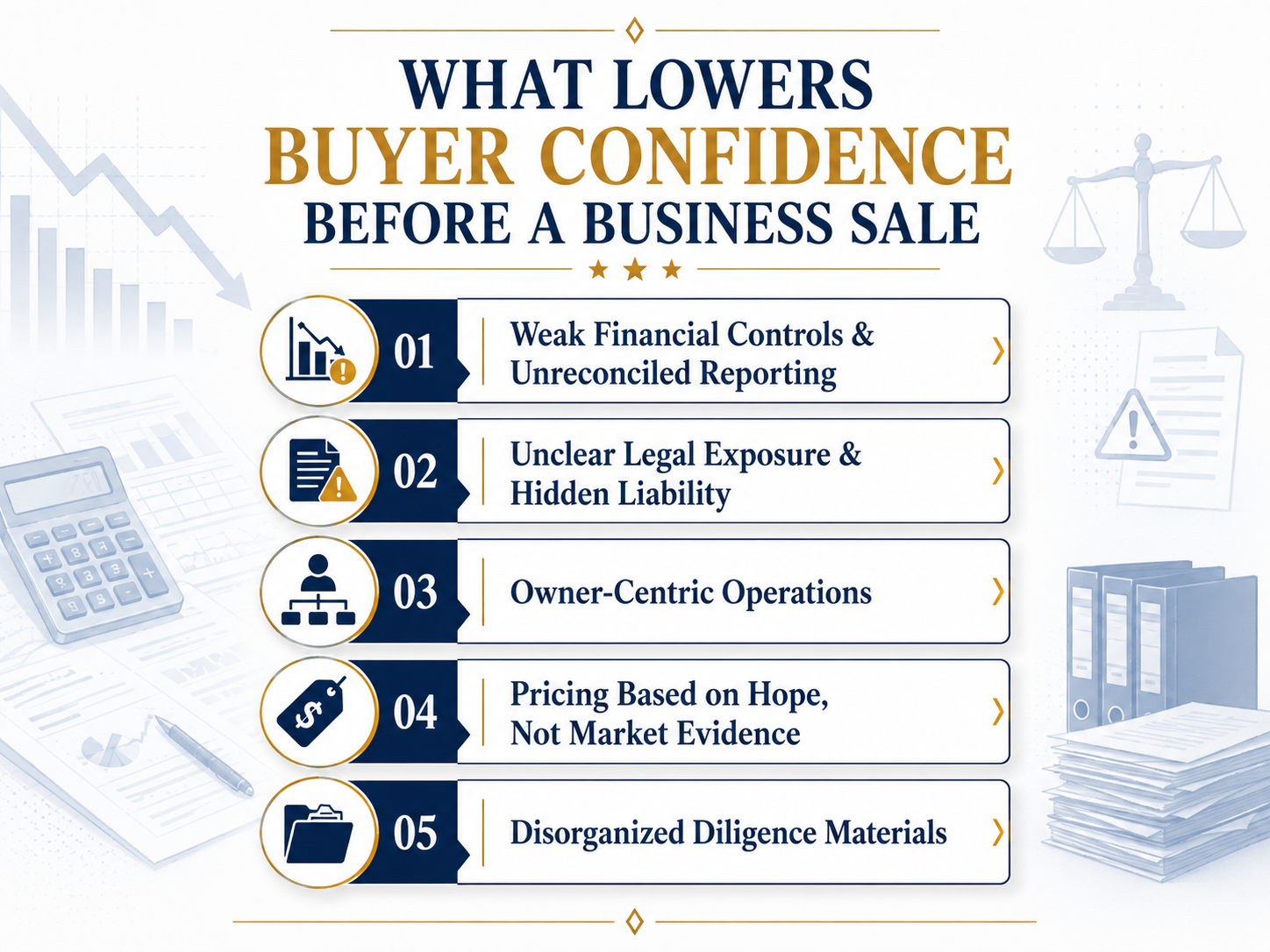
A buyer does not need to see fraud to get uncomfortable. Most deals lose momentum because the company was brought to market before the evidence was organized, the pricing was disciplined, or the risks were fully understood. These are the issues that turn a promising process into a slower, more defensive one.

When internal reports do not tie to tax filings, bank activity, payroll records, or ledger detail, buyers assume the earnings quality is poorer than presented. They may still stay in the process, but they will test every number harder and often reduce confidence in the stated cash flow. That can lower the offer, tighten terms, or push the buyer to demand more support before moving forward.
This problem is especially common in owner-led companies where bookkeeping evolved around tax filing rather than transaction readiness. A company can be profitable and still look risky if the reporting is inconsistent, late, or heavily adjusted without support.
Legal uncertainty makes buyers defensive because it is difficult to price accurately. The issue may be a lease problem, an undocumented obligation, a tax matter, a contractor classification risk, or an open claim that seems small to the seller but significant to a buyer. If the exposure is not organized early, it often shows up late and changes negotiation leverage immediately.
This is why contract review and liability review matter before the company is shown broadly. Buyers will protect themselves with escrows, indemnities, holdbacks, or price changes when they think risk is still emerging.
Buyers want to acquire an operating business, not become dependent on the former owner’s memory and relationships. If pricing, sales, job scheduling, hiring, escalation management, or top customer communication still sits with one person, the operation becomes harder to underwrite. That weakens the case for a premium valuation and can narrow the pool of buyers willing to proceed.
Transferability improves when management depth, process documentation, and role clarity are visible before the process starts. Even modest improvements here can create peace of mind for buyers.
A seller may have very understandable reasons for targeting a certain number. Retirement needs, years of work, and emotional attachment are all real. Buyers still look at adjusted earnings, risk, transferability, and how the opportunity compares with other acquisition options. If price expectations are disconnected from the actual market, the process usually gets longer and more frustrating.
This is where early valuation work helps most. It gives the seller a framework for what the market may support today and what needs to improve if the target value is higher.
Read Next:
A delay in producing documents often gets interpreted as a deeper problem, even when the issue is only disorganization. Buyers notice when responses are late, numbers change, contracts are missing, or explanations keep evolving. The result is not just inconvenience. It changes trust.
A well-prepared seller can answer questions with source documents, clear logic, and consistent files. That does not guarantee a deal closes, but it does help streamline the process and preserve credibility when the buyer is testing the business more aggressively.
Read Next: Top 3 Reasons Business Owners Leave Money on the Table When Selling Their Business
A cleaner sale starts before outreach, before the first buyer call, and well before any agreement is drafted. The strongest position is not just having a company that performs. It is having a company that can prove performance, transfer operations, and respond quickly when scrutiny increases.
This preparation gives you more control over the timing, buyer conversations, and negotiating posture once the market starts reacting.
At Legacy Entrepreneurs, we work with Tennessee owners who need clearer sale readiness, better pricing discipline, and stronger preparation before entering the market. Request a business valuation to clarify how your business may be positioned in the market, reduce preventable deal risk, and support a more defensible sale process.
Start by clarifying your goals, getting a realistic valuation, and cleaning up the records buyers will review first. That usually means reconciling financial statements to tax returns, documenting add-backs, organizing contracts, identifying liabilities, reducing owner dependency, and building a diligence-ready file before the business is marketed.
Most buyers will want three years of tax returns, monthly profit and loss statements, balance sheets, trailing twelve-month performance, AR and AP aging, major customer and vendor contracts, lease documents, payroll summaries, licenses, insurance information, debt schedules, and documents supporting any earnings adjustments. They will also expect a clear CIM once the process is underway.
Preparation time depends on how organized and transferable the company already is. If the records are clean and the business is ready on day one, a marketed process can sometimes move in roughly three to four months, but six months is fast in real terms. Many businesses need much longer preparation because diligence can fail, owner dependency may still be high, or financial and legal cleanup is still unfinished.
Most valuations start with normalized earnings, then adjust for risk, transferability, concentration, industry conditions, and comparable market transactions. Buyers will examine the support behind cash flow, add-backs, customer stability, management depth, and growth assumptions before deciding what price and terms make sense.
Buyers test whether the story told during marketing holds up in the underlying documents. They review earnings quality, tax filings, contracts, concentration risk, working capital needs, liabilities, employee structure, legal exposure, and transition readiness. The more organized and consistent the evidence is, the easier it is to maintain credibility through diligence.
Not every sale uses a broker, but many owner-led companies benefit from having a broker or advisor manage positioning, buyer screening, confidentiality, negotiation flow, and process discipline. The right support becomes more valuable when pricing is sensitive, diligence is likely to be heavy, or the owner does not want to manage buyer interactions directly.
Selling a restaurant in Tennessee comes down to preparation. Buyers will look closely at your financials, lease terms, licenses, payroll, and...
Selling a roofing company in Tennessee requires clean financials, transferable operations, and a sale process that can stand up to buyer and lender...
The real decision is not whether you can list a business next month. It is whether your financials, valuation, lease terms, and transfer documents...