


16 min read

11 Costly Mistakes To Avoid When Selling Your Business in Tennessee

11 Costly Mistakes To Avoid When Selling Your Business in Tennessee

Selling your business means proving what a buyer is actually getting, what risks transfer with it, and what price the numbers can support. Buyers will review earnings, customer mix, lease terms, owner dependence, and the structure of the deal before they decide how much to offer and how much risk they are willing to accept.

Tax consequences matter just as early. The IRS treats the sale of a business as a sale of individual assets rather than a single asset, so the purchase price may be allocated in ways that change the seller’s after-tax outcome. Two deals with the same headline sale price can leave the owner with very different net proceeds. Many sales problems start when expectations are set before the financials, tax treatment, transferability, and buyer requirements are fully understood.

This guide covers:

  • The pricing, diligence, and buyer screening mistakes that quietly weaken sale outcomes
  • The documents, transfer issues, and deal terms are tested by buyers before closing
  • The fixes that protect value before marketing your Tennessee business for sale

P.S. Problems in a business sale usually start where assumptions have not been tested yet. Legacy Entrepreneurs works with Tennessee owners who need a clearer view of value, transfer risk, and the issues that can slow financing or weaken buyer confidence once diligence begins. 

Schedule a consultation to identify the sale-readiness gaps most likely to affect price, timing, and closing.

Quick Decisions That Prevent Costly Sale Mistakes

Mistake What To Do Instead
Pricing From Instinct Instead Of Valuation Support Test three years of tax returns, monthly P&Ls, trailing twelve-month results, add-backs, customer concentration, and owner dependence before setting a sale price range.
Unreconciled Financials Prepare financial statements that tie to filed returns, bank deposits, merchant processing, payroll, and balance sheet changes so buyers can trust the earnings story.
Weak Buyer Screening Confirm proof of funds, lender readiness, acquisition fit, timeline, and post-close expectations before sharing sensitive information or spending time on negotiation.
Loose Confidentiality Use confidentiality agreements, staged disclosures, redacted summaries, and controlled buyer communication so employees, customers, and competitors do not learn too much too early.
Ignoring Transferability Review lease assignment language, contract consent requirements, licensing rules, and key employee retention risk before bringing the business to market.
Late Tax Planning Speak with tax advisor and legal counsel before deal structure discussions harden, so allocation, entity treatment, and capital gains consequences are understood early.
Diligence By Improvisation Build a diligence file with tax returns, financial records, contracts, payroll, equipment lists, lease documents, insurance, and add-back support before listing the business.
Negotiating Only On Headline Price Compare cash at close, seller financing, holdbacks, working capital, transition period, non-compete terms, and post-sale exposure before accepting an offer.


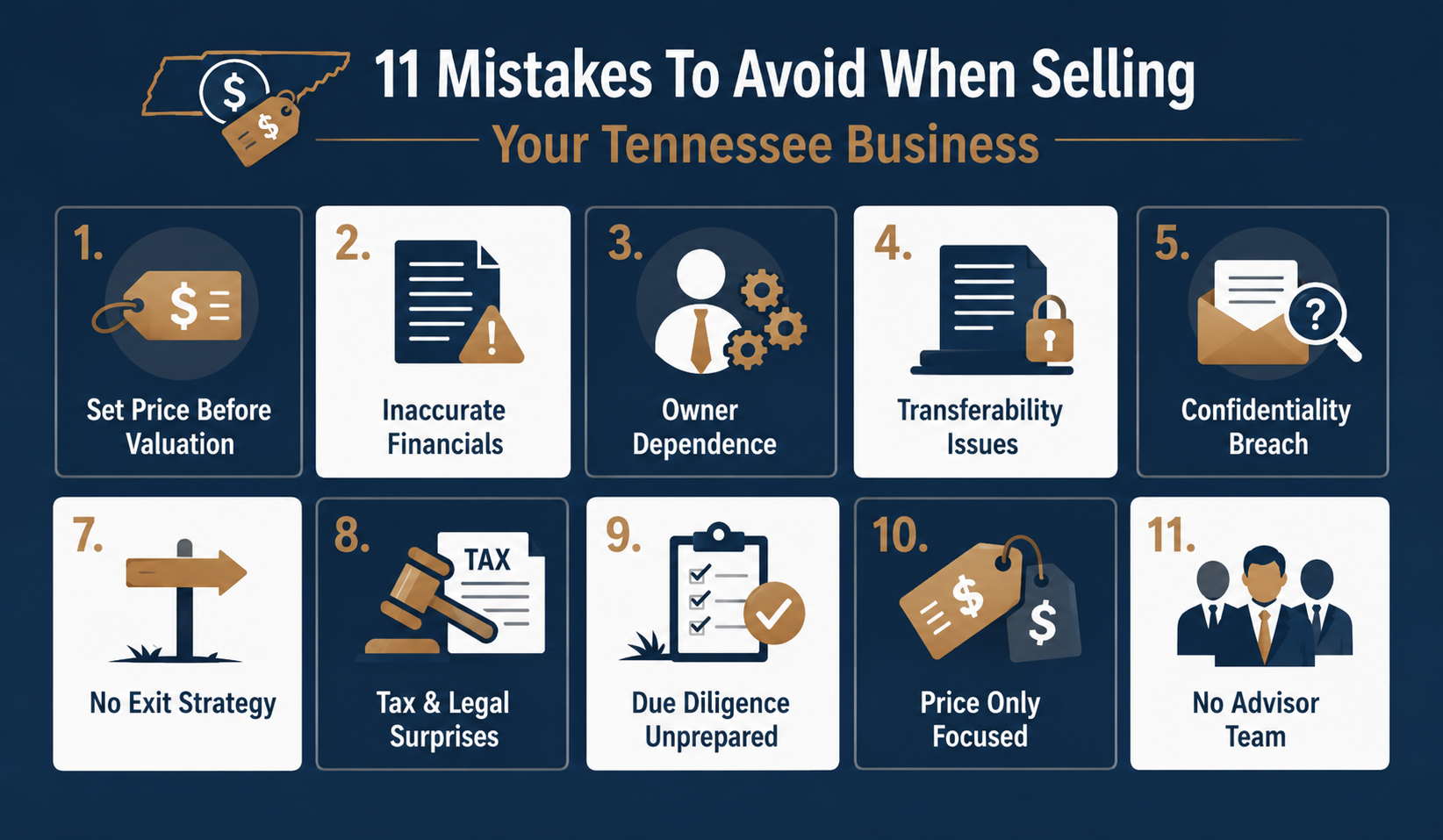
11 Mistakes To Avoid When Selling Your Tennessee Business

Sales problems usually build quietly during preparation, pricing, and buyer conversations long before a deal breaks. The issue is usually not one error. It is a series of weak assumptions about value, records, transferability, confidentiality, or deal terms that starts to show once a buyer asks for proof. If you want to sell a business well, you need to know where the sale process tends to weaken and what buyers, lenders, and advisors will check before they stay engaged.


1. Setting A Sale Price Before Testing Valuation Support

Owners often decide what the company’s value should be before they test whether the market will support it. That is one of the most expensive mistakes to avoid when selling because price shapes buyer response, financing feasibility, and negotiation leverage from the start. If the asking number is built on emotion, future hopes, or what another entrepreneur sold their business for, potential buyers will usually discount the opportunity long before they make an offer.

A credible valuation starts with what buyers need to see in the earnings. That includes three years of tax returns, monthly financial statements, trailing twelve-month performance, owner compensation, discretionary expenses, customer concentration, and the degree to which the business depends on you.

A business owner may believe a premium is justified because revenue is growing, but buyers will look harder at margin consistency, repeatability, contract strength, and how much of the sales are dependent on the current owner.

Overpricing does not just risk a lower offer later. It can shrink the buyer pool, reduce inquiry quality, and create a stale business for sale listing that signals weakness. A better approach is to establish a defensible range, understand what assumptions support the top end, and decide whether those assumptions will survive due diligence.

2. Going To Market With Financials That Do Not Reconcile

The first serious review usually starts with the numbers. If the financials do not tie together, buyers start questioning the earnings story before they evaluate the business itself. That creates avoidable friction in valuation, financing, and due diligence.

  • Tax Return Alignment: Compare three years of filed business tax returns to internal profit and loss statements so revenue, owner pay, and discretionary expenses tell the same story. Mismatches raise concerns about whether the reported business value is real or adjusted after the fact.
  • Monthly Statement Consistency: Prepare monthly P&Ls and balance sheets with clear period-to-period logic, including seasonality, gross margin shifts, and unusual expense spikes. Buyers use these reports to assess trend reliability, not just annual totals.
  • Trailing Twelve-Month Support: Build a current trailing twelve-month schedule that ties to closed monthly statements and recent bank activity. That gives prospective buyer groups a current earnings view instead of forcing them to rely on stale year-end numbers.
  • Deposit and POS Reconciliation: Match sales shown in financial records to bank deposits, merchant processor reports, or POS summaries. If cash activity, discounts, refunds, or timing differences are unexplained, buyers may assume the reporting discipline is weak.
  • Add-Back Documentation: Support each claimed adjustment with general ledger detail, invoices, payroll records, or one-time expense evidence. Unsupported add-backs are a common misstep that can reduce the sale price once diligence begins.
  • Payroll and Labor Detail: Reconcile payroll reports to wage expense and identify owner family members, one-time staffing anomalies, or roles that would need replacement after closing. Buyers need this to understand the true operating cost and transferability.

3. Waiting Too Long To Address Owner Dependence

Too much of the business depending on the owner is a major concern for buyers. If you handle the top customer relationships, approve every major quote, solve most operational problems, and make key purchasing or staffing decisions, the buyer has to underwrite your continued involvement instead of the business itself.

That affects value and deal terms. A buyer may lower the price, ask for a longer transition, or hesitate to move forward because the business does not look stable without the current owner. Strong revenue does not fully solve that problem if the systems, relationships, and decision-making still depend on one person.

Fixing owner dependence takes time. Key employees may need more authority. Customer relationships may need to be shared across the team. Processes may need to be written down instead of explained verbally. If you wait until there is a pending sale, the buyer will usually treat that issue as an unresolved risk.

4. Ignoring Lease, License, And Contract Transferability

A buyer can like the business and still walk away if the site, permits, or major contracts do not transfer on workable terms. Transferability should be reviewed before the business is marketed because weak lease language, licensing uncertainty, or contract consent requirements can delay financing, force repricing, or stop the transaction altogether.

Transfer Issue What Buyers Check And What Happens If It Is Weak
Lease Assignment Terms Buyers review years remaining, renewal options, rent escalations, personal guarantees, and landlord consent language. Short remaining term or restrictive assignment provisions can reduce lender support or force repricing.
Use Restrictions They confirm the lease permits the current business use, signage, parking, and any planned expansion. Weak use rights can create post-close operating risk that the buyer cannot accept.
Licenses And Permits Buyers need to know whether licenses transfer, require reapplication, or trigger inspections and approval delays. If the permit path is unclear, closing timelines stretch, and financing confidence drops.
Customer Contract Consents Contracts may require notice, assignment approval, or renegotiation after a change of control. Weak consent language creates revenue uncertainty around major accounts.
Vendor And Distribution Agreements Buyers check whether supply terms survive a sale, whether pricing is tied to ownership, and whether any vendor can terminate on short notice. Supply uncertainty can reduce perceived transferability.
Franchise Or Brand Restrictions Franchise systems or licensed brands may impose approval standards, training rules, net worth thresholds, or transfer fees. If the buyer cannot qualify, the deal can stop, even with an agreed sale price.


5. Letting Confidentiality Slip During The Sale Process

Confidentiality problems can damage a sale before the parties ever reach closing documents. Employees may worry about job stability, customers may question continuity, vendors may tighten terms, and competitors may use the uncertainty against the business. Once that information spreads too early, the seller loses control over who is shaping the narrative around the business.

Confidentiality agreements matter, but they do not protect the process on their own. You also need a staged disclosure approach that limits what each buyer receives at each step. Early materials can describe the business without identifying it, while customer names, employee details, pricing, and vendor concentration should be reserved for buyers who have signed an NDA, demonstrated financial capacity, and shown a credible path to close.

This discipline also protects against weak buyers. Some prospective buyers are only gathering information. Some are competitors. Some do not have the funds or financing capacity to complete the transaction. A controlled disclosure process protects leverage and reduces the risk of reputational damage.

Find out if you’re making expensive sales mistakes


6. Treating Buyer Interest As Buyer Quality

A large number of inquiries does not mean the business is attracting the right buyer. Many business owners assume interest equals progress, but the sale only advances when the buyer has the money, fit, and seriousness to complete the deal.

  • Proof of Funds: Ask for evidence of liquidity or a clear funding plan before spending time on meetings, site visits, or detailed disclosures. Interest without capital rarely leads to a completed transaction.
  • Lender Readiness: Determine whether the buyer has spoken with an SBA lender or other financing source, understands down payment requirements, and can support a loan file. Financing uncertainty can derail the sale after an LOI is signed.
  • Relevant Experience: Evaluate whether the buyer can reasonably operate the business or lead the team that will. A buyer with no operational fit may struggle with lender credibility or post-sale execution.
  • Transition Fit: Clarify how much seller support the buyer expects, how long they need you involved, and whether those expectations match what you are willing to provide. Mismatched expectations create friction later.
  • Acquisition Intent: Separate serious buyers from information gatherers, competitors, and people who are reviewing many listings without focus. Qualified buyers usually move toward specific diligence requests, financing steps, and concrete terms.
  • Group Buyer Differences: Compare individual buyers, private equity groups, family offices, and strategic buyers based on timeline, diligence depth, approval layers, and post-sale demands. The most enthusiastic buyer is not always the most qualified one.

7. Starting Buyer Conversations Without A Clear Exit Strategy

A seller who has not defined their own goals usually creates confusion during buyer conversations. That often appears in inconsistent answers about timing, seller financing, post-sale involvement, and acceptable deal terms. Buyers notice that quickly, and it weakens the seller’s position because the decision criteria do not appear settled.

An exit strategy means deciding more than whether you are ready to leave. It includes the time to sell, the minimum acceptable cash at close, whether you would offer seller financing, how long you are willing to stay involved after closing, and how the sale fits into your financial planning, wealth planning, or estate planning. Those decisions affect buyer fit and determine which structures deserve serious attention.

Without that clarity, owners often negotiate in response to pressure instead of according to a plan. They respond differently from one buyer to another, reveal inconsistent priorities, and make concessions that do not match the outcome they actually want from the business sale.

8. Underestimating Tax And Legal Issues

Tax and legal issues affect the economics of the transaction, not just the paperwork at the end. Owners who wait too long to involve legal counsel or a tax advisor often discover that the structure being negotiated is less favorable than they expected and harder to change once the buyer is committed to a particular form of deal.

Legal review starts with ownership records, entity documents, operating agreements, partner approvals, contract obligations, employment matters, intellectual property, and pending disputes. Buyers want to know that the seller has the authority to complete the sale and that there are no unresolved issues that could affect closing or create post-sale liability.

Tax planning matters just as much. Asset sales, stock sales, purchase price allocation, depreciation recapture, installment treatment, and post-sale compensation can all change the seller’s net result. State taxes may matter, too, depending on the transaction. Two offers with the same sale price can produce different after-tax outcomes once those items are reviewed carefully.

9. Failing To Prepare For Due Diligence Before Listing The Business

Due diligence becomes more difficult when the seller starts collecting records only after the buyer asks for them. That usually signals weak preparation, slows the process, and gives the buyer more reasons to question the earnings, the contracts, and the overall quality of the business. Good preparation means assembling the records buyers need before the marketing process begins.

  • Core Financial Package: Assemble tax returns, monthly financial statements, balance sheets, trailing twelve-month results, AR and AP aging, and bank or merchant support so buyers can test the earnings claims tied to valuation.
  • Add-Back And Normalization File: Prepare a schedule of owner salary, personal expenses, one-time repairs, unusual legal fees, non-recurring payroll, and other adjustments with backup documents. Weak support is one of the fastest ways to reduce the value of your business.
  • Contract File: Organize customer agreements, vendor contracts, lease documents, loan documents, equipment financing, and any agreements with change-of-control or assignment language. Buyers review these to judge transfer risk and hidden obligations.
  • People and Payroll Records: Document payroll by role, key employees, compensation arrangements, contractor status, and retention risk. Buyers look closely at who is essential to continuity and whether labor classification issues exist.
  • Asset and Maintenance Records: Prepare fixed asset lists, equipment schedules, maintenance logs, and inventory methods where relevant. Missing records create doubt about asset condition and replacement needs.
  • Insurance, Compliance, and Claims History: Gather policy summaries, certificates, prior claims, licenses, permits, and any unresolved compliance issues. Buyers use these records to evaluate legal exposure and post-close risk.
  • Operational Proof: Maintain written processes, KPI tracking, customer mix reports, and vendor concentration summaries when available. These records help buyers understand whether performance is repeatable or too informal.

10. Negotiating Only On Price Instead Of Total Deal Terms

The sale price matters, but it is only one part of the deal. Cash at close, seller financing, holdbacks, earnouts, working capital adjustments, training obligations, and non-compete terms can materially change the value of the transaction and the amount of risk the seller keeps after closing.

Some cash offers look strong until the seller reviews what is being withheld or conditioned. Other offers can work well if the buyer is credible, the seller's notes are reasonable, and the post-sale obligations are limited and clear. Owners who focus only on the headline number often agree to more risk than they intended.

The better comparison is total proceeds, total risk, and the likelihood that the transaction will close on the agreed terms. That means reviewing the structure line by line instead of assuming the highest sale price is automatically the best offer.

11. Running The Process Without The Right Advisor Team

Selling businesses requires coordination across valuation, buyer outreach, confidentiality, negotiation, due diligence, legal review, and tax planning. Many owners try to manage too much of that themselves while still running the company. That usually leads to missed details, inconsistent communication, and slower decisions at the point when discipline matters most.

The right support depends on the size and complexity of the business sale, but most owners benefit from clearly defined advisor roles. A broker or M&A advisor can help with market positioning, buyer qualification, process management, and negotiation support. Legal counsel handles documents, risk allocation, and legal issues that affect closing. A tax advisor helps the owner understand the after-tax proceeds before agreeing to the structure. In larger transactions, an investment banker or managing director may be relevant, but many closely held businesses need practical execution more than impressive titles.

Weak advisor coverage creates predictable problems. Confidentiality can slip, buyer quality can be misread, deadlines can drift, and the owner may start making concessions just to keep the process moving. Experienced professionals help keep the sale process organized, credible, and easier to defend.

Read Next: 

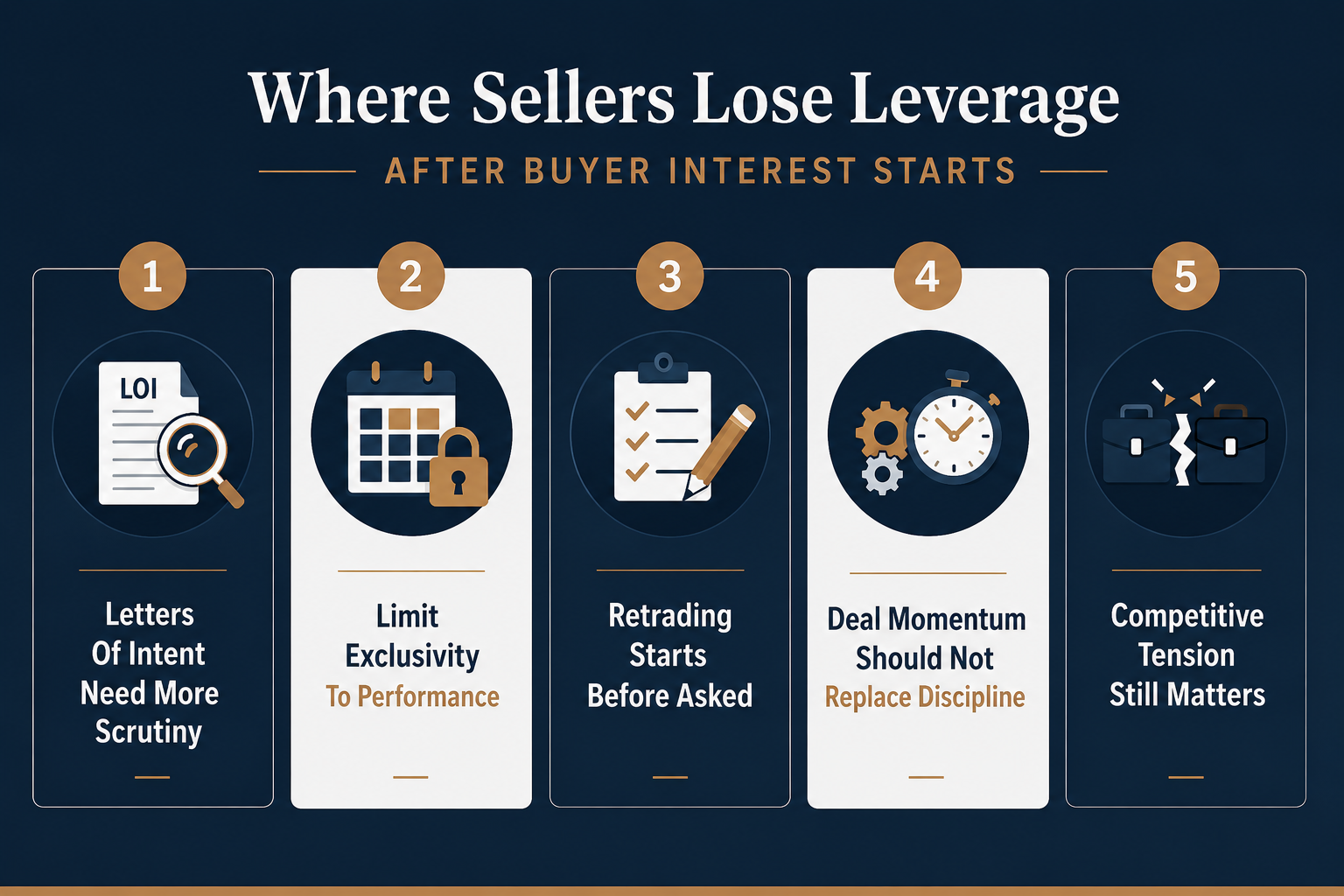
Where Sellers Lose Leverage After Buyer Interest Starts

Many owners assume the main risk in selling a business is failing to attract a serious buyer. A different problem often does more damage. Sellers lose leverage after a buyer is already engaged because the process becomes too loose, one buyer gets too much control too early, or key terms are accepted before the assumptions behind them are fully tested. That usually leads to repricing, longer timelines, weaker deal terms, or more post-sale risk for the seller. The issue is not buyer interest itself. The issue is losing process control once that interest appears.

Letters Of Intent Need More Scrutiny Than Most Sellers Give Them

A letter of intent is not final deal documentation, but it shapes the rest of the sale process. Many owners focus on the headline sale price and overlook the terms that will control diligence, exclusivity, financing flexibility, and the buyer’s room to renegotiate later. That is a mistake because a weak LOI can reduce leverage before the purchase agreement is even drafted.

The seller should review the full economic and process effects of the LOI. That includes exclusivity length, working capital assumptions, financing contingencies, seller financing language, training expectations, diligence scope, and any vague wording that allows the buyer to revisit major terms later. If those points are not defined carefully, the seller may spend weeks moving forward under terms that were never as firm as they first appeared.

Exclusivity Should Be Limited And Tied To Buyer Performance

Exclusivity is sometimes appropriate, but it should not be granted without structure. Once the seller agrees not to speak with other buyers, the buyer has more time and more control. If the exclusivity period is long and loosely defined, the buyer can slow the process, expand diligence, or revisit terms while the seller has fewer practical alternatives.

A better approach is to tie exclusivity to specific actions and deadlines. That can include lender engagement, delivery of diligence requests, management meetings, draft purchase agreement timing, and target dates for major decisions. If those steps are missed, the seller should have a clear basis to end exclusivity or reopen discussions with other qualified buyers. Without that discipline, exclusivity can become a one-sided concession.

Retrading Usually Starts Before The Buyer Asks For It

Retrading happens when the buyer returns after the LOI and asks for a lower price, a different structure, or more seller concessions. Some changes are based on legitimate diligence findings. Many are possible because the original assumptions were weak, incomplete, or poorly supported from the beginning.

Common causes include unsupported add-backs, unclear working capital targets, unresolved lease transfer issues, vague seller transition expectations, and customer concentration that was disclosed without enough context. Buyers have more room to change the deal when the original package leaves material issues open to interpretation. Sellers reduce that risk by defining the key assumptions early and supporting them with records, schedules, and clear deal language.

Deal Momentum Should Not Replace Process Discipline

Once a buyer is engaged, sellers often feel pressure to keep the transaction moving at any cost. That pressure can lead to rushed answers, poorly controlled disclosures, missed follow-up, and unnecessary concessions simply to avoid losing momentum. Those decisions usually weaken the seller’s position rather than protect it.

A disciplined process still needs structure after buyer interest begins. Document requests should be organized, deadlines should be tracked, material changes in terms should be compared to the original LOI, and buyer delays should be addressed directly. Progress matters, but it does not justify accepting weak process behavior that increases risk or reduces leverage.

Competitive Tension Still Matters After A Buyer Steps Forward

A seller does not need a broad auction process to preserve leverage, but the process should not become dependent on one buyer too early. If the buyer believes they are the only realistic option, they have more freedom to slow the timeline, press for concessions, or test whether the seller will accept weaker terms to keep the deal alive.

Competitive tension can be maintained without making the process disorderly. The seller can continue measured discussions with other qualified buyers until exclusivity is justified, avoid signaling emotional commitment to one outcome too early, and keep backup interest alive where appropriate. Buyers usually behave more carefully when they know the seller still has alternatives and is managing the process with discipline.

How Serious Buyers Evaluate A Business For Sale

Serious buyers usually focus on three issues early in the process. They want to know whether the earnings are credible, whether the business can transfer without major disruption, and whether the deal is feasible under the proposed structure. That explains why some businesses attract interest but lose momentum once the review becomes more detailed.


Financial Credibility

Buyers start by checking whether the earnings can be trusted. That means the financial statements should connect to tax filings, the add-backs should be documented, and the margin trends should make sense. They are not only reviewing revenue totals. They are evaluating whether the business generates dependable cash flow that supports the valuation and any financing the buyer may use.

This also affects the lender’s view of the deal. If the relationship between reported earnings and debt service is unclear, the buyer may face lower borrowing capacity or more closing friction. Even cash buyers often review the business with lender-style discipline because it gives them a clearer read on risk.

Transfer Risk

Transfer risk measures how much of the business will remain stable after the ownership change. A company with strong financials can still look risky if the owner controls the major relationships, the lease is hard to assign, or the key employees are not secured. Buyers are looking for continuity they can rely on after closing, rather than performance that depends too heavily on one individual.

Risk also increases when customer concentration is high, vendor terms are informal, or contracts require consent that has not been reviewed. The more clearly those issues are documented and managed before market, the easier it is for a prospective buyer to stay confident during due diligence.

Deal Feasibility

Deal feasibility brings valuation, buyer quality, financing, legal review, and transition planning into one practical question: Can this transaction close on workable terms? A deal becomes harder when one or more of those points were never tested early. Overpricing can break financing, weak records can slow diligence, and unclear seller expectations can reset negotiations.

Deals move more cleanly when both sides understand what is being bought, what support is expected after closing, and what structure the business can realistically sustain. That is why preparation matters. It removes preventable reasons for a buyer to reduce price, delay the process, or walk away.

Read Next: Business Sale Preparation Checklist — A 12-Point Plan to Prepare Your Business for Sale

A Better Sale Starts Before The Listing Goes Live

Most sales problems are easier to fix before a buyer starts asking for proof. If the pricing is grounded, the documentation is ready, the transfer issues are understood, and the buyer screening process is disciplined, the seller usually keeps more control over the outcome. Many business owners focus on finding a buyer first, but better results usually come from making the business easier to evaluate, easier to finance, and easier to transfer before outreach begins.

  • Valuation Discipline: Pressure-test your sale price against tax returns, current earnings, add-back support, owner dependence, and transferability issues so you do not anchor the process on a number the market will reject.
  • Diligence Preparation: Organize financial records, contracts, lease documents, payroll details, and legal files before outreach begins so buyers need fewer explanations and have fewer reasons to retrade.
  • Buyer Qualification: Decide what counts as a serious buyer, including liquidity, financing path, experience, and transition fit, before releasing sensitive information or accepting early momentum as progress.

Legacy Entrepreneurs works with Tennessee business owners who need a more grounded path through valuation, preparation, buyer screening, and closing decisions. 

Schedule a consultation to clarify sale readiness, reduce avoidable deal risk, and move forward with a process that can hold up under buyer and lender review.

Ready to sell your business but feeling overwhelmed? 


Frequently Asked Questions

How to avoid million-dollar mistakes when selling your business?

Start by testing whether your valuation, financials, transferability, and deal expectations can survive due diligence. Most major mistakes when selling a business come from unsupported price expectations, weak financial records, owner dependence, poor buyer screening, and late tax or legal planning. A disciplined process reduces those risks by preparing the records, contracts, and decision points buyers need to evaluate before negotiations deepen.

How long does it take to sell my business?

The process of selling a business often takes several months and sometimes longer, depending on valuation support, buyer quality, financing, diligence complexity, and transfer issues. A pending sale can slow down quickly if the lease needs consent, financial statements do not reconcile, or the buyer is not fully qualified. Clean documentation and realistic pricing usually improve timing more than aggressive marketing alone.

What should I do before I put my business up for sale?

Prepare three years of tax returns, monthly financial statements, a trailing twelve-month earnings view, add-back support, lease and contract summaries, payroll detail, and a clear picture of owner involvement. You should also review tax strategy, legal issues, buyer qualification standards, and your own post-sale goals before marketing the business for sale. That preparation helps protect value and reduces the chance of late surprises.

What is the best way to value a small business for sale?

The best approach is to build a valuation from verifiable earnings, realistic add-backs, transfer risk, customer concentration, owner dependence, and market evidence from comparable selling businesses where available. Buyers care less about what the owner feels the business should be worth and more about what cash flow, risk, and deal structure support. A valuation should produce a defensible range rather than a hopeful number.

Do I need a broker to sell my business?

Not every owner uses a broker, but many benefit from experienced business sale support because the process includes valuation framing, confidentiality control, buyer screening, negotiation, and diligence management. A broker or advisor can help reduce common mistakes, especially when the owner is still running day-to-day operations. The main question is whether you have the time, market knowledge, process discipline, and advisor support to manage the sale effectively on your own.

What are the tax consequences of selling a business?

Tax consequences depend on deal structure, purchase price allocation, entity type, depreciation recapture, capital gains treatment, installment terms, and state-level considerations. The sale price alone does not tell you what you will keep after closing. Early work with a tax advisor and legal counsel can improve the after-tax outcome and prevent a strong headline deal from producing a disappointing net result.

Selling Your Business in Tennessee: How to Know When the Timing Is Right

Selling Your Business in Tennessee: How to Know When the Timing Is Right

Selling a business in Tennessee starts with one hard decision: should you go to market now, or would waiting improve price, buyer interest, and deal...

Read More
How to Maintain Confidentiality When Selling a Business in TN

How to Maintain Confidentiality When Selling a Business in TN

Selling a business in Tennessee requires a controlled disclosure process from the start. You need to protect employee stability, customer...

Read More