



How to Sell a Restaurant in Tennessee: A Practical Guide for Owners
Selling a restaurant in Tennessee comes down to preparation. Buyers will look closely at your financials, lease terms, licenses, payroll, and...
15 min read
Joseph Steigman : Updated on March 26, 2026
The real decision is not whether you can list a business next month. It is whether your financials, valuation, lease terms, and transfer documents can hold up long enough to get from buyer interest to closing. Most delays happen after a business owner thinks the hard part is done, because a potential buyer, lender, landlord, or attorney starts asking for records that should have been prepared before the business ever went to market.
That timing pressure matters because many owners are counting on the proceeds from the sale to fund retirement, reduce burnout, or move into a different role. Gallup research found that 74% of small business owners with employees say they plan to sell or transfer ownership of their business when they retire, which makes timeline mistakes expensive, not just inconvenient.
This guide covers
P.S. Before you list a business for sale, it helps to know whether the valuation, financial statements, legal documents, and transfer terms will hold up once a buyer starts reviewing the acquisition.
At Legacy Entrepreneurs, we help Tennessee business owners prepare to sell a business through our business brokerage support and business valuation services built around readiness, pricing discipline, and buyer confidence.
Contact a broker today to identify timeline risks, document gaps, and transfer issues before they slow the sale of your business.
| Timeline Issue | What It Means For The Sale |
|---|---|
| Six Months Is Fast | Legacy Entrepreneurs treats six months as a fast result, not a baseline expectation, because even clean deals still need marketing prep, buyer sourcing, offers, diligence, and closing coordination. |
| Three Months Is The Minimum | A three-month sale is only possible if the business owner has financial statements, tax returns, legal documents, lease terms, and transfer issues fully organized on day one. |
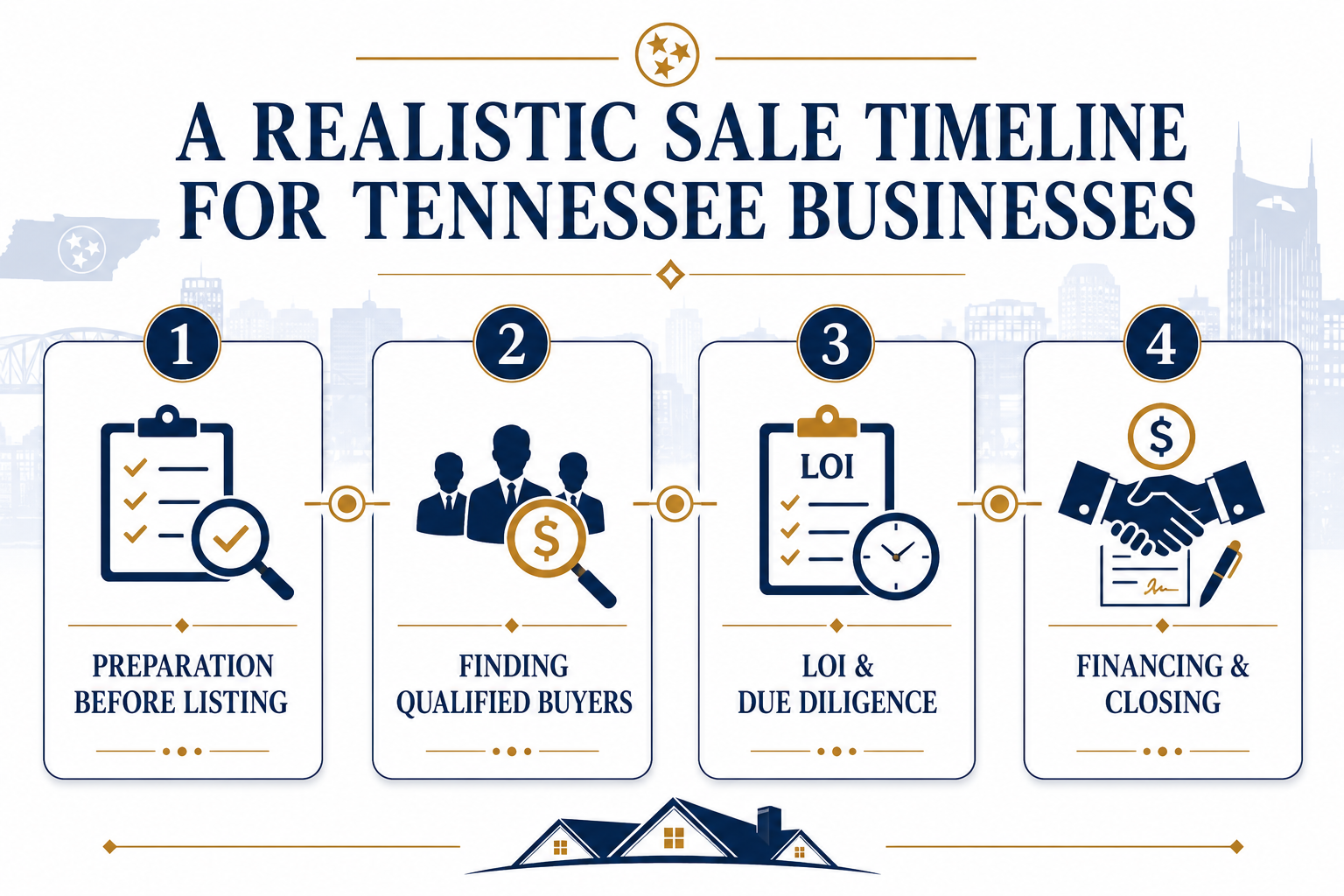
| Typical Working Sequence | A common path is about one month of marketing prep, around two months of sourcing buyers and allowing pre-LOI screening, and another month for diligence. |
| Why 12 Months Of Exclusivity Makes Sense | A business broker may ask for a year because buyer screening, failed diligence, lender underwriting, and re-marketing risk can easily push a deal beyond an optimistic early timeline. |
| Prep Can Start Long Before Market | Some businesses need one month of cleanup before marketing. Others may need a year or even several years to become ready to sell. |
| Diligence Can Reset The Process | If due diligence fails because the cash flow, contracts, tax records, or transfer rights do not hold up, the business may go back to market. |
| This Is Not Like Selling A House | A sale of a business transfers earnings, contracts, staff, licenses, systems, and legal obligations, so an accepted offer does not mean the buyer can actually close. |
| The Best Way To Speed Up The Process | Prepare valuation support, tax returns, financials, lease documents, and legal documents early so qualified buyers can move without losing confidence. |
The answer depends on the type of business, the size of the business, the quality of the financials, and how ready the business owner is before the sales process starts. Many business owners think the time to sell a business begins when the listing goes live. In practice, the time it takes to sell often starts earlier, with valuation work, legal cleanup, lease review, and document preparation that determine whether a buyer can move from interest to signed agreement.
Legacy Entrepreneurs’ position is clear: six months is fast. That is why a broker may ask for 12 months of exclusivity even when the owner wants to move quickly. The reason is practical. Even a clean process usually requires one month of marketing prep, at least one month to find buyers and get offers, and at least one month of due diligence, which means three months is the minimum if everything is ready on day one. A more common path is one month of prep, two months of sourcing buyers and letting them complete pre-LOI screening, and another month of diligence. If diligence fails, the business goes back to market.
The fastest version of a business sale is not the normal one. A buyer still has to be found, screened, and moved through confidentiality controls before serious offers appear. Then the buyer has to verify the numbers, contracts, and legal transfer rights. That is why the time it takes to sell is controlled by stages, not by a single headline number.
| Sale Stage | Typical Timing Logic | What Must Happen | What Delay Usually Looks Like |
|---|---|---|---|
| Pre-Market Preparation | Can be one month in a cleaner small business, or much longer if records need cleanup | Build financial statements, organize tax returns, review legal documents, lease terms, and confidential information packages | The business is not ready to sell, even if the owner wants to list quickly |
| Marketing Prep | Often, about one month | Finalize valuation support, sale price logic, buyer materials, confidentiality process, and outreach plan | Weak financials, missing legal documents, unclear cash flow story |
| Buyer Sourcing And Offers | Sometimes one month in the best case, often closer to two months | Reach qualified buyers, control confidentiality, screen interested parties, and let prospective buyers complete pre-LOI screening | Too many casual inquiries, too few qualified buyers, unrealistic asking price |
| Due Diligence | At least about one month in cleaner deals | Buyer verifies financial statements, tax returns, contracts, licenses, lease rights, and operating claims | Numbers do not reconcile, legal documents are incomplete, and transfer rights are weak |
| Financing And Closing Coordination | May overlap with diligence, but often extends beyond it | Finalize purchase agreement, lender underwriting, landlord consent, assignment documents, and closing conditions | SBA delays, purchase agreement revisions, and landlord approval issues |
| Back To Market Risk | Adds another cycle | Relaunch buyer outreach after failed diligence or failed financing | Buyer confidence drops, timeline restarts, new buyers ask harder questions |

A professional business sale starts with records, not marketing. A business broker can help organize the process, but the seller still needs to produce the evidence that supports value and transferability. Without that, the time to sell stretches before a buyer even appears.
Legacy Entrepreneurs believes it can even take three years of preparation to start selling, even if many businesses only need about one month of prep. That prep period is part of the real timeline. If the business owner skips it and rushes to market, the likely result is a weaker valuation, a slower buyer process, or failed diligence after a buyer is already under agreement.
Many business owners make the mistake of assuming prep is optional if they want to sell quickly. In reality, that prep work is part of the time it takes. Skipping it often adds more delay later, when a potential buyer has already started asking harder questions.
Finding a buyer is not the same as finding the right buyer. Most inquiries do not come from qualified buyers. They come from interested parties who are curious, undercapitalized, inexperienced, or not ready for the acquisition process.
It can take one month to find buyers and get offers, but it's only possible in a cleaner, faster process. However, many deals take closer to two months because buyers need time for pre-LOI screening.
A business brokerage process should protect confidentiality from day one. Employees, customers, and suppliers should not learn that the business is for sale from a loose conversation or broad ad copy. The broker needs a confidentiality agreement, screening steps, and a way to separate casual inquiries from buyers who can actually review confidential information responsibly.
A broker also needs to assess whether the potential buyer has funds, lender access, industry fit, and enough operational understanding to run the business after closing.
The Tennessee market affects this stage, too. Some local business opportunities attract first-time buyers, strategic acquirers, or private equity interest because the cash flow is stable and the transfer is straightforward. Others tend to sell more slowly because the type of business is specialized, regulated, seasonal, or too dependent on one owner. That is one reason business owners think exposure alone will solve the timeline. It will not. The quality of the buyer pool matters far more than the volume of attention.
Many business owners get excited when they receive an LOI, but the time for the buyer often becomes more demanding after exclusivity begins. The LOI is not the purchase agreement. It is the starting point for deeper verification.
This is where the length of time it takes to sell a business becomes a live issue rather than a planning estimate. Diligence and financing are the stages that prove whether the business can support the original deal. If the evidence is weak, the purchase price drops, the buyer asks for better terms, or the transaction dies.
A signed LOI does not mean the sale of your business is secure. Diligence can fail, financing can fail, and legal transfer issues can derail a deal after weeks of work. When that happens, the business goes back to market, and the timeline resets.
Financial credibility is the most common reason. The buyer may discover that internal books do not match tax returns, that margins are weaker than expected, or that personal expenses were mixed into the business without support. The same problem appears when cash flow depends on the owner more than the marketing materials suggest. A buyer who cannot trust the numbers will either renegotiate the purchase price or leave.
Transferability failures are just as serious. A landlord may not approve an assignment. A supplier may not continue the terms. A license may require a new application rather than a simple transfer. A contract may contain change-of-control restrictions. If those issues were ignored early, the business selling process becomes slower, more expensive, and less credible with the next round of buyers.
That is why many business owners should plan around the possibility that one diligence cycle may not close. This is not a house transaction. A sale of a business involves earnings verification, legal rights, tax exposure, operational continuity, and post-closing risk that the buyer has to evaluate in detail.
A faster transaction usually means fewer unknowns. It does not mean the broker got lucky. It means the business was easier to understand, easier to finance, and easier to transfer.
Longer transactions usually show the same problems. These are the issues that make a small business harder to sell, reduce buyer confidence, and increase the average time to sell.
Read Next: Top 3 Reasons Business Owners Leave Money on the Table When Selling Their Business
Tennessee-specific legal, tax, and licensing issues can slow a sale even when the buyer is serious, and the price is already negotiated. Buyers, lenders, and counsel often need to confirm that the business is in good standing, that required tax accounts and filings are current, and that any required licenses or permits can remain in place or be updated after closing.
These issues matter because owners often assume delays come from the market or from financing alone. In practice, timing problems often come from internal cleanup items such as missing authority documents, unresolved tax registrations, or approvals tied to the current owner, entity, or location.
In Tennessee, the right review usually depends on the company’s structure and industry. A restaurant, contractor, or other regulated business may face a different transfer process than a standard service company, which is why these issues should be reviewed before the business is listed.

Before you sell your business, the entity should show clear authority to complete the transaction. For an LLC or corporation, buyers and counsel will typically want to review governing documents, ownership records, and approval authority, and they may also check the company’s Tennessee business record and good-standing status.
This matters because ownership disputes, outdated records, or missing approvals can delay drafting and signing even after the business terms are settled. The legal structure also affects the deal itself, since many small business transactions are structured as asset sales, which means the parties need to identify exactly which assets, contracts, permits, and liabilities will or will not move at closing. This transaction-structure point is common deal practice rather than a Tennessee-only rule, so it is safest to present it that way.
Tax cleanup often decides whether diligence moves cleanly or drags.
They play a direct role in buyer diligence, lender review, and overall closing preparation because they help confirm how the business has been reporting income, handling tax obligations, and maintaining compliance over time. In Tennessee, they also matter at the end of the process, since businesses that close or cease operations may need to submit final state filings and resolve open tax accounts before the transaction is fully wrapped up.
License transferability can change the whole timeline. Some approvals move with the entity, some require notice, and some require a new application before the buyer can fully operate. That affects both the time to sell and the buyer’s willingness to sign an agreement at the expected value.
| License or Permit Issue | What Should Be Verified and Why It Matters |
|---|---|
| Local Business License | Confirm whether the business tax registration and local license information are current and whether a new license or account update will be required after closing. Tennessee says business tax registration is handled through the Department of Revenue, with local clerk involvement for the license fee, and some business licenses cannot be transferred across jurisdictions. |
| Health Department Permits | For food-service businesses, confirm whether the buyer will need a new permit, filing, inspection, or other approval. Tennessee’s health and agriculture agencies both note permitting and review requirements for regulated food operations, including cases involving a business under new ownership or acquisition of an existing retail food establishment. |
| Alcohol-Related Licensing | Tennessee alcohol licensing can require separate state-level approval, and the buyer may need its own application or approval before lawful operation. This can materially affect the timing for restaurants, bars, and package-store transactions. |
| Contractor Or Trade Licensing | Check whether the license is tied to the current entity, ownership structure, or qualifying agent. Tennessee contractor guidance states that a license is not transferable to another entity, and qualifying-agent or ownership changes may trigger notice, revision, or a new application. |
| Other Industry Permits | Regulated businesses should verify early whether their permits stay with the location, the entity, or the current owner, and whether notice, amendment, or a fresh application is required. Tennessee’s licenses-and-permits guidance makes clear that requirements vary by agency and industry. |
A buyer is not just buying assets. They are buying continuity of operations, rights to occupy the location, customer relationships, and supplier access, so any consent or assignment issue can lengthen the sale process. This is not uniquely Tennessee-specific, but it is still one of the most common reasons a deal slows down late in the process.
Read Next: The Ultimate Guide to Choosing a Business Broker in Tennessee
You cannot control the buyer's decision, but there are steps you can take to reduce avoidable delay. The goal is not to force a rushed deal. The goal is to make the business easier to evaluate, finance, and transfer.

Read Next: Bad Bookkeeping Kills Deals — Focus on These 4 Fixes
Owners who want to sell quickly often focus on the first buyer conversation. The stronger approach is to focus on what will still hold up thirty or sixty days later, when the business is under agreement, and every assumption is being tested. That is where the real time it takes to sell is decided.
That is why a disciplined sales process matters more than a short estimate.
At Legacy Entrepreneurs, we work with Tennessee business owners considering selling their business but need a clearer path. We focus on helping business owners get realistic on value, prepare confidential information for qualified buyers, and address transfer risks before due diligence starts.
Contact a broker today to clarify your sale timeline, reduce avoidable deal risk, and move toward a cleaner, more defensible process.
The average time to sell a small business is often several months, with many deals landing in the six to twelve-month range once active preparation, buyer sourcing, due diligence, and closing are included. A clean, well-priced business can move faster. A business with weak financials, lease issues, or financing challenges will often take longer.
Due diligence often takes four to eight weeks in a small business transaction, but it can take longer if the buyer is using lender financing or if the records are incomplete. The buyer and advisors will review financial statements, tax returns, contracts, legal documents, and operating details to verify that the business can support the proposed purchase price.
It is usually time to sell when your goals, financial performance, and transferability are aligned. If the business can run with less owner involvement, the financials are organized, and the valuation is grounded in real cash flow, you are in a stronger position to go to market.
Sales alone do not determine value. Buyers look at cash flow, margins, owner dependence, growth potential, legal and compliance risk, and how easily the business can transfer. Two companies with the same revenue can have very different values if one is easier to operate, verify, and finance.
The first step is to determine whether the business is actually ready to sell. That means reviewing valuation, financials, legal documents, lease terms, tax returns, and transfer issues before marketing begins. Without that groundwork, the sales process often becomes slower and more fragile.
You do not have to use a business broker, but many sellers do because the process involves confidentiality, buyer screening, valuation positioning, due diligence coordination, and agreement management. A broker can help protect the process from unqualified buyers and reduce avoidable delays.
Selling a restaurant in Tennessee comes down to preparation. Buyers will look closely at your financials, lease terms, licenses, payroll, and...
Selling a roofing company in Tennessee requires clean financials, transferable operations, and a sale process that can stand up to buyer and lender...
The real decision is not whether you can list a business next month. It is whether your financials, valuation, lease terms, and transfer documents...