


10 min read

Building a Succession Plan to Protect Your Family Business in Tennessee

Written by Updated July 21, 2026
Picture of Joseph Steigman
Joseph Steigman

Joe Steigman is the Founder of Legacy Entrepreneurs, a boutique business brokerage and exit advisory firm focused on helping business owners maximize value and transition their companies with confidence. With a background that combines operational leadership, corporate consulting, finance, and entrepreneurship, Joe brings a practical, owner-focused perspective to business sales and acquisitions. Joe is a Certified Business Intermediary (CBI), a designation awarded by the International Business B...

Building a Succession Plan to Protect Your Family Business in Tennessee

Building a succession plan gives Tennessee family business owners a structured way to transfer leadership and ownership without putting the company at unnecessary risk. Whether the business stays in the family, is sold to employees, or is acquired by a third-party buyer, planning helps protect business value, reduce disruption, and give everyone involved a clearer understanding of what comes next.

A successful transition requires more than selecting a successor. Owners also need to prepare the business itself by developing future leaders, documenting key processes, reviewing ownership and estate planning documents, and reducing day-to-day dependence on a single individual. These steps often take years to complete, which is why succession planning works best when it begins well before retirement is on the horizon.

According to PwC's 2025 Global Family Business Survey, 78% of family business leaders say safeguarding the business is a long-term priority, while 77% say preserving the family's legacy is equally important. Those priorities reflect a common reality: business owners want the company they've built to continue creating value long after they step away.

💡 TL;DR: What a Successful Transition Requires

  • Start planning years, not months, in advance. Most succession strategies require time to develop future leaders, strengthen operations, and address legal, financial, and tax considerations before ownership changes hands.

  • Choose the succession path that fits your goals. Passing the business to family is one option, but management buyouts, employee ownership, and third-party sales may provide a better outcome depending on your financial objectives and your successor's readiness.

  • Prepare the business for life after the owner. Buyers, lenders, and future leaders want to see documented processes, capable management, stable financial performance, and a business that can operate without relying on one individual.

  • Treat business valuation as part of the planning process. Understanding what drives value helps owners prioritize improvements before transferring ownership or beginning sale discussions.

  • Address family, legal, and financial issues together. A comprehensive succession plan should align business strategy with estate planning, ownership agreements, tax planning, and family expectations to reduce future disputes.

  • Keep your options open. Even if your goal is to transition the business to the next generation, building a transferable business gives you greater flexibility if circumstances or family priorities change.

  • Work with experienced advisors early. Attorneys, CPAs, valuation professionals, and exit planning advisors each play a role in helping business owners make informed succession decisions and avoid costly mistakes.

What a Succession Plan Should Accomplish

A succession plan is more than a document that names the next owner. It establishes how leadership, ownership, and decision-making will transition while keeping the business operating with as little disruption as possible.

For many family-owned businesses, the planning process begins years before anyone retires. Future leaders need time to gain experience, ownership structures may need to be updated, and important customer relationships often need to be transferred gradually. Waiting until retirement is around the corner leaves far fewer options.

A well-prepared business is also easier to finance, easier to manage, and easier to transfer, whether ownership stays within the family or eventually passes to an outside buyer. The work you do before the transition often has a greater impact than the transition itself.

Is Your Business Ready for a Leadership Transition?

The following framework highlights areas that often separate a smooth transition from a difficult one.

Area Business Is Ready Needs Attention
Leadership A successor has been identified and is actively leading key responsibilities. Leadership depends almost entirely on the current owner.
Operations Processes are documented, and employees understand their roles. Important knowledge exists only in the owner's head.
Ownership Estate planning documents, operating agreements, and ownership records are current. Ownership or legal documents have not been reviewed in years.
Customer Relationships Key customers know and trust multiple leaders within the business. Customers rely primarily on the owner's personal relationships.
Financial Management Financial records support long-term planning and business valuation. Records are incomplete or maintained primarily for tax purposes.

This framework isn't intended as a pass-or-fail test. Instead, it highlights the areas that deserve attention before ownership changes hands. Addressing these issues early gives business owners more flexibility and often leads to a smoother transition for employees, customers, family members, and future owners.

Read Next: Exit Planning for Tennessee Business Owners

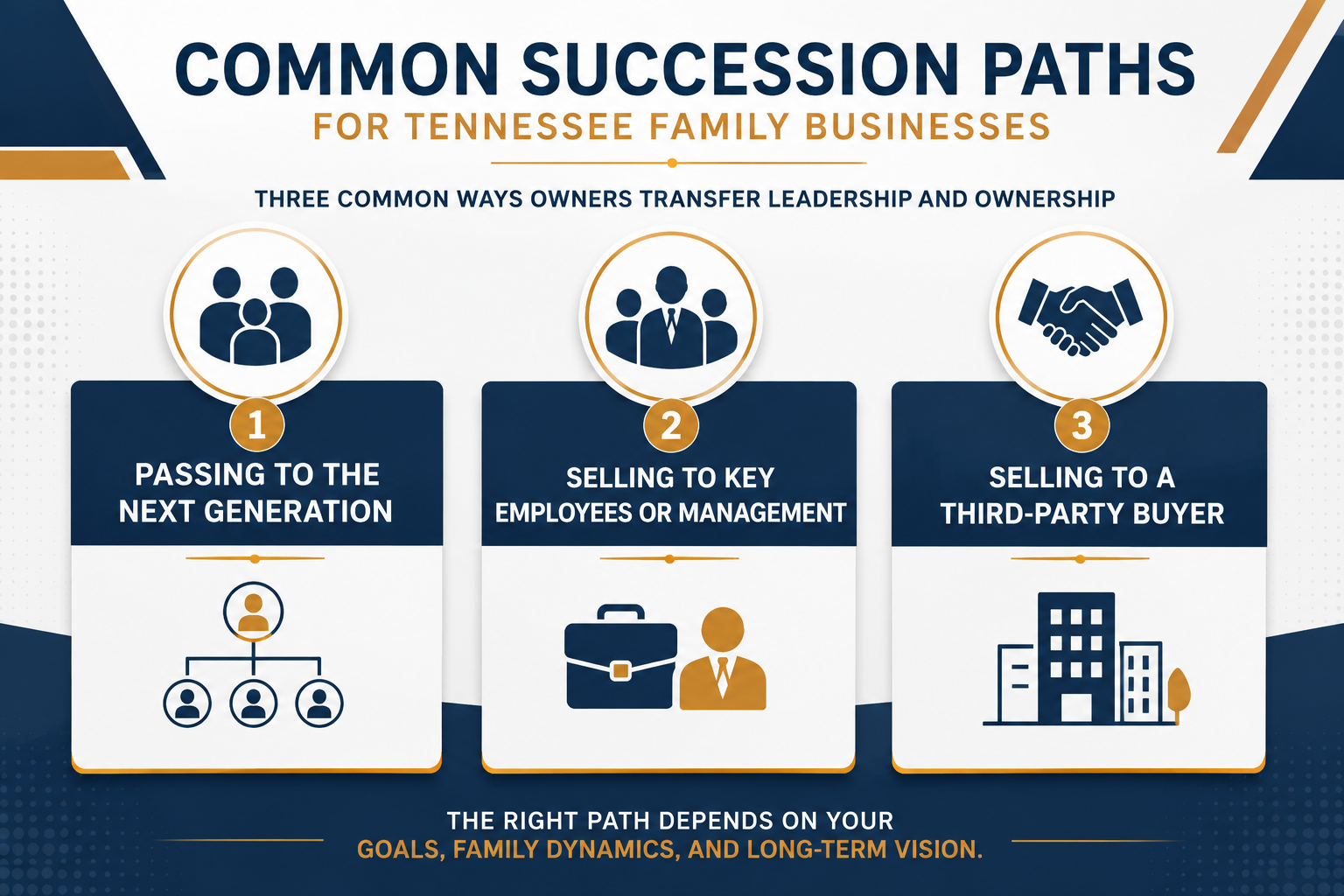
Common Succession Paths for Tennessee Family Businesses

Every family business has different goals, financial needs, and family dynamics. While many owners hope to keep the business in the family, that isn't always the best or most practical solution. The right succession strategy depends on whether a capable successor is available, how involved the family wants to remain, and the owner's long-term financial objectives.

The following are the most common succession paths for family-owned businesses.

1. Passing the Business to the Next Generation

For many families, transferring ownership to children or other relatives is the preferred outcome. This approach can preserve the family's legacy while allowing the business to continue under familiar leadership.

Success depends on preparation rather than family relationships alone. Future leaders need operational experience, management responsibility, and the confidence of employees, customers, and lenders before ownership changes hands. Many family businesses achieve a smoother transition by gradually transferring responsibilities over several years instead of making a sudden leadership change.

2. Selling to Key Employees or Management

A management buyout allows owners to transfer the business to people who already understand its operations, culture, and customers. Because the leadership team is familiar with the business, employees and customers often experience less disruption during the transition.

These transactions typically require thoughtful financial planning, particularly when employees need outside financing, or the owner agrees to a phased purchase over time.

3. Selling to a Third-Party Buyer

When there isn't a suitable family successor or internal buyer, selling to an outside buyer may provide the strongest financial outcome. Strategic buyers, private investors, and entrepreneurs often seek established businesses with experienced employees, recurring revenue, and opportunities for future growth.

Preparing the business well before selling a business in Tennessee can improve both buyer confidence and business value. Many of the changes that support a successful succession, such as strengthening management, documenting processes, and reducing owner dependence, also make the business more attractive in the marketplace.

Comparing the Most Common Succession Paths

Succession Path Best For Key Considerations
Family Transfer Businesses with a qualified family member who is interested in leading the company. Requires early leadership development, family alignment, and clear ownership planning.
Management or Employee Buyout Businesses with an experienced leadership team that wants to become owners. Often requires financing, phased ownership transfers, or seller support.
Third-Party Sale Owners who want maximum flexibility or the highest potential financial return. Buyers typically expect strong financial records, documented operations, and limited owner dependence.

Choosing a succession path is only one part of the planning process. Once you've identified the direction that best aligns with your goals, the next step is preparing the business for a successful transition. That includes developing future leaders, reducing owner dependence, organizing financial records, and addressing legal and tax considerations well before ownership changes hands.

Read More: Types of Business Buyers in Nashville: Buyer Spotlight with Colin Price

Preparing Your Family Business for a Smooth Transition

Choosing a succession path is only the beginning. Whether ownership stays within the family, transfers to employees, or is sold to an outside buyer, the business needs to be prepared for the change. Many of the challenges that arise during a transition, such as leadership uncertainty, operational disruptions, or disagreements over value, can often be traced back to inadequate preparation.

Starting early gives business owners time to strengthen the company, prepare future leaders, and resolve issues before they become obstacles. The following areas deserve attention long before ownership changes hands.

Develop the Next Generation of Leaders

Preparing a successor takes time. Even someone who has worked in the business for years may need additional experience managing employees, making financial decisions, negotiating with customers, or leading through challenges. Gradually expanding these responsibilities allows future leaders to gain confidence while the current owner is still available to provide guidance.

Leadership development also helps employees and customers adjust to the transition. When key stakeholders see the successor actively leading the business before ownership changes, the transition often feels more natural and creates less uncertainty.

Build a Business That Doesn't Depend on One Person

Many family businesses are built around the owner's knowledge, relationships, and decision-making. While that approach may have contributed to the company's success, it can also become one of the biggest barriers to a smooth transition.

Reducing owner dependence means documenting critical processes, delegating responsibilities, and ensuring that key relationships are shared across the leadership team instead of resting with one individual. The goal isn't to remove the owner from the business overnight. It's to create a company that can continue operating effectively when the owner steps away for a vacation, an extended absence, or retirement.

For some owners, reducing day-to-day dependence may involve developing an internal leader or receiving help to hire a general manager who can take responsibility for operations. This level of operational independence benefits every succession path. Family successors inherit a more stable business, management teams can assume greater responsibility with confidence, and outside buyers often view the company as a lower-risk investment.

Read Next: How to Hire a General Manager: Step-by-Step Guide for Small Business Owners

Organize Financial, Legal, and Ownership Records

Succession planning relies on accurate information. Financial statements, ownership records, shareholder agreements, operating agreements, contracts, and estate planning documents all influence how a transition will be structured.

Reviewing these records early provides time to update outdated agreements, correct inconsistencies, and identify legal or tax issues before they delay the succession process. It also makes conversations with attorneys, accountants, lenders, and potential buyers more productive because decisions are based on complete and reliable information.

Read Next: Asset Sale vs. Stock Sale: Why the Structure Matters as Much as the Price

Understand What Drives Business Value

Many owners don't think about valuation until they're ready to retire or sell. In reality, understanding what the business is worth and why it's valuable throughout the succession planning process.

A professional business valuation provides an objective assessment of the company's value while identifying the factors that influence it. That information can support estate planning, help establish a fair purchase price for a family or management buyout, and highlight opportunities to strengthen the business before ownership changes.

More importantly, valuation shifts the conversation from assumptions to data. Instead of estimating the business's value, owners can make succession decisions based on objective financial analysis.

Read More: Business Valuation Multiples Tennessee Owners Should Understand

Know What Your Business Is Worth Before You Plan Your Transition


Bring the Right Advisors into the Conversation

Succession planning often requires input from attorneys, CPAs, valuation professionals, estate planning attorneys, financial advisors, and business brokers. Each advisor brings a different area of expertise, but their recommendations need to work together. A tax strategy, for example, may affect how ownership is transferred, while a business valuation can influence estate planning and buyout terms.

Legacy ETA works alongside your existing advisors to help coordinate these conversations. Rather than replacing your legal or financial team, Legacy ETA helps connect the different parts of the planning process so your succession strategy supports your business goals, family priorities, and financial objectives.

Starting these discussions early gives you more time to evaluate your options, address potential issues, and move forward with a plan that fits your timeline instead of reacting to unexpected events.

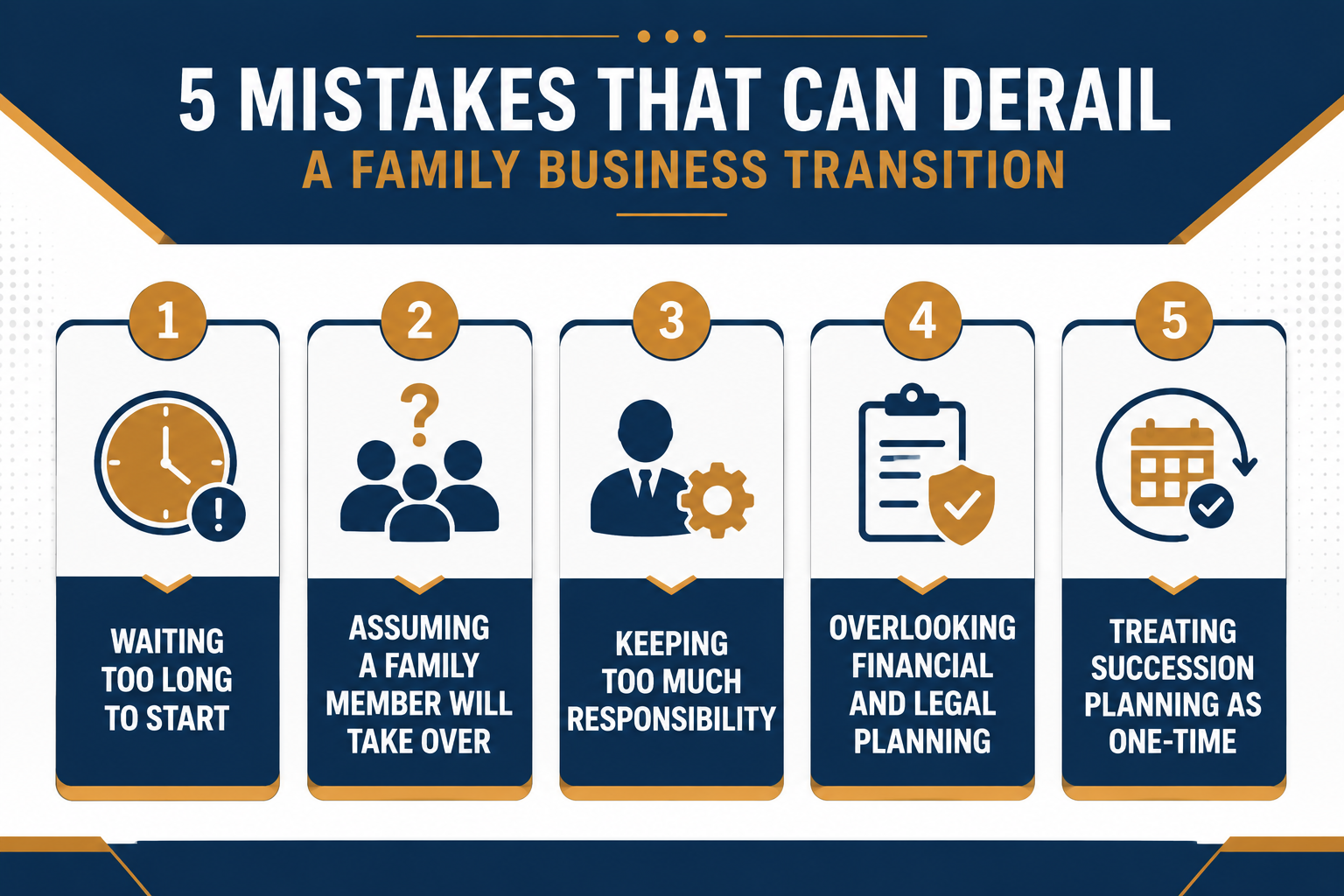
5 Mistakes That Can Derail a Family Business Transition

Even businesses with a clear succession goal can run into problems when planning is delayed or important decisions are left unresolved. Many of these issues develop gradually, making them easier to prevent than to fix.

  1. Waiting too long to start. Succession planning often takes several years to complete. Developing future leaders, updating legal documents, improving operations, and preparing the business for a transfer all require time. Owners who delay planning may have fewer options if retirement plans change or an unexpected event accelerates the transition.

  2. Assuming a family member will take over. Many owners expect the next generation to continue the business, but that assumption isn't always shared by their children or other relatives. Some family members may have different career goals, while others may not be interested in ownership. Open conversations early in the planning process help avoid misunderstandings later.

  3. Keeping too much responsibility. When one person approves every major decision, manages key customer relationships, and holds most of the operational knowledge, the business becomes harder to transition. Delegating responsibilities and documenting important processes gives future leaders time to gain experience while reducing disruption for employees and customers.

  4. Overlooking financial and legal planning. Ownership transfers affect taxes, estate plans, shareholder agreements, financing arrangements, and other legal obligations. Reviewing these areas early provides more flexibility and reduces the likelihood of delays or unexpected costs during the transition.

  5. Treating succession planning as a one-time project. A succession plan should be reviewed as the business evolves. Growth, changes in family circumstances, new leadership responsibilities, or shifting ownership goals may all require updates over time.

Is Your Succession Plan on Track?

Use these questions as a quick check of your current succession planning efforts. If you answer "No" or "Not Sure" to several of them, your business may benefit from additional planning before a transition becomes necessary.

Readiness Check Why It Matters
If I stepped away for six months, could the business continue operating effectively? Measures how dependent the business is on the current owner.
Does my successor have the experience and authority to lead today? Identifies whether leadership development should begin before ownership changes hands.
Are our ownership, estate planning, and legal documents up to date? Helps prevent delays, disputes, and unintended consequences during the transition.
Would employees, customers, and lenders feel confident during a leadership change? Strong stakeholder confidence helps maintain business continuity throughout the transition.
Do I have a recent business valuation? Provides a realistic foundation for succession planning, tax planning, and future ownership decisions.
Have I considered alternatives if family succession isn't the best option? Keeps more transition paths available if circumstances or family priorities change.

Start Planning Before You Need to Transition

The strongest succession plans are built over time. Owners who begin planning early have more flexibility to prepare future leaders, strengthen the business, and evaluate different transition options before important decisions become urgent.

Whether your goal is to pass the business to the next generation, transition ownership to employees, or prepare for a future sale, the planning process is largely the same. Build a business that can succeed without depending on one person, keep your financial and legal records current, and make decisions based on realistic information rather than assumptions.

Every business owner's situation is different. Family dynamics, financial goals, tax considerations, and long-term plans all influence the right succession strategy. Taking the time to evaluate those factors now can help reduce uncertainty and make future transitions more predictable for your family, employees, and customers.

Planning Your Exit Strategy?

A successful ownership transition doesn't happen by chance. It starts with a clear understanding of your goals, the current value of your business, and the steps needed to prepare for the future.

Legacy ETA works with Tennessee business owners to develop practical succession and exit planning strategies. Whether you're beginning the conversation or refining an existing plan, our team can help you evaluate your options, identify opportunities to strengthen your business, and coordinate with your professional advisors throughout the planning process.

Ready to start planning your next chapter? Schedule a confidential consultation to discuss your succession goals and explore the path that best fits your business.

Ready to Build a Succession Plan That Fits Your Goals?


Frequently Asked Questions

When should family business succession planning begin?

The best time to begin family business succession planning is several years before you expect to transfer ownership or retire. A longer planning horizon gives you time to identify and develop potential successors, strengthen business operations, review your estate plan, and address tax and legal considerations before they become urgent. Starting early also provides more flexibility if your preferred succession path changes.

What legal documents are needed for business succession planning?

The required documents depend on your business structure and succession goals, but most business owners should review their operating agreement, shareholder agreement, buy-sell agreement, estate planning documents, and any records related to ownership interests or voting rights. Working with qualified legal and financial advisors helps ensure these documents support your overall business succession planning strategy and reduce the risk of future legal disputes.

How can I reduce family conflict during the succession planning process?

Many succession challenges stem from unclear expectations rather than the transfer itself. Discussing leadership responsibilities, ownership plans, compensation, and long-term goals early can help keep business and family discussions productive. Some larger family-owned businesses also use family councils or regular planning meetings to encourage communication throughout the succession planning process and preserve family harmony.

What if no family member wants to take over the business?

Not every family-owned business has a successor within the family, and that's okay. Many owners choose to sell to a management team, an outside buyer, or, in some cases, establish an Employee Stock Ownership Plan (ESOP). Evaluating these options early helps owners prepare for a smooth succession while protecting the long-term value of the business.

How do taxes affect the transfer of ownership?

The transfer of ownership can have significant tax consequences depending on how the business is structured and whether ownership is transferred through a sale, gift, or inheritance. Factors such as estate taxes, capital gains, business structure (including S-corporations and PLLCs), and succession timing can all influence the outcome. Because every situation is different, business owners should seek professional tax and legal advice before finalizing a succession plan.

Read More: How to Save Taxes When Selling a Business—Most Owners Get This Wrong

Due Diligence Checklist for Sellers: How to Prepare Your Business for Buyers

Due Diligence Checklist for Sellers: How to Prepare Your Business for Buyers

A due diligence checklist for sellers identifies the financial, legal, tax, and operational records a buyer will examine before purchasing a...

Read More
5 Things That Actually Drive Your Roofing Company's Sale Price (and 3 That Don't)

5 Things That Actually Drive Your Roofing Company's Sale Price (and 3 That Don't)

Your roofing company's sale price comes down to one question a buyer is always asking: how much money will this business make me, and how confident...

Read More
What Is SDE? The Number Buyers Actually Use to Price Your Small Business

What Is SDE? The Number Buyers Actually Use to Price Your Small Business

SDE stands for Seller's Discretionary Earnings. It is the total financial benefit a single owner-operator receives from a business in a year. It...

Read More