


Business Appraisal vs. Broker Valuation: Which One is Right for You?
If you're trying to determine what your business is worth, the right choice between a business appraisal and a broker valuation depends on why you...
12 min read
Joe Steigman is the Founder of Legacy Entrepreneurs, a boutique business brokerage and exit advisory firm focused on helping business owners maximize value and transition their companies with confidence. With a background that combines operational leadership, corporate consulting, finance, and entrepreneurship, Joe brings a practical, owner-focused perspective to business sales and acquisitions. Joe is a Certified Business Intermediary (CBI), a designation awarded by the International Business B...
Joseph Steigman
August 13, 2026
If you're trying to determine what your business is worth, the right choice between a business appraisal and a broker valuation depends on why you need the valuation. A business appraisal is generally used for legal, tax, estate, or other formal matters that require an independent, well-supported conclusion. A broker valuation is typically used to estimate what a business could sell for in the current market. Understanding that distinction helps you choose the right approach before making an important business decision.
Using the wrong type of valuation can create unnecessary problems. An appraisal prepared for estate planning may not help you establish a realistic asking price, while a broker's opinion of value may not satisfy a lender, court, or tax authority. Before hiring an appraiser or business broker, it's worth identifying the purpose the valuation needs to serve.
That distinction becomes even more important because many owners still don't know what their business is worth. According to the BizBuySell Q2 2026 Insight Report, 52% of business owners say they have an exit plan, but only 14% have completed a professional valuation. Half rely on only a rough estimate of value, while 35% have no estimate at all. Whether you're preparing for a future sale, succession, or another ownership transition, understanding which valuation fits your situation is an important first step.
Start with your goal: The right valuation depends on the decision you're making, not just the terminology.
Business appraisal: Best for estate planning, tax matters, litigation, shareholder disputes, and other situations requiring a formal, defensible valuation.
Broker valuation: Best for estimating market value and developing an asking price before selling a business.
Professional business valuation: Ideal for owners who want to understand business value, improve sale readiness, or plan an eventual exit.
Different purpose, different outcome: Appraisals and broker valuations may analyze similar information, but they differ in methodology, reporting, and intended use.
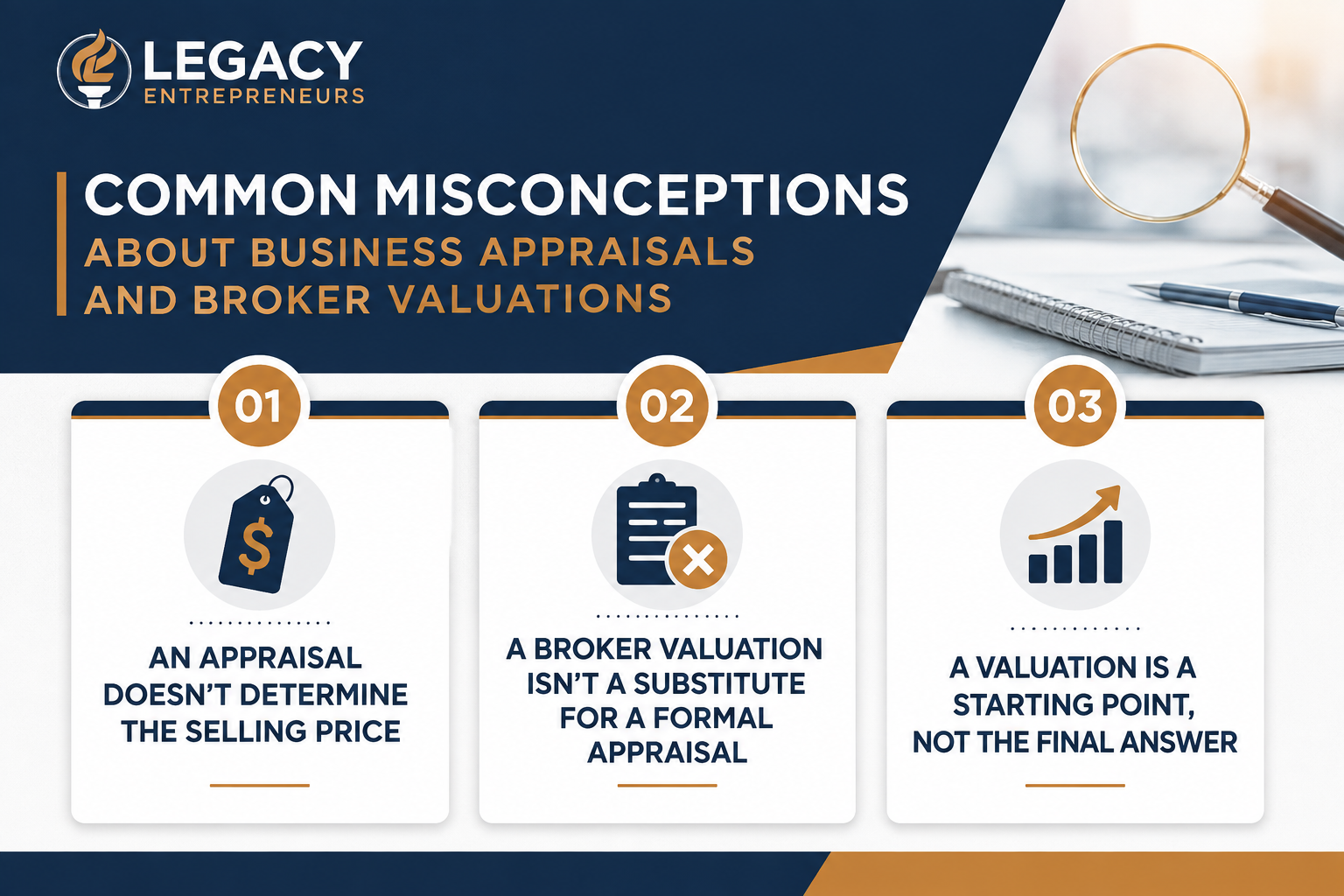
Selling price is determined by the market: Buyer demand, negotiations, due diligence, and deal structure ultimately determine what a business sells for.
A business appraisal is a formal determination of a company's value prepared for a specific purpose. It is commonly used when an independent, well-supported conclusion of value is needed for legal, financial, or tax-related matters. Examples include estate planning, shareholder disputes, divorce proceedings, gift tax reporting, and certain financing or litigation situations.
Unlike a valuation prepared primarily to support the sale of a business, a business appraisal follows established appraisal methodologies and documents how the conclusion was reached. The report explains the financial analysis, assumptions, valuation methods, and standard of value used so that other parties like attorneys, accountants, lenders, or tax authorities can understand and evaluate the appraiser's reasoning.
Although every engagement differs, the overall process follows a structured methodology. A business appraiser begins by reviewing the company's financial statements, operating history, and supporting records to understand its financial performance and risk profile. Earnings are often normalized by adjusting discretionary or non-recurring expenses so the analysis better reflects the business's ongoing earning capacity.
From there, the appraiser evaluates the business using one or more recognized valuation methods, such as the income, market, or asset approach. The appropriate method depends on the nature of the business, the available information, and the purpose of the appraisal. The findings are then documented in a formal appraisal report that explains the methodology, assumptions, and final conclusion of value.
Read More: EBITDA Explained: What Small Business Owners Need to Know
A business appraisal is most appropriate when the valuation must support an important legal, financial, or regulatory decision rather than establish a likely selling price. For example, an owner creating an estate plan, resolving a shareholder dispute, or navigating divorce proceedings may need an independent appraisal that can withstand professional scrutiny.
Similarly, certain tax matters, financing requirements, and litigation proceedings may require a formal appraisal prepared according to recognized professional standards. The Uniform Standards of Professional Appraisal Practice (USPAP) provide generally recognized ethical and performance standards for the appraisal profession, including business valuation, although the specific requirement to follow USPAP depends on the engagement and the applicable laws, regulations, or client requirements.
If your goal is different, such as understanding what your business is worth before planning an exit or preparing for a future sale, a formal appraisal may not always be the most practical starting point. In those situations, the purpose of the valuation becomes just as important as the methodology behind it, which is where the distinction between a business appraisal and a broker valuation begins to matter.
A broker valuation, often referred to as a broker opinion of value (BOV), is an estimate of what a business could reasonably sell for in the current market. Rather than determining value for legal or regulatory purposes, it helps owners understand how buyers are likely to view the business and what may be an appropriate asking price.
Unlike a formal business appraisal, a broker valuation is developed with the market in mind. An experienced business broker considers not only the company's financial performance but also current buyer demand, recent comparable sales, industry conditions, financing trends, and the overall attractiveness of the opportunity. The goal is to estimate a realistic market value that supports a successful sale rather than produce a formal appraisal report.
Although financial statements remain an important starting point, brokers evaluate businesses through the lens of the marketplace. Historical cash flow, profitability, and growth trends all matter, but they are only part of the picture. Brokers also consider factors such as owner dependence, recurring revenue, customer concentration, management depth, and the level of buyer demand for businesses in a particular industry.
Market conditions also influence a broker valuation. A company operating in a sector with strong acquisition activity may attract greater buyer interest than a similar business in a slower market. Likewise, two businesses with comparable financial performance may receive different opinions of value because of differences in risk, transferability, or overall sale readiness.
For that reason, a broker opinion of value should be viewed as an informed estimate based on current market conditions rather than a formal determination of value. It helps owners establish realistic expectations before taking a business to market, but it is not intended to replace an appraisal when one is required for legal, tax, or other formal purposes.
Read More: Business Valuation Multiples Tennessee Owners Should Understand
A broker valuation is generally most appropriate when an owner is preparing to sell a business or wants to understand how the market may value the company today. It can help guide pricing discussions, evaluate sale readiness, and identify opportunities to strengthen the business before it goes to market.
For owners who are still several years away from selling, however, another question often comes first: "What is my business worth today, and what can I do to increase its value?"
That is where a professional business valuation can provide broader strategic insight beyond establishing a potential asking price, making it a valuable starting point for exit planning and long-term decision-making. When an owner is ready to move from valuation into an active transaction, Legacy ETA’s Selling a Business Service provides guidance through market preparation, buyer qualification, negotiations, due diligence, and closing.
A business appraisal and a broker valuation may review much of the same financial and operational information, but they are prepared for different purposes. A business appraisal supports a defined legal, tax, financial, or ownership matter. A broker valuation estimates how the market may price the business in a sale.
That difference affects who prepares the valuation, the standard of value applied, the depth of the report, and how the conclusion should be used.
| Factor | Business Appraisal | Broker Valuation |
|---|---|---|
| Primary Purpose | Supports a formal legal, tax, financial, or ownership decision. | Estimates a likely market range and helps guide sale pricing. |
| Prepare By | A qualified business appraiser, often with recognized valuation credentials. | An experienced business broker or M&A advisor familiar with current buyer activity. |
| Typical Standard of Value | Uses a defined standard, such as fair market value, based on the engagement. | Focuses on probable market value or expected selling price in the current transaction environment. |
| Analysis | Reviews financial performance, normalized earnings, assets, liabilities, risk, industry conditions, and applicable valuation methods. | Reviews financial performance, normalized cash flow, comparable sales, buyer demand, marketability, transferability, and current market conditions. |
| Level of Documentation | Usually includes a detailed appraisal report explaining assumptions, methods, and the conclusion of value. | Often provides a shorter opinion of value, pricing range, or market-positioning analysis. |
| Common Uses | Estate and gift planning, divorce, shareholder disputes, litigation, tax matters, and other formal transactions. | Sale preparation, asking-price guidance, marketability reviews, and early discussions with prospective buyers. |
| Market Perspective | May consider market evidence but must remain consistent with the defined purpose and standard of value. | Places greater emphasis on how active buyers are likely to respond to the business today. |
| Main Limitation | May not predict the price a specific buyer will offer in a negotiated sale. | May not satisfy courts, tax authorities, lenders, or other parties requiring an independent formal appraisal. |
A formal appraisal and a broker opinion of value can produce different conclusions without either one being incorrect. They may use different standards of value, valuation dates, assumptions, market evidence, or intended uses.
For example, an appraisal prepared for estate planning may estimate fair market value under the requirements of that engagement. A broker evaluating the same company for a near-term sale may place greater weight on current buyer demand, financing conditions, industry activity, and the features most likely to affect marketability. The resulting figures answer different questions.
Read More: Why Buyers and Sellers Don’t Agree on Business Valuation — And What to Do About It
A valuation provides a reasoned estimate or conclusion of value. It does not guarantee what a business will sell for.
The final price depends on the buyers who enter the process, the strength of their offers, available financing, due diligence findings, deal structure, working-capital requirements, and negotiated terms. A strategic buyer may pay more because the acquisition creates operating advantages. Another buyer may reduce its offer after identifying customer concentration, owner dependence, or near-term capital needs.
The practical question is therefore not which valuation is better. Business owners should determine what decision the valuation must support and choose the approach designed for that purpose.
Read More: What’s My Business Worth? Why You Can’t “Double Dip” on Equipment, Fixtures & Inventory
Many business owners are not facing a court, tax, or estate requirement, and they may not be ready to take the company to market. They want a reliable understanding of what the business is worth, which factors are supporting or limiting value, and what they can improve before making a major ownership decision.
Legacy ETA’s Business Valuations Service is designed for that stage. It helps Tennessee business owners evaluate current value, understand how buyers may view the company, and identify practical steps that can support exit planning, succession, or a future sale.
This approach works best when the owner needs a decision-making tool rather than a formal appraisal report or an immediate asking-price recommendation. The purpose is to create a clearer financial and strategic baseline before the next move is made.
Read Next: How to Increase Business Value Before Selling: 8 Proven Strategies
Choosing between a business appraisal, a broker valuation, and a professional business valuation starts with understanding the decision you're trying to make. Each serves a different purpose, and selecting the right one can save time, reduce unnecessary costs, and provide information that's actually useful for your next step.
| Your Situation | What You're Trying to Accomplish | Best Starting Point |
|---|---|---|
| You're planning to sell within the next 6–12 months. | Estimate a realistic asking price and understand how buyers may value the business today. | Broker Valuation |
| You're planning to sell in several years. | Understand current value and identify ways to increase it before going to market. | Professional Business Valuation |
| You want to improve business value before an exit. | Identify value drivers, risks, and opportunities to strengthen the business. | Professional Business Valuation |
| You're developing an exit or succession plan. | Establish a financial baseline to support long-term planning and ownership decisions. | Professional Business Valuation |
| You're involved in estate planning or gift tax planning. | Obtain an independent valuation for legal or tax purposes. | Business Appraisal |
| You're navigating a divorce, shareholder dispute, or litigation. | Support a formal legal or financial process with a documented valuation. | Business Appraisal |
| You're unsure what your business is worth. | Gain an objective understanding of value before making important decisions. | Professional Business Valuation |
Many business owners begin by asking whether they need a business appraisal or a broker valuation. A better question is what they need the valuation to accomplish.
If you're preparing to list your business for sale, understanding current market pricing is often the priority. If you're satisfying a legal, tax, or regulatory requirement, a formal appraisal may be appropriate. If you're planning and want to understand your company's value before making major decisions, a professional business valuation can provide the insight needed to evaluate options, strengthen the business, and prepare with greater confidence.
That's why many owners begin with Legacy ETA's Business Valuations Service. Rather than focusing only on a single number, it helps business owners understand what drives value, where improvements can be made, and how today's decisions may affect future outcomes—whether the goal is selling, succession, or long-term strategic planning.
Read Next: Exit Planning for Tennessee Business Owners
Business appraisals and broker valuations are often discussed as though they serve the same purpose. While they can both estimate the value of a business, the similarities end there. Misunderstanding how each is used can lead owners to seek the wrong type of valuation or place too much weight on a single number.

A formal business appraisal provides a conclusion of value based on the purpose of the engagement and the assumptions used in the analysis. It does not predict what a buyer will ultimately pay.
The final selling price depends on factors that cannot be fully captured in an appraisal report, including buyer demand, competition among bidders, financing availability, due diligence findings, and deal structure. In many transactions, strategic buyers are willing to pay more because the acquisition creates value beyond the business's standalone financial performance.
A broker valuation is designed to help owners understand how the market may value their business if it were offered for sale. That makes it an effective tool for pricing strategy and sale preparation, but it generally isn't intended to satisfy legal, tax, or regulatory requirements where an independent appraisal may be necessary.
Choosing between the two shouldn't be viewed as a question of accuracy. Each is designed to answer a different question.
Many business owners focus on the number they receive and overlook the reasons behind it. The greater value often comes from understanding what influenced the conclusion and what can be improved over time.
For owners who are planning several years, that insight can be more valuable than the valuation itself. Identifying issues such as owner dependence, inconsistent cash flow, customer concentration, or weak financial reporting allows you to strengthen the business before a buyer begins evaluating it.
Read More: You Think Your Business Is Worth $2M — But It Might Only Be Worth $1.4M
Before deciding between a business appraisal, broker valuation, or professional business valuation, clarify what you're trying to accomplish. The answers to the following questions will usually point you toward the valuation approach that's most appropriate for your situation.
Why do I need a valuation? Are you preparing to sell your business, developing an exit strategy, planning your estate, resolving a shareholder dispute, or simply trying to understand what your business is worth today? Your objective should determine the type of valuation you pursue.
Who will rely on the valuation? Some valuations are prepared primarily for the business owner, while others are intended for buyers, lenders, attorneys, courts, or tax authorities. Knowing the intended audience helps determine whether a formal business appraisal, broker valuation, or another valuation approach is appropriate.
What decisions will I make after receiving it? A valuation should support action, not simply provide a number. If the results will influence pricing, succession planning, negotiations, or long-term business strategy, you may benefit from understanding the factors driving value as much as the valuation itself.
What is my timeline? Owners planning to sell within the next year often need different information than those preparing several years in advance. Matching the valuation to your timeline helps ensure it supports your next step rather than answering the wrong question.
For many business owners, choosing between a business appraisal and a broker valuation isn't the first decision that needs to be made. The more important decision is understanding your goals, your timeline, and how you'll use the valuation once it's complete.
That's where Legacy ETA's Business Valuations Service can provide value. Rather than focusing only on what the business is worth today, the process helps owners understand the factors influencing value, identify opportunities for improvement, and determine the valuation approach that best supports their objectives. Whether you're preparing for a future sale, planning a succession, or evaluating your options, starting with the right conversation can lead to better-informed decisions.
Business appraisals, broker valuations, and professional business valuations each serve a different purpose. The right choice depends on the decision you're making and how the valuation will be used. Understanding that distinction helps you choose the right approach, avoid unnecessary costs, and make more informed business decisions.
For many business owners, the best place to start is understanding what their business is worth today and what factors are influencing that value. That insight can support everything from exit planning and succession to business growth and future ownership transitions.
Legacy ETA's Business Valuations Service helps business owners gain a clearer understanding of their company's value and the factors driving it. Whether you're preparing for a future sale, evaluating succession options, or planning your next strategic move, starting with the right valuation provides a stronger foundation for the decisions ahead.
It depends on why you're determining the value of your business. If the valuation is required for legal matters, estate planning, tax reporting, or another formal transaction, you may need a business appraisal prepared by a qualified appraiser using recognized appraisal standards and an appropriate standard of value, such as fair market value. If your goal is to understand what your business is worth, prepare for a future sale, or improve value before an ownership transition, a professional business valuation may be the more practical starting point.
Although the terms are sometimes used interchangeably, they are not always the same. Fair market value is a defined standard of value commonly used in a formal business valuation or appraisal for tax, legal, and estate purposes. Market value, on the other hand, generally reflects what buyers may be willing to pay under current market conditions. Depending on the purpose of the engagement, an appraiser or business broker may apply different assumptions when determining value.
Some CPAs have valuation credentials and regularly perform business appraisals, while others focus primarily on accounting and tax services. If a formal business valuation or appraisal is required, it's important to work with a qualified professional who has experience in business valuation and follows recognized appraisal practice and applicable professional standards. Before engaging any advisor, ask about their valuation experience, credentials, and the intended use of the valuation report.
Both business appraisers and experienced business brokers analyze many of the same factors, including financial performance, cash flow, growth trends, industry conditions, and market data. They may also consider valuation methods such as the income, market, and cost approach when appropriate. The difference is that a formal appraisal is prepared for a specific purpose using defined standards, while a broker valuation focuses on estimating what the business may sell for in the current market.
A formal business valuation is commonly required when the valuation will be used for estate planning, gift or tax matters, shareholder disputes, divorce proceedings, financing, litigation, or other formal transactions. If your objective is preparing to sell your business or understanding its current value for planning purposes, the appropriate solution may be different. The best starting point is identifying why the valuation is needed before deciding which professional to engage.
If you're trying to determine what your business is worth, the right choice between a business appraisal and a broker valuation depends on why you...
A manufacturing exit plan prepares a company for a sale, succession, or other ownership transition while there is still time to improve its value....
Most owners think about selling their business through a single lens: price.