

New SBA 7(a) Business Acquisition Loan Rules: What Sellers Need to Know in 2026
If you are thinking about selling your business in the next year or two, the new SBA 7(a) business acquisition rules could affect whether a buyer can...

13 min read
Joe Steigman is the Founder of Legacy Entrepreneurs, a boutique business brokerage and exit advisory firm focused on helping business owners maximize value and transition their companies with confidence. With a background that combines operational leadership, corporate consulting, finance, and entrepreneurship, Joe brings a practical, owner-focused perspective to business sales and acquisitions. Joe is a Certified Business Intermediary (CBI), a designation awarded by the International Business B...
Joseph Steigman
Updated on September 14, 2026
If you are thinking about selling your business in the next year or two, the new SBA 7(a) business acquisition rules could affect whether a buyer can finance the purchase.
You may never apply for an SBA loan yourself. But if your buyer does, the rules can affect your buyer pool, how much cash the buyer needs, whether seller financing works, and whether the agreed price holds up during underwriting. According to a July 2026 Coleman Report analysis of SBA lending data, change-of-ownership loans accounted for 25.4% of all SBA 7(a) lending dollars during the first half of fiscal 2026.
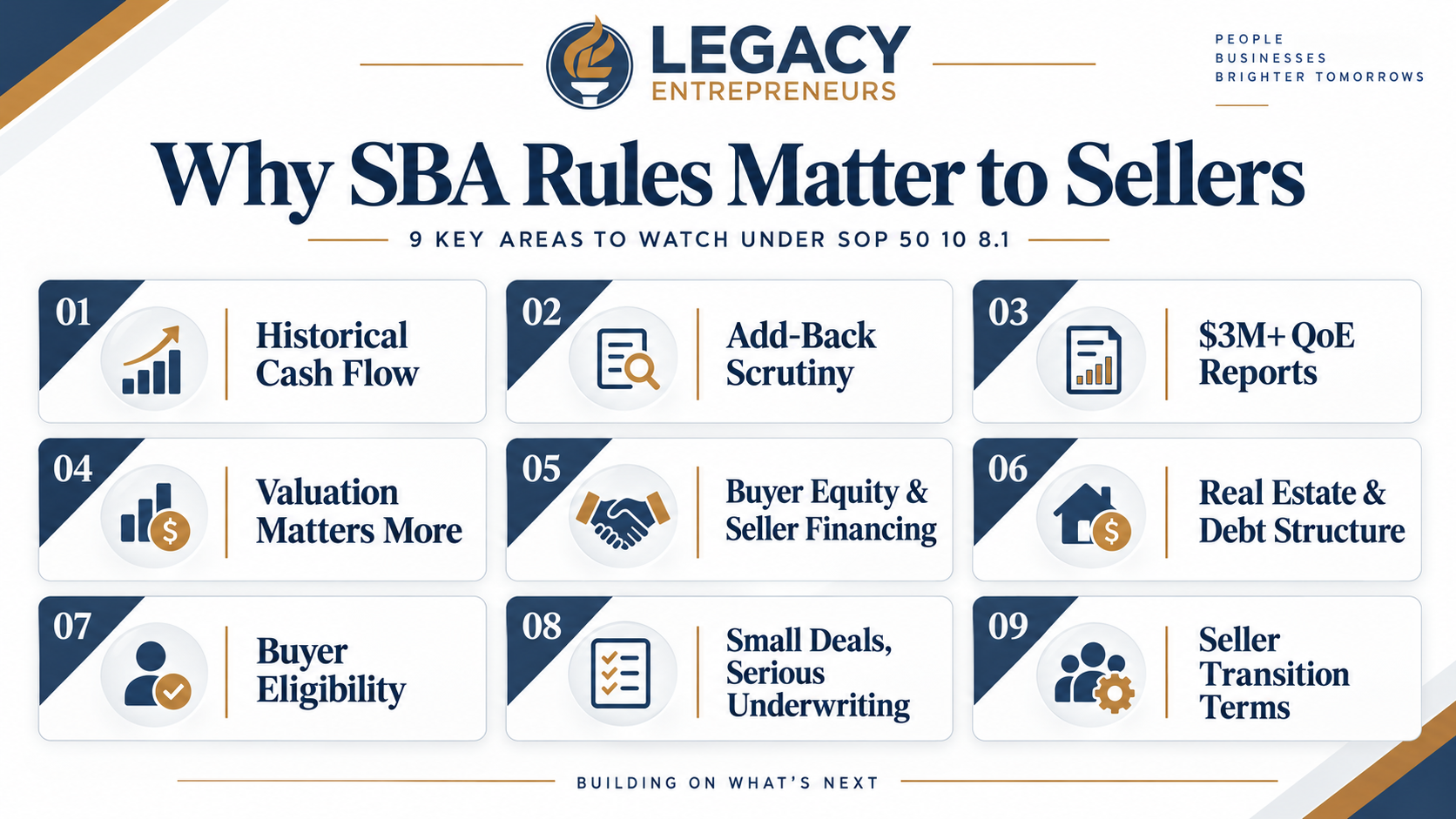
SBA SOP 50 10 8.1 takes effect October 1, 2026, replacing SOP 50 10 8. The changes cover cash flow, debt-service coverage, valuation, buyer equity, and financial due diligence. Business owners do not need to become SBA underwriters, but they should understand how these rules can affect a sale.
Here is the short version: Starting October 1, 2026, SBA 7(a) business acquisitions will follow updated requirements that can affect financing, valuation, diligence, and deal structure.
SBA 7(a) financing is an important source of capital for buyers acquiring small businesses. Even though the buyer is the one applying for the loan, the financing can directly affect the seller’s deal.
A business can have an interested buyer and a reasonable asking price, but the transaction can still run into trouble if the lender concludes that the business cannot support the acquisition debt or the valuation does not support the purchase price. Under SOP 50 10 8.1, sellers should expect greater attention to historical cash flow, valuation, buyer equity, financial diligence, and deal structure.
These financing questions can be especially important for Main Street business owners, whose buyers often rely on lender-backed financing to complete the purchase, but the same financing issues can affect larger acquisitions as well. The business has to support the price. The buyer has to support the financing. And the documentation has to support both.

One of the most meaningful changes is the Debt Service Coverage requirement, or DSCR. It is the lender’s way of asking a simple question:
Does this business generate enough cash to comfortably make the loan payments?
Under SOP 50 10 8.1, Initial Acquisitions, Owner Buyouts, and ESOP or Cooperative transactions generally require at least 1.25x Debt Service Coverage. Business Expansions remain at 1.15x.
For an Initial Acquisition, that calculation must be supported by historical or properly adjusted financial performance. The SBA lender will still evaluate post-closing projections, but projected growth cannot be used to satisfy the required Debt Service Coverage test.
Maybe you just hired a salesperson. Maybe a large new contract is about to start. Maybe margins should improve after the buyer takes over. Those things can still matter. But if the historical numbers do not support the acquisition debt, a buyer using an SBA 7(a) loan may have a harder time financing the business at your desired price.
For sellers, this makes clean, defensible earnings even more important. Your SDE, EBITDA, and add-backs need to hold up under scrutiny.
Most privately held businesses have legitimate adjustments to earnings. Maybe the company pays for the owner’s vehicle. Maybe there was a one-time legal expense. Maybe owner compensation needs to be normalized. These adjustments are commonly called add-backs, and they can include:
Seller discretionary expenses
Owner compensation adjustments
One-time legal or professional costs
Nonrecurring income or expenses
They matter because normalized earnings are often the starting point for valuing an owner-operated business and evaluating its cash flow. But an add-back only helps if it can be defended.
SOP 50 10 8.1 requires lenders to support the adjustments used in their cash-flow analysis. A clearly documented owner expense may be straightforward. A large line item labeled simply as “one-time expenses” is much harder to rely on during the loan process.
That is one reason owners should not wait until a buyer is under a Letter of Intent to figure out what the business really earns. The time to clean up your financial story is before you go to market.
Read More: Bad Bookkeeping Kills Deals — Focus on These 4 Fixes | Legacy Entrepreneurs
For an Initial Acquisition or Business Expansion with a Business Purchase Price of $3 million or more, excluding owner-occupied commercial real estate, the lender must obtain a Quality of Earnings report, commonly called a QoE, in addition to the required business valuation.
A QoE takes a deeper look at whether the company’s reported earnings are accurate, repeatable, and supportable.
| Area Reviewed | What It Helps Verify |
|---|---|
| Tax Returns and Financial Statements | Whether reported earnings are consistent |
| Bank Activity | Whether cash activity supports reported revenue |
| Add-Backs | Whether earnings adjustments can be supported |
| Revenue Quality | Whether current earnings appear sustainable |
| Customer Concentration | Whether revenue depends heavily on a few accounts |
The SBA-required review also includes a Cash Proof, which reconciles bank activity with financial and tax information. For a seller at this size, the practical point is simple: if the tax returns say one thing, the internal P&L says another, and the bank deposits say something else, that can become a problem during underwriting. Lenders generally expect the numbers to agree with each other.
Business valuation has always been important in SBA acquisition financing. Under SOP 50 10 8.1, every change-of-ownership transaction requires a valuation from a qualified independent source obtained for the lender. For sellers, it helps to separate three concepts:
| Measure | What It Means |
|---|---|
| Asking Price | What the seller wants to receive |
| Supported Valuation | What the lender’s independent valuation supports |
| Financeable Structure | What the valuation, cash flow, and buyer equity can support |
If the price paid for the business exceeds the supported valuation, the difference has to be made up with equity rather than simply added to the acquisition debt.
Read Next: Business Valuation Multiples Tennessee Owners Should Understand
You can ask any price you want for a business. But if the likely buyer needs an SBA business acquisition loan, the valuation and Debt Service Coverage requirements can put a practical limit on what the transaction supports.
This is why getting a realistic Business Valuation before going to market can be useful. It can help establish whether your expectations align with the earnings, risk, and market factors a buyer is likely to evaluate. It does not predict the exact closing price, but it can reveal whether the underlying economics are likely to hold up when a buyer’s lender reviews the deal.
For a typical Initial Acquisition, the buyer generally must contribute at least 10% of the required project cost as equity. But the details matter.
The SBA places limits on how certain forms of seller debt and outside investment can count toward the required contribution. Seller financing can still be part of a business acquisition, but it needs to be structured around the SBA loan requirements from the beginning. When reviewing an SBA-financed offer, sellers should look at four things:
How much qualifying equity is the buyer contributing?
How will any seller note be structured?
Is outside investment part of the deal?
Does the buyer have a credible path to loan approval?
Seller financing should not be treated as a last-minute fix for a buyer who is short on cash. Do not evaluate an offer based on price alone. A $3 million offer that cannot be financed is not necessarily better than a $2.8 million offer from a qualified buyer with sufficient equity and a realistic path to closing.
Read More: Seller Financing, SBA Loans & Small Business Purchase in TN
Acquisitions that include owner-occupied commercial real estate can have a different financing structure from business-only purchases. Under SOP 50 10 8.1, the business and real estate portions may be financed separately or, where appropriate, structured using a blended weighted-average maturity.
| Transaction | General Treatment |
|---|---|
| Business Acquisition Only | Business portion generally carries a term of up to 10 years |
| Business + Real Estate | Separate or blended financing may apply |
| Real Estate Portion | May support a longer term than the business portion |
Why should a seller care? Loan term affects annual debt payments. Higher annual payments require more business cash flow to satisfy the lender’s Debt Service Coverage test.
So two businesses with similar earnings may support different acquisition financing structures depending on whether real estate is included and how the deal is put together. This is another reason to consider the financing structure before the rest of the transaction is agreed upon.
Sellers also need to pay attention to whether a prospective buyer can actually qualify for an SBA loan. The SBA tightened its citizenship and residency requirements effective March 1, 2026, before SOP 50 10 8.1 takes effect in October. Those eligibility requirements can affect who is able to use SBA financing for a business purchase.
For most sellers, this changes nothing about how the business operates, but it can change the buyer pool.
A financially capable buyer may still be unable to use an SBA 7(a) loan because the buyer or ownership structure does not meet current SBA eligibility requirements. That does not necessarily mean the buyer cannot purchase the business, but another source of business financing may be required. If an offer depends on an SBA loan, buyer eligibility is worth confirming early.
A smaller business purchase does not mean a casual loan process. Under SOP 50 10 8.1:
7(a) Small loans cannot be used for change-of-ownership transactions
Financial due diligence is required
A lender-ordered business valuation is required
Acquisition-specific documentation and verification requirements apply
A $700,000 business may be smaller than a $4 million business. The SBA lender still cares whether the earnings are real, the price is supported, and the proposed business loan can be repaid.
For owners of smaller businesses, that makes clean financial statements, tax returns, business balance sheets, and documented add-backs just as important when preparing for a sale. A smaller deal should not be confused with a casual deal.
Business owners also need to think about what happens after closing. For a typical Initial Acquisition or Business Expansion, the seller generally cannot remain an officer, director, stockholder, or employee of the business after the sale. A transition period is allowed when the buyer needs time to learn the business.
| Seller Role After Closing | General Treatment |
|---|---|
| Officer, Director, Stockholder, or Employee | Generally not permitted |
| Consultant | May be permitted for up to 24 months in aggregate |
That consulting period is longer than the 12-month limit under the prior SOP and can give a buyer more time to learn customer relationships, vendor relationships, business operations, and other knowledge that may still depend on the seller. It does not mean the seller can remain indefinitely involved in the business.
For owners whose businesses are highly dependent on them personally, this is another reason to start reducing owner dependence before going to market. A business that can operate without the seller is generally easier to transfer to a new owner.
Read Next: Exit Planning for Tennessee Business Owners
I would not make major operating decisions simply because the SBA changed an SOP. But if selling your business is on your radar in the next year or two, the new rules are another reason to get the business, the financials, and your expectations in order before going to market.
Start with a realistic business valuation based on Seller’s Discretionary Earnings, or SDE, for many owner-operated businesses, or EBITDA for larger and more management-dependent companies. The earnings number is only part of the equation. The multiple can also be influenced by factors such as:
Customer concentration
Owner dependence
Management depth
Revenue consistency
Margins
Industry risk
Recurring or repeat business
Condition of equipment and facilities
Transferability of customer and vendor relationships
Then ask a second question:
Does that valuation also make sense from a buyer-financing perspective?
If the likely buyer will use an SBA 7(a) loan to purchase the business, the asking price eventually has to work alongside the lender’s valuation, the business’s historical cash flow, and the buyer’s available equity. A valuation can help you understand what the business may be worth in the market. Looking at financeability shows whether a typical buyer can realistically fund the deal.
Your tax returns, P&Ls, balance sheets, and bank activity should tell a consistent story. Before going to market, review the financial records the same way a buyer, CPA, or SBA lender eventually will. Document legitimate add-backs, reconcile obvious discrepancies, and be prepared to explain unusual revenue, expenses, or one-time events.
If the business had a weak year, lost a major customer, made a large capital purchase, or incurred an unusual expense, that does not automatically create a problem. What matters is whether the numbers can be explained clearly and supported with documentation.
It is much easier to address those questions before a buyer submits a loan application than after underwriting has already started.
An individual buyer using SBA financing evaluates a business differently from a strategic acquirer, family office, or private-equity-backed company.
An individual buyer may depend heavily on the business’s historical cash flow to qualify for an SBA business acquisition loan. A strategic buyer may place more value on customer relationships, market share, geography, employees, or capabilities that fit an existing operation. That difference can affect:
How the business is valued
How the transaction is financed
Which risks matter most to the buyer
How the business should be marketed
What kind of offer is most likely to close
This is part of why simply listing a business online and waiting for inquiries is not much of a sale strategy. The buyer matters. The buyer’s financing matters too.
A high offer that cannot be financed is not automatically the better offer. Before accepting a Letter of Intent, look beyond the headline purchase price. Consider the buyer’s liquidity, expected equity contribution, financing source, seller-financing request, due diligence conditions, contingencies, and overall probability of reaching closing.
If the buyer plans to use an SBA loan, it is also worth understanding where they are in the loan process and whether the proposed deal structure appears consistent with SBA loan requirements.
A well-financed offer at a reasonable price may ultimately carry less risk than a higher offer that depends on aggressive assumptions, insufficient buyer equity, or a financing structure that has not been tested with a lender. Under the new SBA rules, those questions are better addressed before both sides invest months in a transaction that may not be financeable.
Read More: Business Sale Preparation Checklist — A 12-Point Plan to Prepare Your Business for Sale
SOP 50 10 8.1 takes effect October 1, 2026.
For transactions already in process, the applicable version of the SOP generally depends on when the application receives its SBA loan number. Loans assigned a number on or after October 1 will be subject to the new rules.
Some SBA lenders may set earlier internal deadlines so they have enough time to process a transaction under the current SOP. Those internal cutoffs are separate from the SBA’s official effective date. If your business is already under Letter of Intent and the buyer plans to use SBA financing, the buyer should confirm with the lender which version of the SOP will govern the loan.
Read Next: How Long Does It Take to Sell a Business in TN? Valuation, Preparation, and Other Considerations
None of these changes alter the fundamentals of selling a good business. Buyers still want reliable earnings, a business that can operate without the owner doing everything, and a clear understanding of risks such as customer concentration, management depth, recurring demand, and margins.
Lenders still want to know that the business can support the debt. SOP 50 10 8.1 simply puts more structure around those questions. For business owners considering an exit, that makes preparing before going to market even more important. A business should be priced based on what the market and the underlying financials can reasonably support.
The financials should be ready for diligence. The marketing should reach the right buyer pool. And the deal should be structured with a realistic understanding of how the buyer is going to finance the purchase. For sellers, the goal is to identify those issues before they become problems during underwriting, due diligence, or closing.
If you are asking, “Who can help me value, market, and sell my business?”, look for a business broker or M&A advisor who can manage those pieces through one coordinated sale process.
It starts with valuation. You need to understand what the business is worth, what is driving that value, and whether your expectations are realistic before you take the company to market.
From there, the business needs to be prepared and positioned for buyers. That means presenting the financials clearly, explaining how the operation works, identifying the strengths and risks a buyer will see, and developing professional marketing materials without compromising confidentiality.
Once buyers enter the process, the work shifts to qualification, offers, and deal structure. The highest price on paper is not always the best offer. Buyer liquidity, financing, seller notes, contingencies, transition terms, and the probability of reaching closing all matter.
At Legacy Entrepreneurs, we help Tennessee business owners through the business sale process, from valuation and market preparation through buyer qualification, negotiation, due diligence, and closing, with a focus on Nashville and Middle Tennessee. Our work can include:
Business valuation and exit-readiness analysis
Preparing and positioning the business for market
Confidential marketing and buyer outreach
Buyer qualification and screening
Offer, financing, and deal-structure evaluation
Negotiation and coordination through due diligence and closing
We also coordinate with lenders, attorneys, CPAs, and other transaction professionals as the deal moves forward. The SBA lender ultimately makes its own credit decision and obtains any independent valuation or financial diligence required by the loan program.
A business broker cannot control that decision. But a well-prepared sale process can account for financing realities before they become closing problems. If an exit is on your radar in Nashville, Franklin, Brentwood, Murfreesboro, Columbia, Cookeville, or elsewhere in Middle Tennessee, a good place to start is with the numbers.
Find out what your business is worth, understand what a qualified buyer is likely to finance, and build the sale process from there.
Note: This article is intended for general informational purposes and is not legal, tax, or lending advice. SBA requirements can be transaction-specific. Buyers and sellers should work with their lender and professional advisors regarding the rules applicable to a particular transaction.
Yes. The SBA 7(a) loan program can be used for a complete or partial change of ownership, including the purchase of an existing business. It is one of the primary SBA programs used for business acquisitions. For sellers, that means the buyer’s ability to qualify for an SBA loan can directly affect the financing structure, available equity, and likelihood of closing.
A buyer and the business must meet SBA eligibility requirements, and the lender must be satisfied that the loan can be repaid. SBA requirements generally include operating for profit, meeting SBA size standards, being located in the United States, and demonstrating creditworthiness and a reasonable ability to repay.
For a business acquisition, the SBA lender will also review the transaction itself, including cash flow, valuation, buyer equity, and the proposed ownership structure.
Yes. SBA 7(a) loan proceeds can be used for both changes of ownership and short- or long-term working capital. That can allow a buyer to structure financing for the business purchase while also providing appropriate working capital after closing. The lender will determine the permitted loan amount and structure based on the transaction and SBA loan requirements.
Yes. SBA financing does not determine the market value of your business, but it can affect how much of the purchase price a buyer is able to finance. The lender will look at the business valuation, historical cash flow, buyer equity, and debt-service coverage when evaluating the transaction.
If the likely buyer depends on an SBA 7(a) loan, those financing constraints can influence how the final deal is structured.
Before accepting an offer, look beyond the headline purchase price. Ask how much equity the buyer plans to contribute, whether seller financing is requested, which SBA lender is handling the acquisition loan, and how far the buyer is into the loan process.
A buyer working with an SBA lender experienced in business acquisitions may be able to identify financing issues earlier. For the seller, the important question is whether the proposed price and deal structure have a credible path to loan approval and closing.
If you are thinking about selling your business in the next year or two, the new SBA 7(a) business acquisition rules could affect whether a buyer can...

You can confidentially market a business for sale by keeping the company anonymous during early outreach, screening prospective buyers before...
Roofing company buyers in Tennessee include individual acquisition entrepreneurs, strategic roofing contractors, regional consolidators, and private...