

Who is Buying Roofing Companies in Tennessee? A Guide to Finding the Right Buyer
Roofing company buyers in Tennessee include individual acquisition entrepreneurs, strategic roofing contractors, regional consolidators, and private...

17 min read
Joe Steigman is the Founder of Legacy Entrepreneurs, a boutique business brokerage and exit advisory firm focused on helping business owners maximize value and transition their companies with confidence. With a background that combines operational leadership, corporate consulting, finance, and entrepreneurship, Joe brings a practical, owner-focused perspective to business sales and acquisitions. Joe is a Certified Business Intermediary (CBI), a designation awarded by the International Business B...
Joseph Steigman
August 20, 2026
Roofing company buyers in Tennessee include individual acquisition entrepreneurs, strategic roofing contractors, regional consolidators, and private equity-backed platforms. The right buyer depends on the company’s earnings, management depth, service mix, crew stability, market position, and how dependent the business remains on the owner.
Buyer type can also shape the transaction itself. A strategic acquirer may value geographic expansion, crews, or customer relationships, while a private equity-backed platform may place greater weight on EBITDA, management infrastructure, and scalable sales systems. Financing, rollover equity, transition expectations, and the owner’s role after closing can differ considerably between buyers.
Acquisition activity in roofing has expanded quickly. Roofing Contractor reported in 2025 that roofing platforms acquired 134 contracting firms in 2024, up more than 25% from 106 in 2023. Tennessee is part of that activity: in July 2026, Franklin-based Five Points Roofing partnered with HighPoint Exterior Home Services, a private equity-backed roofing and exterior-services platform entering the Tennessee market. For owners considering a sale, understanding who the buyers are and what each one wants can make it easier to compare opportunities before entering negotiations.
Several buyer types are active: Tennessee roofing companies may attract individual acquisition entrepreneurs, strategic roofing contractors, regional consolidators, private equity-backed platforms, and other long-term investors.
Buyer fit depends on the business: Earnings, management depth, crew stability, service mix, geographic reach, sales systems, and owner dependence all influence which buyers are most likely to pursue a company.
Different buyers value different strengths: A strategic buyer may care about market expansion and crews, while a private equity-backed platform may focus more heavily on EBITDA, management infrastructure, and scalable operations.
Deal structure can vary significantly: Offers may include bank or SBA financing, seller notes, earnouts, rollover equity, or continued owner involvement after closing.
The highest price may not produce the best outcome: Financing certainty, diligence requirements, closing risk, transition expectations, employee plans, and the seller’s future role should all be considered alongside headline value.
Buyer qualification matters: Owners should understand who has the capital, authority, acquisition experience, and realistic path to closing before sharing sensitive information or entering serious negotiations.
The buyer pool for Tennessee roofing companies is broader than it was a few years ago. Depending on the size and structure of the business, an owner may receive interest from an individual operator, another roofing company, a regional consolidator, a private equity-backed platform, or a longer-term investment group.
The important point is that these buyers are not looking for the same thing. A company that appeals to an individual buyer may be too small for a private equity platform, while a strategic roofing contractor may see value in a market, crew base, or customer mix that another buyer would not prioritize. The main buyer groups include:

Individual acquisition entrepreneurs: These buyers typically want to own and operate the business themselves. They often focus on dependable cash flow, manageable owner transition, and a company that can support acquisition financing.
Strategic roofing companies: An established roofing contractor may acquire another company to enter a new territory, add crews, expand into commercial or residential work, strengthen local market share, or gain an established customer base.
Regional consolidators: These buyers often own or operate multiple roofing or exterior-service businesses and look for acquisitions that increase density in an existing market or extend their footprint into a nearby region.
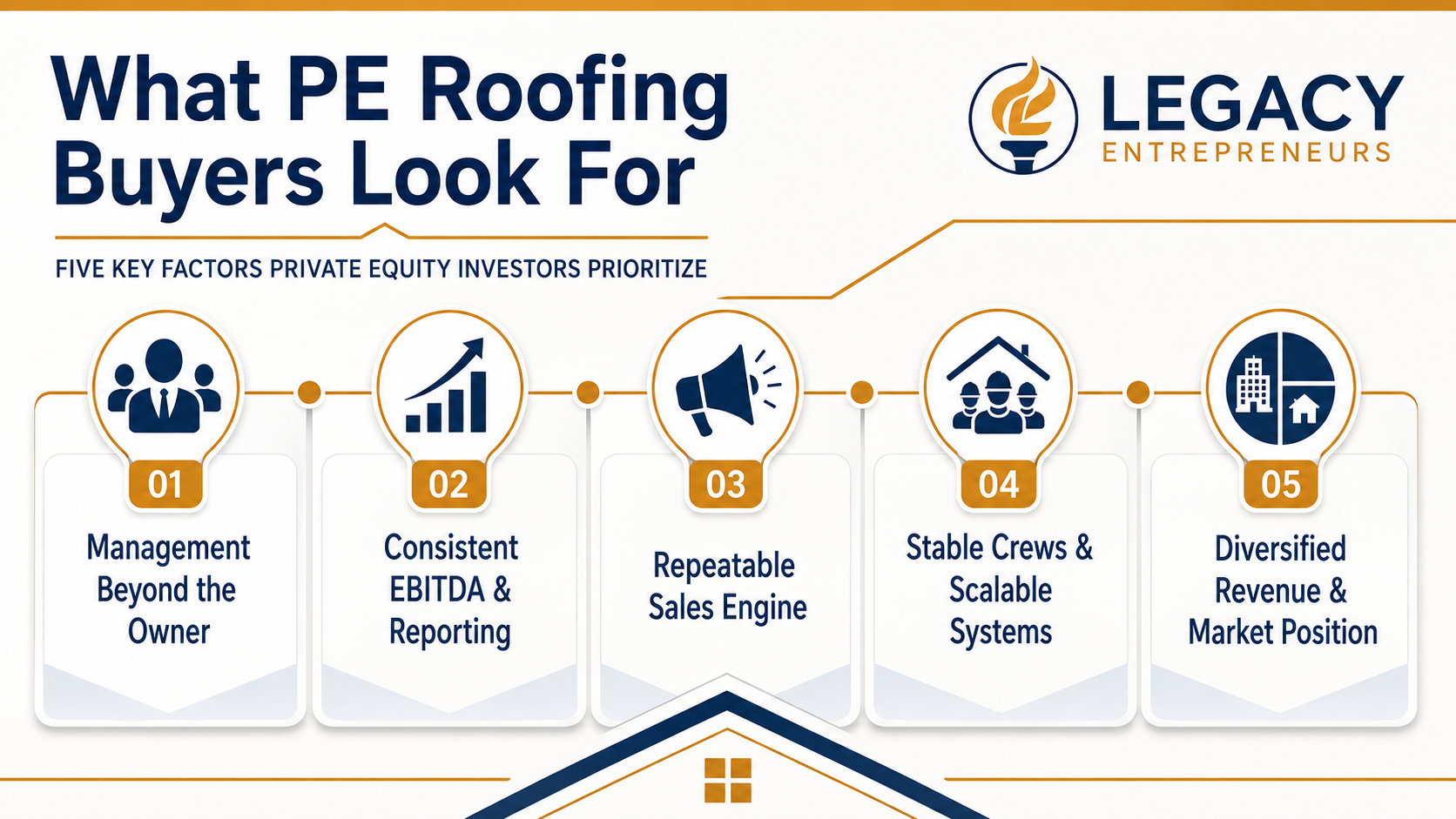
Private equity-backed roofing platforms: These groups generally look for businesses that can support continued growth. Management depth, EBITDA, sales systems, operational processes, and the ability to perform without the owner are often important.
Family offices and other long-term investors: Some investment groups pursue established service businesses with durable cash flow and strong local positions. Their ownership horizon and post-closing expectations may be more flexible than those of a traditional private equity fund.
Which group is most likely to pursue a particular roofing company depends on factors such as earnings, service mix, geographic reach, management strength, customer concentration, crew stability, and owner dependence. Understanding those differences gives the seller a better basis for deciding which buyers are worth engaging and which offers deserve closer attention.
Individual buyers and acquisition entrepreneurs are often a natural fit for smaller, owner-operated roofing companies. These buyers are typically looking for an established business they can own and operate themselves rather than building a roofing contractor from the ground up.
Their attention usually centers on dependable cash flow and whether the business can transfer successfully to a new owner. Clean financials, experienced crews, a stable lead-generation process, good local reputation, and documented operating procedures can all make the transition easier to underwrite. Heavy reliance on the seller for estimating, sales, customer relationships, or day-to-day decisions can create more concern because the buyer may need to replace several functions at once.
For companies in this part of the market, buyers may evaluate Seller’s Discretionary Earnings (SDE) closely because it helps them understand the economic benefit available to an owner-operator. They will also examine whether proposed add-backs are reasonable and whether earnings are consistent enough to support the purchase and any acquisition debt.
Read More: Seller Financing, SBA Loans & Small Business Purchase in TN
| Business Characteristic | Why It Matters to the Buyer |
|---|---|
| Reliable Earnings | Consistent historical cash flow gives the buyer more confidence that the business can support ownership income and acquisition debt. |
| Transferable Operations | Experienced crews, supplier relationships, sales processes, and customer relationships reduce the risk of performance dropping after the seller exits. |
| Manageable Owner Transition | A defined handoff is easier to underwrite than a business where the seller remains essential to estimating, sales, or daily decisions. |
| Strong Local Reputation | Reviews, referrals, and an established market presence give the buyer a customer-acquisition base they do not have to build from scratch. |
| Documented Operating Systems | Clear processes for estimating, scheduling, job costing, collections, and quality control make the company easier for a new owner to manage. |
The main challenge for sellers is often financing certainty. An individual buyer may have strong operating experience and genuine interest but still depend on lender approval or other financing to complete the acquisition. Owners should therefore evaluate the buyer’s available capital, financing plan, and ability to reach closing before assuming an offer is secure.
Strategic buyers are typically established roofing contractors or exterior-services companies looking to expand into a new market, add crews, strengthen service capabilities, or acquire an existing customer base.
For a Tennessee roofing company, that may mean interest from a buyer that wants immediate access to a local operation in Nashville, Knoxville, Chattanooga, or another market. Experienced crews, strong production management, commercial accounts, reliable lead sources, supplier relationships, and a solid local reputation can all increase strategic interest.
Service mix can also matter. A buyer may pursue a company to add commercial roofing, storm restoration, metal roofing, or other complementary services that fit its existing operation.
Because strategic buyers may see value in geography, people, customers, or capabilities that other buyers do not, sellers should understand why the buyer wants the business. That insight can help clarify what the buyer values most and where the seller may have leverage in negotiations.
Regional consolidators use acquisitions to build stronger coverage across several markets without having to create each branch from the ground up. In roofing, that model has become increasingly visible as platforms acquire established local contractors while often preserving the brands, customer relationships, and operating teams that made those companies valuable in the first place. Roofing Contractor highlighted this approach in 2025, noting that groups such as Omnia Exterior Solutions had built regional scale through repeated acquisitions while maintaining localized branding.
For a Tennessee roofing owner, that creates a different buyer profile from either an individual entrepreneur or a single strategic contractor. The consolidator is often evaluating how well the company can function as part of a broader network.
A consolidator may acquire a roofing company because it provides an immediate foothold in a market the buyer wants to enter or strengthens coverage around locations it already serves.
Recent roofing transactions show that geographic expansion is a common acquisition rationale. In 2025, Tecta America used acquisitions to deepen its West Coast presence and establish its first operation in New Mexico, while other roofing platforms expanded across multiple states through add-on deals.
That matters for a Tennessee contractor with a strong position in an attractive service area. Local crews, market knowledge, referral relationships, and an established reputation can give the buyer a working operation immediately. A buyer entering the market organically would need to develop those capabilities over time.
Revenue alone does not tell a consolidator whether an acquisition will integrate well. Buyers also need confidence that the company can continue operating after ownership changes.
A roofing company may become more attractive when it has:
experienced production and sales leadership beneath the owner;
crews that are likely to remain after closing;
consistent estimating, scheduling, job-costing, and sales processes;
a recognizable local brand with established demand;
financial reporting that gives the buyer a clear view of margins and earnings; and
enough operational independence that the seller does not remain the center of every customer, employee, and production decision.
The logic behind many roofing platforms is to combine strong local operators with broader resources. For example, Omnia has described its partner model as bringing local and regional roofing leaders into a larger organization that can provide administrative support, digital tools, and other resources while retaining local market knowledge.
For the seller, owner dependence becomes especially important here. A consolidator can add centralized resources after closing, but replacing an owner who personally generates sales, manages production, recruits crews, handles key accounts, and approves every major decision creates immediate execution risk.
The July 2026 partnership between Franklin-based Five Points Roofing and HighPoint Exterior Home Services shows how this strategy can play out locally. HighPoint, a residential roofing and exterior-services platform backed by Lake Street Capital Partners, had operated in North Carolina before partnering with Five Points as part of its expansion into Tennessee.
Five Points brought more than a location into the transaction. The company had an established Nashville-area presence, residential roof replacement and restoration capabilities, insurance-claims expertise, and an experienced management team. HighPoint and Five Points also publicly emphasized cultural fit and continued growth as important parts of the partnership.
That example is useful for Tennessee roofing owners because it shows what a regional consolidator may be evaluating:
A functioning local business that can extend the buyer's geographic footprint while continuing to perform under established leadership.
An owner approached by a regional consolidator should understand how the roofing company fits into the buyer's larger strategy. Is the buyer trying to enter Tennessee? Build density around Nashville? Add commercial roofing capabilities? Acquire experienced crews? Strengthen an existing residential roofing platform?
Those answers can affect both valuation and negotiations. A company that solves a specific geographic or operational need may have greater strategic relevance to one consolidator than to another.
Owners should also understand what happens after closing. Some consolidators preserve the local brand and management team, while others may integrate functions more aggressively. Questions about leadership, employees, branding, systems, seller involvement, and future acquisitions deserve attention alongside the purchase price.
The stronger the fit between the roofing company and the consolidator's expansion plan, the more useful it becomes for the seller to understand exactly what the buyer is acquiring and why it matters to them.
Private equity-backed roofing platforms generally pursue companies that can continue growing after the acquisition without relying on the seller to hold everything together. Some buyers are looking for a larger platform business that can support future acquisitions, while others pursue add-on companies that strengthen an existing geography, service line, or operating team.
For sellers, the distinction matters because these buyers tend to evaluate the business as an operating system, not simply a collection of roofing jobs. They want to understand whether earnings are durable, leadership is transferable, and the company can absorb additional growth without creating operational problems.

Management depth is one of the first areas a sophisticated buyer will examine. A roofing company becomes easier to transition when responsibility for sales, production, estimating, finance, and day-to-day operations is already distributed among capable employees.
Heavy owner dependence creates additional risk. If the seller personally closes major accounts, manages crews, prices jobs, and resolves most problems, the buyer has to determine how those responsibilities will be replaced after closing. A strong general manager or experienced leadership team can make that transition much easier.
Private equity-backed buyers generally evaluate larger roofing businesses through EBITDA, with close attention to the quality of those earnings.
They will examine whether margins are consistent, whether add-backs are well supported, and whether recent performance can reasonably continue under new ownership. Large swings caused by one-time storm work, aggressive adjustments, or weak job costing may require more explanation.
Reliable monthly reporting, accurate job-level profitability, and a clear understanding of gross margin give buyers more confidence in the numbers they are underwriting.
Buyers want to understand where future roofing projects will come from.
A business that consistently generates opportunities through referrals, digital marketing, commercial relationships, property managers, insurance work, or other established channels is generally easier to scale than one dependent on the owner’s personal network.
They will also look at how leads move through the sales process: who performs inspections, who prepares estimates, how close rates are tracked, and whether the system can support additional salespeople or territories.
Growth becomes difficult if every additional roofing project creates problems with labor, scheduling, materials, or quality control.
Buyers therefore pay close attention to crew stability, production leadership, subcontractor relationships, safety practices, estimating, scheduling, job costing, and warranty management. They want confidence that higher volume can move through the company without damaging margins or customer experience.
Documented systems also reduce transition risk because the buyer is acquiring a repeatable way of operating rather than knowledge that exists mainly in the owner’s head.
Revenue quality matters alongside revenue size. Buyers will examine the mix between residential and commercial roofing, storm-related and non-storm work, recurring commercial relationships, customer concentration, geographic exposure, and the company’s reputation within its service area.
A company that depends heavily on one salesperson, one referral source, one large account, or a single type of weather-driven work may appear more vulnerable than a business with several dependable revenue channels.
Strong reviews, established market recognition, supplier relationships, and a defensible position in attractive markets in growing Tennessee areas can also make the company more strategically useful to a platform.
Private equity-backed transactions may involve more than a clean exit at closing. The seller could be asked to remain for a transition period, continue in an operating role, or retain equity in the larger organization.
Owners should understand those expectations early. The amount paid at closing, any rollover equity, future responsibilities, decision-making authority, and treatment of the existing brand and employees can materially affect whether the buyer is a good fit. For a roofing owner, the strongest private equity candidates are typically companies with durable earnings, capable management, repeatable sales, disciplined operations, and enough independence from the seller to support continued growth.
Read More: How to Sell Your Business to Private Equity the Smart Way
Family offices and other long-term investment groups represent a smaller but relevant part of the buyer pool for established Tennessee roofing companies. These buyers typically invest private capital on behalf of a family or investment group and may hold businesses for longer periods than a traditional private equity fund.
Their interest tends to center on companies with durable cash flow, capable management, a defensible local position, and reasonable opportunities for continued growth. A roofing contractor with consistent earnings, experienced crews, strong customer acquisition, and limited owner dependence may fit that profile.
Some family offices are comfortable owning a strong operating business for many years. That can influence how they approach growth, management, and integration after closing.
Rather than combining the roofing company quickly with several other businesses, a long-term investor may be willing to preserve the existing brand, leadership team, and operating model when those pieces are already working well.
A longer holding period does not make these buyers less disciplined. They still need confidence that the earnings are sustainable and that the company can perform without excessive dependence on the seller.
They may examine management depth, customer concentration, gross margins, crew stability, financial reporting, and the consistency of lead generation. Heavy dependence on storm activity or unusually volatile earnings can require additional scrutiny because the investor expects the business to produce results across different market conditions.
Family-office transactions can sometimes allow more flexibility around the seller’s future role, management retention, or ownership structure. One buyer may want the owner to remain involved, while another may support a defined transition and allow the existing management team to run the company.
For sellers, the important question is how the investor intends to own and operate the roofing business after closing. Understanding the buyer’s time horizon, growth expectations, decision-making structure, and plans for employees can help determine whether the relationship fits the owner’s goals.
Two buyers can value the same roofing company similarly and still present offers with very different economics. The purchase price is only one part of the equation. How much is paid at closing, how the acquisition is financed, whether future payments are contingent, and what the seller must do after closing can materially change the value of an offer.
The structure may also reflect the buyer itself. An individual buyer may depend more heavily on acquisition financing, while a private equity-backed platform may include rollover equity or continued owner involvement. Strategic buyers and consolidators may structure around their own integration plans and the role they expect the seller to play.
| Offer Component | How It Can Vary | What the Seller Should Evaluate |
|---|---|---|
| Cash at Closing | One buyer may pay most of the consideration at closing, while another may defer a meaningful portion. | How much of the purchase price is guaranteed and immediately available to the seller. |
| Financing Conditions | Individual buyers may rely heavily on bank or SBA financing, while institutional buyers may use committed capital or established acquisition facilities. | Whether financing is secured, what approvals remain, and how financing conditions could affect closing. |
| Seller Financing | A buyer may ask the owner to carry part of the purchase price through a seller note. | Repayment terms, security, buyer creditworthiness, and how much sale proceeds remain at risk after closing. |
| Earnouts | Part of the purchase price may depend on future revenue, EBITDA, or another performance target. | How the target is calculated, how achievable it is, and how much control the seller retains over the factors that determine payment. |
| Rollover Equity | Some consolidators and private equity-backed buyers may ask the seller to reinvest part of the proceeds into the combined company. | The amount of cash being exchanged for future equity value, the seller’s rights as an investor, and the risks attached to the retained ownership. |
| Seller Involvement | The buyer may require anything from a short transition to several years of continued leadership. | Time commitment, compensation, authority, responsibilities, and whether the arrangement fits the owner’s personal exit goals. |
| Closing Certainty | Offers can differ substantially in diligence requirements, approval processes, and the number of conditions that must be satisfied. | The buyer’s available capital, acquisition experience, decision-making authority, and realistic ability to complete the transaction. |
A higher headline offer can therefore deliver less certainty or less cash than a lower one. For example, an offer containing a large earnout and several years of required owner involvement carries a very different risk profile from an offer with slightly less total consideration but substantially more cash at closing.
Roofing company owners should compare offers based on what they receive, when they receive it, what remains at risk, and what will be required of them after closing. That provides a much clearer picture of the transaction than purchase price alone.
Read More: Asset Sale vs. Stock Sale: Why Deal Structure Matters
When multiple buyers are interested in a roofing company, the highest purchase price can be difficult to ignore. But the strongest offer is usually the one that balances value with a realistic path to closing and terms the seller can accept.
A buyer can put an attractive number on paper and still leave significant uncertainty around financing, due diligence, working capital, future payments, or the seller’s obligations after closing. Those details often become more important as the transaction progresses.
A seller should separate the headline purchase price from the portion that is reasonably expected to be received at closing.
An offer may look higher because it includes an earnout, seller financing, or rollover equity. Another buyer may offer a lower total amount but provide substantially more cash at closing with fewer contingencies. Those are economically different proposals, even when the difference in headline value appears small.
The seller should also understand what assumptions support the offer. If the buyer’s valuation depends on aggressive EBITDA adjustments, future performance, or financial conclusions that have not yet been tested through diligence, there may be more room for the price to change later.
Some offers come with a much longer list of conditions than others.
A buyer may need financing approval, additional investment-committee approval, satisfactory customer calls, confirmation of working-capital levels, or extensive financial and operational diligence before it will close. None of those conditions necessarily makes the buyer unsuitable, but each creates another point where the transaction can change or fail.
This is particularly important when an owner takes the roofing company off the market or limits conversations with other buyers after signing a letter of intent. A high offer loses much of its appeal if the buyer later uses diligence to materially reduce the price or restructure the transaction.
Price also needs to be viewed alongside the seller’s personal objectives.
One buyer may allow the owner to complete a defined transition and retire. Another may expect the seller to remain for several years, hit performance targets tied to an earnout, or continue operating the roofing company as part of a larger platform.
The same applies to employees and management. Owners who care about retaining their team, preserving the local brand, or maintaining a particular operating culture should understand the buyer’s plans before choosing an offer. Those expectations are much harder to resolve after the transaction is already under exclusivity.
A well-structured offer should therefore be evaluated on price, certainty, conditions, risk, and post-closing obligations together. For many roofing company owners, the better deal is the one most likely to deliver the outcome they actually want, not simply the largest number at the top of the letter of intent.
Read More: Business Valuation Multiples Tennessee Owners Should Understand
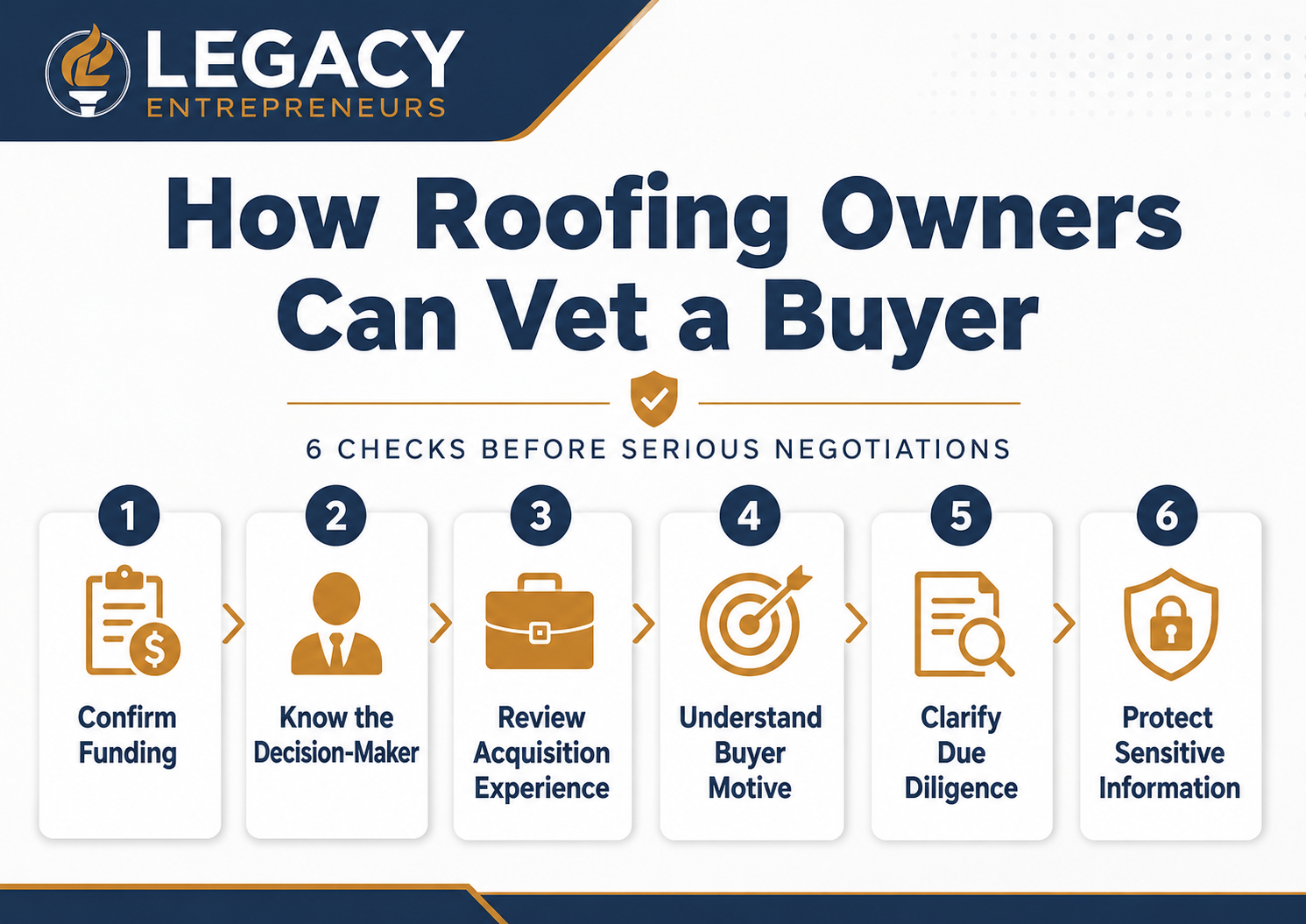
Not every expression of interest deserves the same access to a roofing company’s financials, employees, customers, or operating information. Before a Tennessee roofing contractor moves into serious negotiations, the owner should confirm that the buyer has the resources and authority to complete the deal.

Confirm how the acquisition will be funded. Ask how much capital is available, whether bank or SBA financing is required, and what approvals remain before closing.
Find out who makes the final decision. The person contacting the owner may still need approval from a lender, investment committee, board, or private equity sponsor.
Review the buyer’s acquisition experience. Look for completed transactions involving roofing services, commercial roofing, home services, or similar contractor businesses. A credible buyer should be able to explain its process and typical timeline.
Understand why they want your company. A buyer entering a TN service area may value the company differently from one looking to add commercial roofing services, crews, customer relationships, or a stronger presence in Middle Tennessee.
Ask what diligence will involve. Serious buyers should be able to outline what they need to review, including financial records, customer concentration, insurance matters, contractor licenses, warranties, and other obligations that could transfer with the business.
Limit sensitive information until the buyer is qualified. This is especially important when the prospective buyer is another roofing contractor or direct competitor. Detailed pricing, customer data, employee information, and supplier relationships should be disclosed in stages.
When buyer screening, confidentiality, and industry fit become difficult to manage directly, our Roofing Business Broker work helps Tennessee roofing owners evaluate qualified buyers and manage the sale process with roofing-specific transaction experience.
Read More: How to Maintain Confidentiality When Selling a Business in TN
An unsolicited approach can be worth exploring, but we generally recommend that roofing owners avoid reacting to the first number presented before understanding who the buyer is, why they are interested, and how the proposed terms compare with the company’s actual value.
At Legacy ETA, we specialize in the roofing industry and help Tennessee owners evaluate inbound buyer interest before negotiations become too advanced. Through our Business Valuations service, we help establish normalized earnings, identify value drivers and risks, and provide a more grounded view of what the company may be worth in the current market.
That context matters when a buyer is already at the table. An offer can appear attractive while still including assumptions around EBITDA, seller involvement, financing, earnouts, or other terms that change the economics of the deal.
Through our Roofing Business Broker expertise, we also help owners assess buyer fit, protect confidentiality, and determine whether an inbound offer deserves serious consideration or whether the business may benefit from exposure to a broader pool of qualified buyers.
The right buyer for a roofing company is rarely determined by price alone. Buyer fit, financing certainty, deal structure, post-closing expectations, and the owner’s personal goals all shape whether an offer is actually attractive.
At Legacy ETA, we specialize in the roofing industry and understand how strategic buyers, consolidators, private equity-backed platforms, and individual buyers can view the same company differently. That context matters when comparing offers and deciding which buyer is most likely to deliver the outcome the owner actually wants.
If you are considering a sale or have already been approached by a buyer, our Selling a Business service can help you prepare the company, evaluate qualified buyers, structure the transaction, and navigate negotiations through closing. The goal is to enter the process with a clear understanding of your options, your priorities, and the type of buyer that best fits the business you have built.
Read Next: How to Sell Your Roofing Company in Tennessee: Positioning the Business for a Smoother Sale
Yes. Buyer interest can extend across residential roofing, commercial roofing, and companies providing a mix of roofing services. What changes is how the business is evaluated. A residential roofer may be judged more heavily on lead generation, sales conversion, storm exposure, and homeowner demand, while buyers of commercial roofing companies may place greater weight on recurring customer relationships, maintenance work, backlog, and the strength of the commercial roofing services team.
Very much so. An established presence in an attractive TN market can be strategically valuable to a buyer seeking geographic expansion. The company’s local reputation, crew coverage, customer base, and ability to serve the market without depending heavily on the owner can all influence buyer interest. A buyer already serving Tennessee may also view an acquisition differently from one using the company as its first entry into the state.
They can. Buyers may review manufacturer relationships, certifications, workmanship programs, and warranty obligations as part of understanding the company’s market position and operating requirements. Credentials such as GAF Master Elite certification may also support the company’s reputation with customers. Owners should confirm whether any certification, preferred-contractor status, or roofing manufacturer agreement remains in place after a change of ownership rather than assuming it automatically transfers.
Buyers typically want to understand how dependable each revenue source is. A company with significant hail or storm-damage work may produce strong results in certain periods, but buyers will examine how earnings perform when severe weather activity declines.
They may also compare insurance-claim work with retail roof replacement, roof repair, commercial projects, and other recurring or non-storm roofing services. A diversified revenue mix can make historical performance easier to evaluate than results driven primarily by one weather event or lead source.
Owners should be ready to explain the company’s earnings, service mix, management structure, crews, customer concentration, geographic coverage, and their own role in daily operations. Buyers may also review contractor licenses, warranty obligations, insurance matters, job costing, sales performance, and other records that show how the business actually operates.
Having those areas organized before serious discussions can make it easier to answer buyer questions, support the company’s value, and identify potential issues before they affect negotiations.
Roofing company buyers in Tennessee include individual acquisition entrepreneurs, strategic roofing contractors, regional consolidators, and private...

If you're trying to determine what your business is worth, the right choice between a business appraisal and a broker valuation depends on why you...
A manufacturing exit plan prepares a company for a sale, succession, or other ownership transition while there is still time to improve its value....