

How Roofing Companies Can Add $1 Million in Sales Without Breaking the Business
A lot of roofing company owners ask the same question: How do we add another million dollars in sales without creating more chaos inside the business?
9 min read
Joseph Steigman
:
Updated on May 28, 2026
A lot of roofing company owners ask the same question: How do we add another million dollars in sales without creating more chaos inside the business?
That question sits at the intersection of two things we both work on with business owners: growth systems and business value. Christopher Gunn is a roofing marketing agency that helps roofing and trade businesses with websites, lead generation, SEO, PPC, reputation, and scalable marketing systems. Joe Steigman and Legacy Entrepreneurs is a roofing business broker that works with owners on valuation, exit strategy, acquisitions, and building companies that can operate beyond the owner.
In our conversation, we looked at what actually helps roofing companies grow: faster follow-up, better sales processes, stronger Google reviews, financing, CRM discipline, marketing attribution, and less owner dependency. The conclusion was simple: most roofing companies do not need a magic bullet first. They need better execution of the fundamentals.
That may sound boring, but boring often scales. In a 2024 Roofing Contractor homeowner survey, 66% of homeowners said they were more likely to call a roofer that offers pricing on its website.
For roofing companies, especially those doing roughly $1 million to $10 million in revenue, the path to the next stage of growth usually comes from improving the core sales and marketing system already inside the business. Better call handling. Faster follow-up. Stronger inspections. More Google reviews. Better use of a CRM. Clearer attribution. More consistent financing offers.
Those systems do more than increase profits. They also make the company more transferable, more valuable, and less dependent on the owner.
That matters whether you want to grow, step back from day-to-day operations, hire a general manager, or eventually sell the business.
Watch the full conversation with Christopher Gunn and Joe Steigman on how roofing companies can add $1 million in sales through better sales systems, marketing attribution, CRM usage, and follow-up.
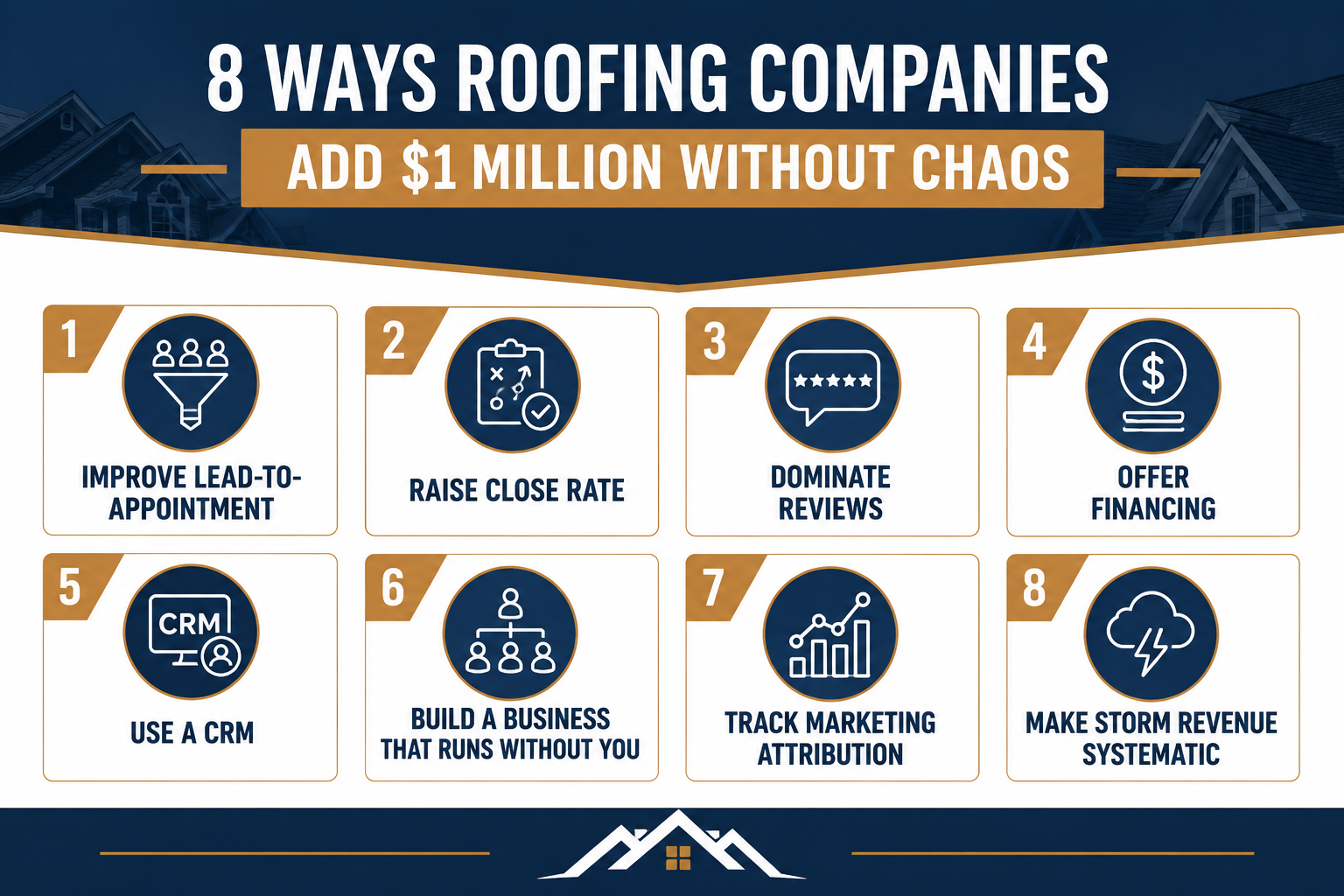
Most $1M revenue jumps come from better lead-to-appointment conversion and faster callback systems, not more ad spend
Raising close rates by 5–10% through structured sales processes often adds more revenue than doubling lead volume
Dominating Google reviews and your Google Business Profile drives both local SEO rankings and buyer confidence
Offering financing increases close rates and average ticket size by making larger roofing jobs affordable to more homeowners
Using a CRM like JobNimbus or ServiceTitan consistently creates repeatable revenue and reduces owner dependency for buyers
Tracking marketing attribution shows which channels generate profitable jobs and helps you allocate budget more effectively
Building owner-independent systems increases valuation multiples and makes your roofing business easier to sell or step back from
Making storm revenue systematic through reviews, CRM, and trained sales teams turns weather events into bankable, repeatable growth

The first major opportunity is simple: stop losing leads before they ever become appointments.
Many roofing companies spend money to generate calls, but then lose those opportunities because of missed calls, slow callbacks, weak intake processes, no text follow-up, or an owner trying to answer the phone while standing on a roof.
That creates a hidden revenue leak.
Fixing that leak starts with making sure every new inquiry has a clear path into the business. Roofing companies need dedicated call handling, fast callbacks, simple website intake forms, automated text follow-up, instant scheduling tools, clear call scripts, and CRM automation that moves each lead into the next step.
A homeowner with water coming through the ceiling is in pain, and they want a fast response. If your company does not respond quickly, they will usually call the next roofer.
That means speed-to-lead is a sales metric and a competitive advantage.
Closing more of the leads you already have is often faster and more cost-effective than buying more leads. Most roofing companies close 20–40% of the jobs they inspect. Raising that close rate by even 5–10 percentage points can add $500K–$1M in sales, depending on your volume and average ticket size.
A stronger sales process includes:
Thorough roof inspections with photo documentation: Show the homeowner exactly what's wrong and why it matters.
Professional proposals with multiple options: Give homeowners a choice between good, better, and best solutions instead of a single take-it-or-leave-it bid.
Clear explanations of materials, warranties, and timelines: Educate the homeowner so they understand what they're buying and why your roofing company is the right partner.
Consistent follow-up sequences: Most roofing jobs don't close on the first visit. A structured follow-up system keeps you top of mind without being pushy.
Financing options presented at the table: Make it easy for homeowners to say yes by offering payment plans that fit their budget.
Roofers should sell certainty, professionalism, and process—not just price. Homeowners hire roofing contractors they trust to do the job right, protect their home, and stand behind the work. A structured sales process builds that trust and makes it easier for potential customers to choose you over the competition.
Google reviews are the single most important factor in local search rankings and buyer confidence for roofing companies. Homeowners searching for roofing services look at your Google Business Profile, read your reviews, and compare you to other local businesses before they ever call. If you have 12 reviews and your competitor has 120, you're losing jobs before you get a chance to bid.
Dominating reviews means:
Ask every happy customer for a review immediately after the job is complete.
Making it easy by sending a direct link to your Google Business Profile.
Responding to every review—good and bad—professionally and promptly.
Using reviews as social proof in your sales process, on your website, and in your digital marketing.
Reviews also feed your local SEO, Google Ads Quality Score, and Local Services Ads performance. The more five-star reviews you have, the higher you rank in search results and the lower your cost per lead. This system compounds over time and becomes a durable competitive advantage in your service area.
Handling bad reviews professionally is just as important. Respond quickly, acknowledge the issue, and offer to make it right. Potential customers read how you handle problems, not just how many five-star reviews you have.
Financing can materially improve roofing sales. If the only option is asking a homeowner for thousands of dollars up front, many buyers hesitate. But when the same project can be explained as a manageable monthly payment, the buying decision changes. Instead of "Can I afford $15,000?" the question becomes "Can I afford $200 a month?" That shift in framing removes the primary objection before it's even raised.
The impact shows up in multiple ways. Financing increases close rates by making projects affordable to homeowners who can't pay cash up front. It also makes it easier to sell upgraded shingles, premium materials, or extended warranties without triggering sticker shock. When monthly payments are manageable, homeowners are more willing to choose the better solution instead of the cheapest one.
Financing also improves average ticket size across the board. For roofers that offer multiple exterior services, financing can turn a single roof replacement into a larger home improvement project. Adding gutter work, siding, or other exterior services to the same loan is an easy conversation when the homeowner is already approved, and the monthly payment only increases slightly. This increases revenue per job without requiring more leads or more marketing spend.
The broader benefit is that financing reduces price resistance and shifts the sales conversation from cost to value. You're no longer competing purely on price. You're selling the best solution and making it accessible through flexible payment options. That improves close rates, increases ticket size, and makes better use of the leads already coming in.
Consistent CRM usage matters to both operations and future buyers. A CRM like JobNimbus or ServiceTitan tracks every lead, job, follow-up, and payment in one place. It creates accountability, reduces owner dependency, and gives you the data you need to make better decisions about marketing, sales, and team performance.
Here's a comparison of two popular CRM platforms for roofing companies:
| Platform | Best Fit | Core Strengths | Consider Before Choosing |
|---|---|---|---|
| JobNimbus | Roofing Companies ~ $1M to $10M | Roofing workflows, insurance restoration, claim stages, and production handoff | Might lack some enterprise level reporting for multi-trade rollups |
| ServiceTitan | Larger, multi-trade, enterprise, or PE-backed | Strong reporting, integrations, and stricter workflows | More complex, potentially heavier implementation for a roofing-only shop |
The right choice matters less than consistent usage and accurate data. If your CRM is full of incomplete records, outdated contact info, and jobs that never got followed up on, it's not helping you grow or increase your business valuation. Buyers look at CRM data to understand revenue repeatability, lead sources, and whether the business can run without the owner.
Train your team to use the CRM for every lead, every job, and every follow-up. Make it the single source of truth for your roofing business. That discipline creates operational maturity and makes your company more valuable.
Owner dependency is the single biggest factor that limits roofing business valuation and deal structure. If the owner is the only person who can sell, manage jobs, handle customer complaints, or make key decisions, the business is not transferable. Buyers recognize that risk immediately. They will either walk away or structure the deal with earnouts, seller notes, and long transition periods to protect themselves. That reduces the upfront cash you receive and ties your payout to the business performing well under new ownership.
Building an owner-independent roofing business requires deliberate systems work. Documented sales processes allow any trained salesperson to follow the same steps, ask the same questions, and close jobs without the owner on every appointment. Consistent follow-up systems managed through your CRM ensure that no lead falls through the cracks because the owner forgot to call someone back. These are operational fundamentals, but they directly affect how buyers evaluate risk and structure offers.
Trained salespeople who can close jobs independently are another critical piece. If the owner is the only closer, revenue depends entirely on the owner's availability and effort. That makes the business a job, not an asset. Buyers pay more for roofing companies where the sales function is repeatable, documented, and executable by a trained team. The same logic applies to marketing systems. If lead generation runs through automated CRM workflows, Google Ads campaigns, and Local Services Ads that anyone can manage, the business is more valuable than one where the owner personally handles every inquiry.
Read Next: 5 Ways a General Manager Transforms Small Business Owners
Roofing owners need to know which marketing channels are actually producing leads and sales.
Christopher Gunn discussed using tools like call tracking to understand where calls are coming from, whether from Google Ads, Local Services Ads, organic search, Google Business Profile, social media, yard signs, or other campaigns.
That matters because not all leads are equal.
If yard signs are producing qualified calls, the company should know that. If Google Local Services Ads slow down because of a policy change, the company should know that too. If SEO is producing high-quality organic leads, the owner should be able to see that in the numbers.
Good marketing attribution helps roofing owners make better decisions about where to invest next.
It also helps a buyer understand how revenue is generated.
Storm events create demand spikes, but most roofing companies treat storm revenue as lucky windfalls instead of systematic opportunities. The roofing contractors who dominate after a storm are the ones who already have the systems in place to capture and convert that demand.
Making storm revenue systematic means:
Strong Google reviews and Google Business Profile: Homeowners searching for roofing services after a storm choose the companies with the most reviews and highest ratings.
CRM and lead-handling systems: When 50 leads come in over a weekend, you need a system to follow up with all of them quickly.
Trained sales team ready to scale: You can't close 50 jobs if the owner is the only salesperson.
Marketing attribution: Track which channels drive storm-related leads so you can double down next time.
Buyers value storm revenue more highly when it's clearly system-driven. If you can show that your roofing business captured 30% market share in your service area after the last hail event because of your reviews, CRM, and sales team, that's repeatable. If storm revenue is just "we got lucky and the owner worked 80-hour weeks," that's not transferable.
Adding $1 million in roofing sales is rarely about one secret tactic. It usually comes from tightening the fundamentals: faster response times, better inspections, stronger sales presentations, more reviews, financing options, CRM discipline, and clear marketing attribution.
Those same systems also make a roofing company more resilient and more valuable. From a marketing perspective, they help the company generate and convert demand more predictably. From a business brokerage and valuation perspective, they reduce owner dependency, make revenue easier to understand, and help buyers see a company that can continue performing after a transition.
That is why growth and exit readiness should not be treated as separate conversations. A roofing company with strong marketing systems, a clear sales process, reliable data, and a capable team is easier to scale, easier to manage, and more attractive to a future buyer.
Christopher Gunn helps roofing and trade businesses build the marketing foundation, lead generation systems, SEO strategy, reputation assets, and digital presence needed for scalable growth through his roofing marketing agency. Joe Steigman, as a Nashville business broker, helps business owners understand valuation, prepare for exit, sell their companies, or hire general managers so they can step away from day-to-day operations.
Whether the goal is to grow, create more owner freedom, or prepare for a future sale, the same principle applies: build systems that make the business stronger without requiring the owner to carry everything personally.
Focus on improving lead-to-appointment conversion, raising your close rate through a structured sales process, and offering financing to increase average ticket size. Most roofing companies add significant profit by tightening execution on fundamentals rather than chasing new marketing channels. Track your numbers in a CRM, so you know which efforts actually drive profitable roofing jobs.
Most roofing companies close 20–40% of the jobs they inspect. Inbound leads from Google Ads or Local Services Ads typically close at higher rates (30–40%) than door-knocked or cold leads (15–25%). Improving your sales process, offering financing, and following up consistently can raise your close rate by 5–10 percentage points, which often adds $500K–$1M in annual revenue.
Build systems that reduce owner dependency: use a CRM to track every lead and job, document your sales process so any trained salesperson can follow it, and track marketing attribution so you know which channels drive profitable work. Hire and train a sales team instead of being the only closer. These systems let you scale revenue without working 80-hour weeks.
JobNimbus is popular with roofing companies in the $1M–$10M range because it's built for roofing workflows, insurance restoration, and production handoff. ServiceTitan is stronger for larger, multi-trade, or PE-backed companies that need enterprise-level reporting and integrations. The right choice matters less than consistent usage—train your team to use the CRM for every lead, job, and follow-up.
Google reviews are the most important factor in local search rankings and buyer confidence. Homeowners searching for roofing services compare your reviews to competitors before calling. More five-star reviews improve your local SEO, lower your Google Ads cost per lead, and increase close rates. Ask every happy customer for a review immediately after the job is complete.
A lot of roofing company owners ask the same question: How do we add another million dollars in sales without creating more chaos inside the business?
Choosing the right business broker in Nashville affects more than transaction speed. It shapes how your business gets positioned, which buyers see...
EBITDA stands for earnings before interest, taxes, depreciation, and amortization. It measures your business's operating profit before financing...