


How a Business Playbook Can Give Buyers More Confidence and Sellers More Flexibility
Most owners think about selling their business through a single lens: price.
7 min read
Joe Steigman is the Founder of Legacy Entrepreneurs, a boutique business brokerage and exit advisory firm focused on helping business owners maximize value and transition their companies with confidence. With a background that combines operational leadership, corporate consulting, finance, and entrepreneurship, Joe brings a practical, owner-focused perspective to business sales and acquisitions. Joe is a Certified Business Intermediary (CBI), a designation awarded by the International Business B...
Joseph Steigman
July 29, 2026
Most owners think about selling their business through a single lens: price.
To buyers, on the other hand, price is only one part of the deal. Buyers also care about risk, transition, growth potential, financing, and whether the business can keep running once the owner steps away. That’s where a business playbook becomes more than an internal operations tool; it becomes a sales tool.
Not because buyers want to read a 200-page manual before making an offer (of course not). But they do want to understand how the business works now, how likely it is to continue working that way after an owner transition, and what the growth opportunities are. A good playbook gives buyers that confidence.
When someone buys a business, they are really buying two things:
The first part shows up in the financials: revenue, profit, margins, add-backs, customer concentration, payroll, rent, and all the usual due diligence items. The second part is much harder to prove.
A seller may say, "There's a lot of room to grow." And that could be true. But buyers hear that all the time. What they really want to understand is whether that opportunity is real. They start asking questions like:
Where would the growth come from?
Will the current foundation of the business remain stable enough to support it?
Has the business already tested that growth channel?
What worked? What didn't?
What would the new owner need to do first?
Who on the team knows how to execute it?
Is this opportunity real, or is it just a hopeful idea?
This is where many good businesses undersell themselves.
Read more: Why Buyers and Sellers Don’t Agree on Business Valuation — And What to Do About It
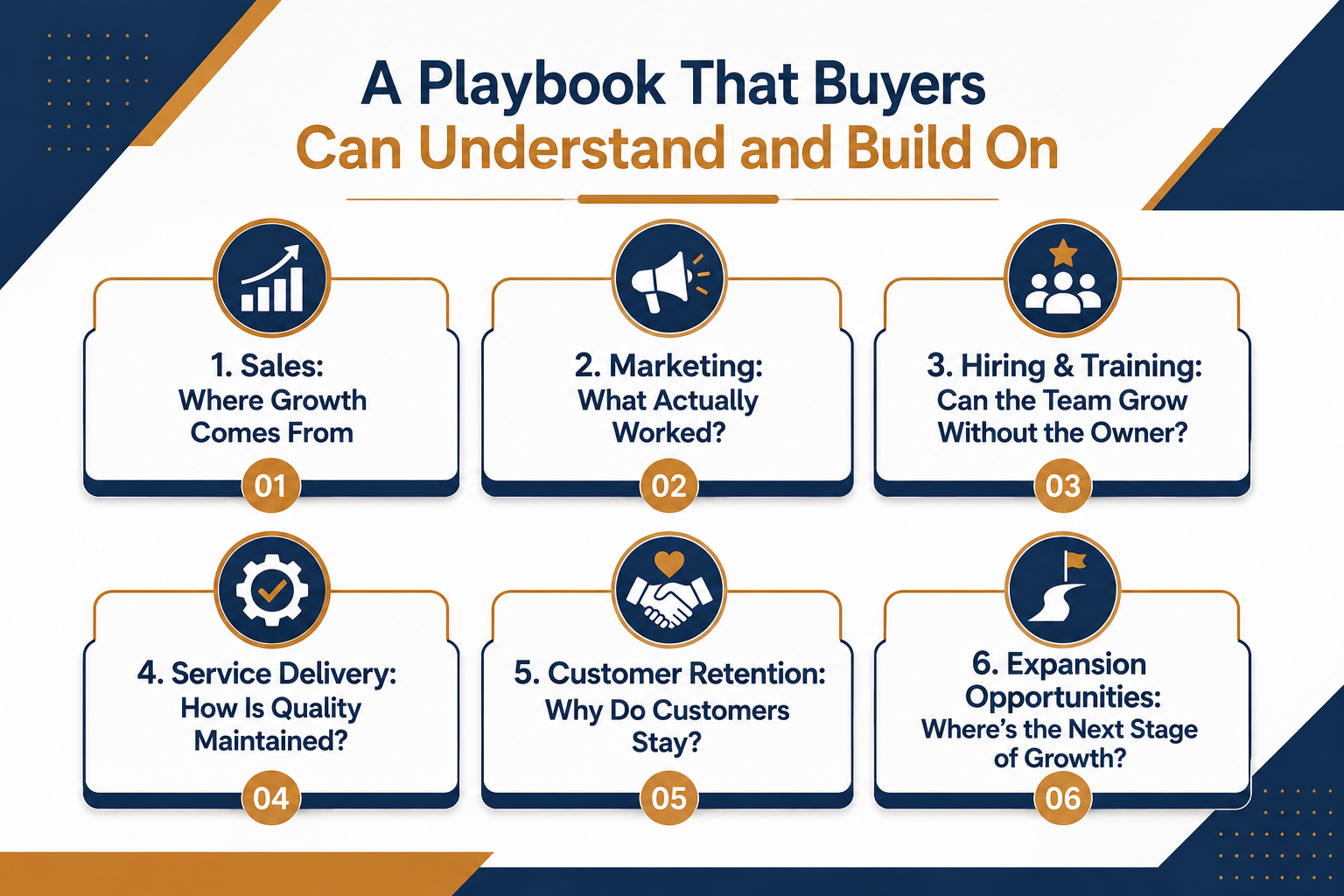
A useful business playbook does not need to document every tiny task in the company. In fact, that can make it worse. The goal is not to create a museum of every process the business has ever used. The goal is to create a practical guide to how the business works and how it can grow.
For a buyer, the most valuable parts of a playbook are the ones that explain what drives the business today and what will continue driving it after the owner steps away.

A buyer wants to understand where leads come from, how they are qualified, who follows up, who closes the deal, and what the handoff looks like after a customer says yes.
The more repeatable the sales process, the easier it is for a buyer to believe future growth is achievable.
Buyers want to know which marketing channels actually work, what messaging resonates, what has been tested, and where there may still be untapped opportunity.
They are less interested in marketing ideas than in evidence. Showing what has already produced results gives buyers more confidence than simply telling them there is "room to grow."
If growth depends on adding people, buyers need to understand which roles matter most, what good performance looks like, how new employees are trained, and where the current team may need additional support.
A documented hiring and training process suggests the business can continue growing without relying entirely on the owner's experience or instincts.
This is where buyers learn how the business delivers consistently, where capacity becomes constrained, and what systems protect quality as the company grows.
Whether the business installs HVAC systems, manufactures products, or provides professional services, buyers want confidence that customers will continue receiving the same experience after the ownership transition.
Buyers want to understand why customers stay, why they leave, what drives repeat business, and whether those relationships depend primarily on the owner or on the business itself.
The more customer loyalty is built into the company rather than one individual, the more transferable the business becomes.
That might mean expanding into new markets, adding complementary services, opening another location, developing new referral partners, or simply investing more heavily in strategies that already work.
A buyer is not looking for ambitious promises. They are looking for a thoughtful roadmap supported by what the business has already proven.
A solid business playbook does not need to be fancy. Most buyers would rather receive a simple, honest playbook that says, "Here are the five things that drive this business," than a beautifully designed binder full of outdated SOPs that nobody uses.
More importantly, a good playbook creates value long before the sale.
It helps the owner run a better business.
It helps the broker explain the opportunity more clearly.
It helps buyers understand exactly what they are purchasing.
And it gives the new owner confidence that they will not have to start from scratch after closing.
Read next: Sales Growth and Valuation: How to Build a Business That’s Ready to Sell
A strong business playbook does not just increase buyer confidence. It can also create more flexibility during negotiations. When buyers understand how the business operates, they are often more comfortable with deal structures that benefit both sides.
| Confidence Builds Flexibility | Uncertainty Creates Friction |
|---|---|
| Shorter transition period | Longer seller involvement |
| Greater confidence in SBA financing | More lender concerns |
| Less reliance on earnouts | More seller financing or earnouts |
| Stronger offers | Lower offers to offset risk |
| Better employee transition | More uncertainty around key employees |
| Faster path to installing a General Manager | Greater dependence on the owner |
On the other hand, when everything depends on the seller, buyers get nervous.
If the owner is the salesperson, trainer, problem-solver, customer relationship manager, pricing expert, and operations manual all in one person, then the buyer is not just buying a business—they are buying a job with a lot of unanswered questions.
That uncertainty limits their options. Buyers may ask for a longer transition, push for seller financing, lower their offer, build in an earnout, or walk away entirely because they cannot see how the business runs without the owner.
A playbook does not solve every problem, but it does reduce uncertainty. And in a business sale, uncertainty usually costs money.
Read more: How to Finance a Small Business Purchase in Tennessee
If you are thinking about selling your business in the next few years, you do not need to document everything at once. Start with the parts of the business that would matter most to a buyer. Here are a few good places to begin.

Where do new customers come from? Break this down by channel. Referral partners, Google, repeat customers, email list, paid ads, trade shows, outbound sales, social media, strategic relationships, or whatever actually applies. Then add context. Which channels produce the best customers? Which ones produce the highest-margin work? Which ones are inconsistent? Which ones could grow with more attention? A buyer does not need perfection. They need a map.
How does a prospect become a customer? This could include how inquiries are handled, who follows up, how quotes or proposals are created, common objections, pricing guidelines, close rates (if known), and what makes someone a bad-fit customer.
This is especially important if the owner is still heavily involved in sales. If the seller says, "I just know when someone is serious," that may be true. But it is not very transferable. A playbook helps turn instinct into something teachable.
What is stopping the business from growing faster? Sometimes the answer is more leads. Often, it is not. The real bottleneck may be hiring, training, scheduling, middle management, equipment, vendor capacity, quality control, or the owner personally approving too many decisions. A buyer will want to know where the ceiling is. Better yet, they want to know what would raise the ceiling.
A buyer needs to understand who does what. This does not need to be a corporate org chart with 17 layers. For most small businesses, a simple role map is enough. Who handles customers? Who handles scheduling? Who handles billing? Who solves problems? Who knows the systems? Who would the team look to if the owner were gone for two weeks? This helps buyers understand whether the company has real management depth or whether everything still flows through the owner.
This is one of the most useful exercises a seller can do. Ask yourself, "If I were buying this business, what would I do first?" That might include meeting the top customers, retaining key employees, cleaning up pricing, relaunching a dormant marketing channel, hiring an operations manager, adding a salesperson, expanding into a nearby market, improving onboarding, tightening job costing, or building a better follow-up system.
This section is not about promising results. It is about showing a thoughtful path. A buyer still has to make their own decisions. But when the seller can hand over a clear picture of the business and its growth levers, the buyer has a better starting point.
Read next: Business Sale Preparation Checklist — A 12-Point Plan to Prepare Your Business for Sale
Many owners wait until they are ready to sell before preparing the business. That's understandable, but not ideal. By the time you go to market, buyers will want answers quickly. Your broker will need to tell the story clearly. Your financials, operations, team structure, and growth opportunities all need to line up.
If you are trying to build that story from scratch during diligence, it can get stressful fast. A better approach is to build the playbook while you are still running the business. That gives you time to test it, clean it up, delegate from it, and see what is missing.
It also helps you run a better company even if you do not sell right away. That is the real benefit. A sale-ready business is usually just a better business. It is less dependent on the owner. It has clearer systems. The team knows what good looks like. Growth opportunities are easier to explain. And the next owner can see a path forward.
Read more: How to Increase Business Value Before Selling: 8 Proven Strategies
If you want maximum flexibility in a future sale, do not just focus on finding a buyer. Focus on making the business easier for a buyer to understand, finance, transition, and grow. That starts with clarity.
What drives the business?
What creates growth? What creates risk?
What lives in the owner’s head that needs to belong to the company?
A thoughtful business playbook helps answer those questions.
For owners preparing to sell in Nashville or Middle Tennessee, Legacy Entrepreneurs helps translate that operational story into a marketable, buyer-ready sale process. As a Nashville business broker, we care about more than getting a listing live. We want buyers to understand the value of what you have built and the opportunity ahead.
For owners who need help finding operational clarity, Untangled helps build practical business playbooks your team can actually use. Both matter. Because when the business is easier to run, it is usually easier to sell. And when buyers can see how they can grow after closing, sellers tend to have more options at the table.
Most owners think about selling their business through a single lens: price.
There is a lot of “scale and sell” content that makes selling a roofing business sound easy, as if buyers are ready to write a check the moment you...
The roofing industry has seen its share of consolidation over the years, but the rise of QXO may prove to be one of the most significant...