


How to Sell a Restaurant in Tennessee: A Practical Guide for Owners
Selling a restaurant in Tennessee comes down to preparation. Buyers will look closely at your financials, lease terms, licenses, payroll, and...
17 min read
Joseph Steigman : Updated on March 26, 2026
Selling a restaurant in Tennessee comes down to preparation. Buyers will look closely at your financials, lease terms, licenses, payroll, and day-to-day operations before they agree to price and terms. If those records are incomplete or the lease is hard to transfer, the sale gets harder.
The National Restaurant Association (NRA) projects that restaurant and foodservice sales will total $1.55 trillion in 2026, up 4.8% from the prior year, which means buyer interest in the category is active, but interest alone does not produce a clean closing.
This guide covers:
P.S. Before you market a restaurant, it helps to know whether the price, lease structure, and financials will hold up under buyer review. At Legacy Entrepreneurs, we help Tennessee restaurant owners evaluate transferability, sale readiness, and value through our restaurant brokerage and business valuation services.
Get a confidential review to identify the issues most likely to affect buyer confidence, financing, and closing before they slow your sale.
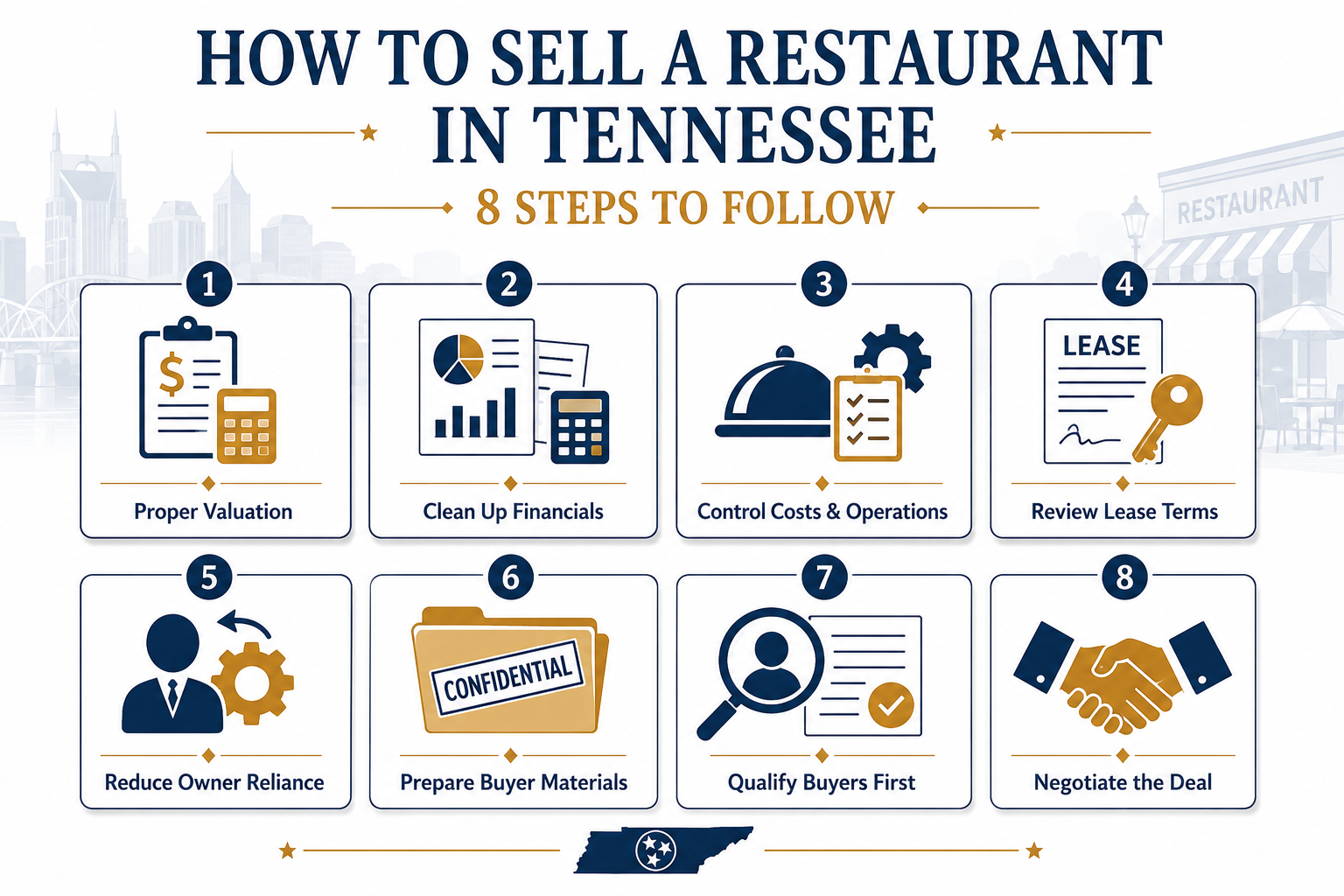
| Key Sale Step | What To Focus On |
|---|---|
| Start with a market-based valuation | Use adjusted cash flow, owner add-backs, lease quality, equipment condition, and transferability to support a price a buyer can finance and defend. |
| Organize financial records before listing | Prepare three years of tax returns, monthly profit and loss statements, POS sales reports, payroll summaries, and documented add-backs before buyer outreach begins. |
| Review lease and transfer requirements early | Check assignment language, years remaining, renewal options, rent escalations, landlord approval steps, and any permits or licenses that require transfer or reapplication. |
| Reduce owner dependence in daily operations | Buyers pay more for a restaurant with management depth, documented routines, stable shift coverage, and less dependence on the owner for daily execution. |
| Control what buyers see and when | Require confidentiality agreements, confirm proof of funds or financing path, and release detailed financials only after the buyer has been screened properly. |
| Negotiate terms that can actually close | Compare purchase price with SBA financeability, seller note exposure, inventory treatment, training commitments, and closing conditions tied to landlord approval. |
| Prepare for diligence before the first offer | Build a clean file set with financials, lease documents, payroll records, equipment schedules, vendor records, and compliance history so the deal does not slow down later. |
Selling a restaurant in Tennessee works best when the process is handled in the right order. The valuation affects buyer response. The lease affects transferability. The financials affect financing. The owner’s role affects how much risk the buyer believes they are taking on.
If you skip one of those issues early, it usually shows up later as a price cut, a financing problem, or a delayed closing.
The practical goal is to present a restaurant that a buyer can understand, verify, and operate after the transition. This means your records need to be reconciled, your lease file needs to be clear, and your operating structure needs to show more than owner effort.
A well-prepared restaurant does not guarantee a favorable sale, but it does give you a much stronger position in negotiation and diligence.

A restaurant valuation should explain what the business is worth, why that value is supportable, and what could move the price up or down during buyer review. It is not just a starting number for negotiation; It is the framework that supports your price when a buyer asks why the restaurant is worth that amount and how the earnings hold up.
Restaurants are valued primarily on earnings quality and transferability. Buyers will review adjusted cash flow, owner compensation, one-time expenses, labor stability, lease quality, equipment condition, and whether the operation can continue without the current owner controlling every important decision.
A restaurant with consistent margins, documented systems, stable shift leadership, and a workable lease often justifies a stronger valuation than a restaurant with similar revenue but weak documentation and heavy owner involvement.
This is also where sellers often lose leverage by overestimating what buyers will pay for effort, brand reputation, or potential. Brand recognition, customer loyalty, and strong local demand can strengthen value, but only when they sit on top of financials and operations that can be verified. If the restaurant’s earnings depend on undocumented cash practices, inconsistent books, or one owner who cannot step away, the valuation becomes harder to defend.
A valuation process should show the specific adjustments being made and the logic behind them. This includes add-backs for owner compensation, one-time legal fees, non-recurring repairs, or personal expenses that ran through the business.
It should also identify risks such as a short lease term, a pending equipment replacement, unstable labor, or vendor concentration. Without that level of detail, valuation becomes a guess instead of a decision tool.
Restaurant deals often slow down because the financial story sounds better than the records behind it. Buyers and lenders do not just want revenue totals; they want evidence that reported earnings are real, consistent, and traceable through the documents they review during diligence.
| Financial Artifact or Issue | What Should Be Verified Inside It | Why Weak Support Causes Problems |
|---|---|---|
| Tax Returns | Three years of filed returns that reconcile to internal profit and loss statements, owner compensation, and reported net income trends | Lenders treat filed returns as a core credibility check. If internal statements show stronger earnings than the returns support, financing confidence drops quickly. |
| Monthly Profit and Loss Statements | Consistent expense categories, clear labor reporting, cost of goods sold detail, and explanations for unusual spikes such as remodel downtime or abnormal repair expense | Buyers use monthly P&Ls to test earnings quality. If categories shift often or large variances go unexplained, the restaurant’s margins become harder to trust. |
| POS Reports | Monthly sales by category, daypart, channel, or service type that tie to reported revenue and explain changes in traffic, ticket average, or seasonality | Buyers want proof that revenue trends are real. POS detail helps them see whether sales are stable, promotion-driven, seasonal, or overstated. |
| Payroll Records | Payroll summaries, management compensation, overtime patterns, and staffing mix across front-of-house and back-of-house roles | Labor is one of the fastest ways a buyer tests operational stability. Weak payroll support can reveal understaffing, hidden labor burden, or off-book risk. |
| Add-Back Schedule | A line-by-line list of owner adjustments supported by invoices, payroll entries, bank records, or one-time expense explanations | Unsupported add-backs directly affect valuation. If an adjustment cannot be documented, buyers usually remove it and reduce the price accordingly. |
| Vendor Invoices and COGS Patterns | Purchase records from key food, beverage, and supply vendors that support margin trends and explain periods of abnormal cost pressure | If the cost of goods sold claims cannot be supported, buyers may assume true margins are weaker than presented and value the restaurant more conservatively. |
| Cash Handling and Deposits | Deposit logs, reconciliations, manager controls, and evidence that reported cash sales were deposited and recorded consistently | Unclear cash handling raises immediate questions about revenue accuracy, shrinkage, and whether the financials reflect the real operation. |
The point of financial cleanup is to make the numbers understandable. If revenue dipped because the kitchen was closed during a hood replacement, explain it with records. If labor improved after a management hire, show the before-and-after pattern in payroll and P&L detail.
Buyers can work with a real story, but they struggle with a story that changes depending on which document they are reading.
Buyers do not stop at revenue and adjusted cash flow. They look closely at food cost and labor because those margins often show whether restaurant earnings are controlled or fragile.
After margins, they evaluate how tightly the operation runs day to day. They want to see whether ordering, prep, scheduling, service standards, and manager accountability are repeatable enough to survive the ownership transition.
A restaurant that runs through disciplined systems is easier to trust, easier to finance, and easier to transfer.
| Area | What Buyers Look For | Why It Matters in a Sale |
|---|---|---|
| Food Cost Margin | Monthly food and beverage cost percentages, explanations for unusual swings, and evidence of portion control, waste discipline, and pricing response to vendor increases | If food cost moves unpredictably or cannot be explained, buyers may assume margins are weaker than reported and lower the value they assign |
| Labor Margin | Labor as a percentage of sales, overtime patterns, manager coverage, and whether the owner is quietly filling unpaid labor gaps | Buyers want to know whether staffing costs are sustainable after closing or whether current margins depend on the owner covering operational holes |
| Prime Cost Discipline | Combined view of food cost and labor trends over time, especially in periods of high sales or staffing pressure | Strong sales do not mean much if prime cost keeps drifting upward. Buyers use this to judge whether earnings are operationally controlled |
| Portion Control and Prep Systems | Standard recipes, prep sheets, line checks, and kitchen routines that produce consistent yield and plate quality | If output depends too heavily on one person’s memory or supervision, the restaurant feels less transferable |
| Ordering and Vendor Management | Who places orders, how pars are set, how shortages are handled, and whether vendor relationships are organized and repeatable | Buyers gain confidence when purchasing is disciplined because it supports stable margins and reduces disruption risk |
| Waste and Inventory Control | Inventory count routines, spoilage tracking, over-ordering controls, and how loss is monitored across key categories | Weak inventory control can distort food cost and signal broader operating sloppiness |
| Scheduling and Shift Coverage | How schedules are built, who covers call-outs, how peak shifts are staffed, and whether the owner must step in regularly | Buyers want a restaurant that runs on a staffing system, not one that depends on constant owner rescue |
| Opening, Closing, and Shift Handoff | Written checklists, drawer close procedures, manager sign-offs, and clear handoff expectations between shifts | These routines show whether day-to-day execution is process-driven or dependent on memory and habit |
| Manager Accountability | Clear ownership of labor control, food quality, guest issues, ordering, and end-of-day review | A buyer is more likely to trust the operation when each recurring responsibility has a defined owner and a repeatable process |
Food cost and labor margins help a buyer understand whether the restaurant is financially disciplined. Daily operating detail helps them decide whether that discipline will continue after closing. That is why buyers pay attention to both. They are not just buying recent revenue. They are buying a system that needs to keep working once the current owner is no longer in the building.
Restaurant value is often tied tightly to location, and location is only transferable if the lease and approval path actually work for the next operator. A buyer may like the concept and the revenue, but the deal can still weaken quickly if the landlord can delay assignment, raise occupancy costs, or require terms the buyer cannot accept.
A restaurant sale becomes much easier to manage when lease and compliance issues are surfaced early instead of discovered after the letter of intent is signed.
A buyer is not only buying your current revenue. They are buying the ability to keep that revenue going after you leave. Therefore, owner dependency affects both price and buyer confidence.
The buyer will see the transition risk immediately if the restaurant needs the owner to solve staffing problems, negotiate with vendors, cover key shifts, manage guest issues, and monitor every important expense decision.
Reducing owner dependency usually starts with role clarity. Buyers want to understand who runs the floor, who supervises the kitchen, who handles ordering, who monitors labor, and who can keep service standards consistent without daily owner intervention. If the owner is still doing most of that, the transition looks heavier, and the operation looks less transferable.
This is often one of the most fixable problems before a sale. A restaurant does not need to become fully absentee-operated to improve value. It does need a clearer operating structure.
That can mean stronger shift leadership, a more capable general manager, documented ordering routines, written opening and closing procedures, or better accountability around labor and vendor management. Those changes can strengthen the sale even if revenue does not change at all.
A serious buyer should be able to understand the restaurant from the marketing package, but the package also needs to hold up once diligence begins. If the early materials are vague, incomplete, or inconsistent with the detailed documents, trust starts to erode before the deal is fully underway.
The best package does not just make the restaurant look attractive. It reduces confusion later by matching what the buyer sees initially with what the diligence file will later confirm.
Read Next: Selling a Restaurant in Tennessee: A Practical Guide
Restaurant listings can attract a lot of attention from people who are curious, undercapitalized, or not prepared to operate the business. If you release sensitive financials too quickly, you increase confidentiality risk without improving the chance of closing.
A qualified buyer is not just someone interested in your restaurant. It is someone who can finance the deal, survive approvals, and take over the operation with a credible plan.
The highest offer is not always the best one. Restaurant deals are often decided by the deal structure and terms, not just the price on page one. Financing, inventory treatment, landlord approval, seller support, and closing conditions all affect whether the transaction actually reaches the finish line.
| Deal Term | What Needs To Be Clarified | Why It Matters |
|---|---|---|
| Purchase Price | Whether the price is supported by earnings, asset value, transferability, and the buyer’s financing capacity | An inflated price may be reduced after due diligence, especially when payroll, margins, or sales quality do not support the original number. |
| SBA or Other Financing | The financing path, timeline, approval conditions, and whether the restaurant’s financials support the requested debt | A deal that looks workable on paper can still fall apart if the lender determines the cash flow will not support the loan amount. |
| Inventory Treatment | Whether food, beverage, and supplies are included in the purchase price or valued separately at closing | Unclear inventory treatment often leads to late-stage disputes when one side assumes inventory is included and the other expects a separate payment at closing. |
| Transition Support | The length of the transition period, expected hours, training scope, and whether the seller will assist with vendor, staff, or operational handoff | Poorly defined transition support can create friction when the buyer expects weeks of hands-on help, and the seller planned only a short handoff. |
| Closing Conditions | Landlord approval, financing approval, due diligence completion, licensing or permit transfer issues, and document deadlines | Vague or open-ended conditions can delay closing, particularly when landlord approval or permit transfer takes longer than either side expected. |
Negotiation should also reflect what you actually care about. Some owners want maximum price, while others care more about speed, confidentiality, employee continuity, or retirement timing.
That is why the best deal is the one that aligns price with realistic closing terms, not the one that sounds strongest before the real work begins.
Read Next: How Restaurants Are Valued in Tennessee
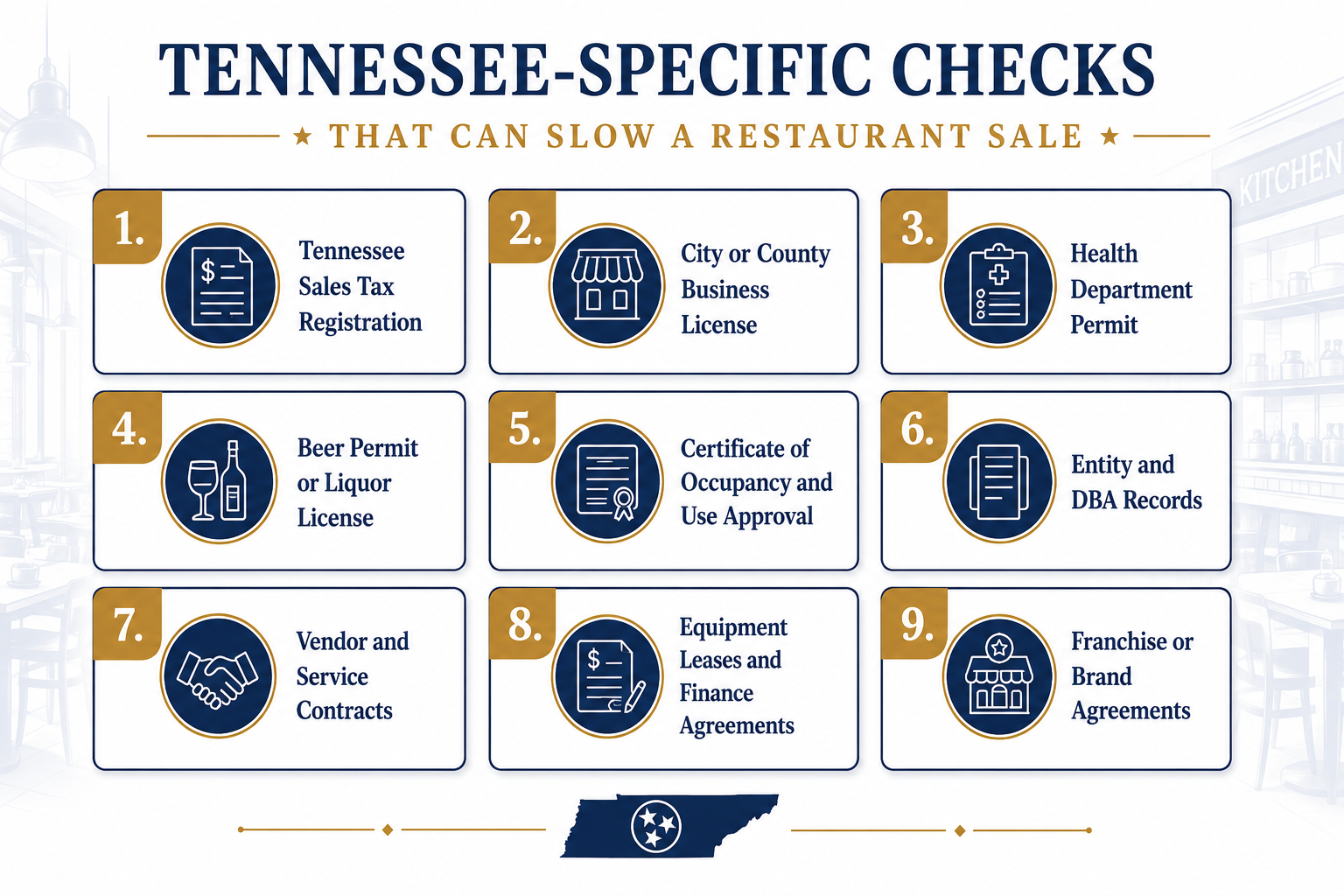
Selling a restaurant in Tennessee can stall when the buyer starts asking for permits, tax registrations, and operating records that were never organized for transfer. This is not just about legal compliance in the abstract. It is about whether the restaurant can move from one owner to the next without delays tied to tax registration, food-service permitting, alcohol approvals, premises-use records, or missing contracts. Before you market the business, pull the exact records that usually matter in a Tennessee restaurant sale and verify how each one will be handled at closing.

Pull the restaurant’s Tennessee sales and use tax registration details and confirm which legal entity holds the account. Tennessee requires registration through TNTAP for businesses making taxable sales, and the Department issues a Certificate of Registration for display at the business location. In an asset sale, the buyer will usually need its own registration rather than relying on the seller’s account. Unpaid taxes, filing gaps, or unclear account history can create closing friction because the buyer and closing team will want a clean division between pre-closing and post-closing tax responsibility.
Locate the local business license or business tax registration tied to the restaurant and verify what the buyer will need to obtain in order to operate after closing. Tennessee business tax registration and licensing are handled through state and local systems, and whether a full business license or a minimal activity license applies depends on the business’s gross receipts. For a sale, the practical issue is usually whether the buyer must complete a new registration or licensing step with the relevant county clerk or city official rather than assuming the seller’s status carries over unchanged.
Pull the current food-service permit, recent inspection reports, any violation notices, and proof of corrective action. In Tennessee, restaurants are generally regulated through the Tennessee Department of Health’s Food Service Establishment Program, with some functions handled through local health departments. Buyers want to see whether the operation is in good standing and whether a change of ownership will require a new permit process, inspection, or approval step before operating under the buyer.
If the restaurant sells alcohol, gather the active beer permit, liquor-by-the-drink license if applicable, renewal records, and any compliance correspondence. These approvals should be reviewed separately because beer permitting is generally local, while liquor-by-the-drink licensing is handled by the Tennessee Alcoholic Beverage Commission. This is a meaningful closing issue, not a minor paperwork item: Tennessee’s alcohol rules also require the purchaser or transferee to be licensed before the completion of an alcohol inventory transfer tied to the sale of a business.
Pull the certificate of occupancy, use-and-occupancy approval, or equivalent local records tied to restaurant's use of the premises. This is a local issue, so the exact document varies by jurisdiction. The buyer wants confirmation that the current buildout and restaurant use were properly approved and that there is no hidden zoning or occupancy problem that could surface during transfer. In Nashville, for example, a U&O permit is required for all restaurants, even when the prior use was also a restaurant, and some agencies may require it in the new company name.
Organize the articles of organization or incorporation, operating agreement or bylaws, EIN confirmation, and any assumed name or DBA filings. These documents matter because the buyer, lender, and closing attorney need to know exactly which entity owns the assets being sold and whether the operating name matches the legal seller shown on tax accounts, permits, leases, and contracts. If the entity structure is unclear, the closing file becomes harder to underwrite and document cleanly.
Pull agreements for key food and beverage vendors, linen service, waste removal, pest control, grease-trap service, merchant processing, POS systems, delivery platforms, and music licensing. Buyers review these to determine what can be assigned, what renews automatically, what can be terminated on short notice, and whether any major service costs could change after closing. This is one of the easiest places for a deal to lose momentum because a buyer may discover too late that a critical contract cannot be assigned on the expected terms.
Gather lease or financing documents for POS hardware, kitchen equipment, refrigeration, dish machines, or specialty beverage systems. A buyer needs to know which assets are owned outright, which require payoff at closing, and which may be subject to assignment restrictions or liens. In restaurant sales, “included in the sale” is not specific enough if the equipment is financed, leased, or encumbered.
If the restaurant is franchised or operates under licensed branding, pull the franchise agreement, transfer terms, approval requirements, and current fee schedule. This can become a major transaction variable because the buyer may need franchisor approval, training, financial qualification, or a new agreement before the sale can close.
Working with a restaurant broker can help because these issues rarely appear one at a time. A professional restaurant business broker and valuation expert who understands restaurant transactions can identify which records need to be assembled before going to market, spot transfer issues that affect value or timing, coordinate with the landlord and closing attorney, and screen buyers before sensitive information is released.
This can reduce avoidable delay by making sure the sale process is organized around the documents, approvals, and operating facts that buyers and lenders will actually test.
A sale is not always the best immediate move. Some Tennessee restaurants would produce a stronger result with a cleaner operating structure, better records, or less owner dependency before entering the market. The point is not to delay for the sake of delay. The point is to know whether another six to twelve months of focused preparation could change the quality of the outcome.
That is especially relevant if you are stepping away because of burnout, retirement, or pressure from daily operations. In those cases, the right path may still be a sale, but the best sequence is not always to list first and solve problems later.
If the restaurant still depends on the owner for scheduling, vendor management, labor control, customer issue resolution, and day-to-day supervision, a buyer will price that risk into the deal. One way to improve transferability before a sale is to strengthen the operating layer beneath the owner.
A capable general manager or operating leader can take on scheduling, staffing accountability, routine vendor coordination, and service oversight. That creates a more stable handoff and gives the buyer a clearer picture of how the restaurant functions without daily owner rescue. It also makes the business easier to present because the team structure becomes more visible and the owner’s role becomes narrower.
A stronger management layer can be valuable even if a sale is still months away. It reduces dependency, helps stabilize operations, and can improve buyer confidence later without requiring a major rebrand or growth plan.
Some restaurant owners need an exit plan before they need a buyer list. That plan should clarify timing, price expectations, readiness gaps, transition goals, and what still needs to be cleaned up before the restaurant is taken to market.
Exit planning is useful because it turns vague intent into specific preparation. Instead of asking whether now feels like the right time, you can ask whether the tax returns reconcile, whether the lease term is strong enough, whether management can cover key functions, and whether the financials justify the price you want. Those are much better decision points.
It also helps with personal planning. Selling your restaurant may be tied to retirement, another venture, or simply stepping away from the stress of daily operations. The cleaner that decision is before marketing begins, the better your negotiation discipline usually becomes.
Read Next:
A restaurant sale gets stronger when the price is supported by evidence, the lease can transfer on workable terms, and the buyer can see how the operation will continue after closing. That is what makes negotiation more productive. You spend less time defending weak preparation and more time deciding whether the terms, timing, and transition structure actually fit your goals.
Legacy Entrepreneurs helps Tennessee restaurant owners who need a clearer path through valuation, preparation, buyer screening, negotiation, and closing. Our restaurant brokerage support and business valuation services are built to help you understand what needs to be fixed before a buyer starts diligence.
Get a confidential review to clarify your restaurant’s value, spot deal risks early, and move toward a cleaner, more defensible sale process.
Selling a restaurant in Tennessee comes down to preparation. Buyers will look closely at your financials, lease terms, licenses, payroll, and...
Selling a restaurant is one of the most significant decisions an owner can make. Whether you’re ready to retire, pivot to a new business, or simply...
If you’re considering selling your business but concerned about the tax hit, you’re not alone. Many business owners hesitate to exit because of the...