


Landscaping Business Valuation in Tennessee: Multiples, Risks, and Price Drivers
For Tennessee landscaping owners, valuation is less about applying a simple revenue multiple and more about showing why the business can hold its...
16 min read
Joseph Steigman : Updated on March 27, 2026
Selling a manufacturing business usually comes with uncertainty around timing, value, and whether the company will actually hold up once buyers begin asking harder questions. Many deals lose momentum because the owner goes to market before the numbers reconcile, before transfer risks are clear, and before the operational story can support the asking price.
Tennessee manufacturing contributed more than $68 billion to the state economy in 2024, which means buyers have real interest in the sector, but they also have enough options to be selective. A stronger outcome usually starts with the same move: understanding what your business can support in the market, fixing the issues that weaken buyer confidence, and preparing the company before the sale process begins.
This guide covers:
P.S. Before you market a manufacturing company, it helps to know whether the cash flow, equipment records, customer contracts, and transfer issues will hold up under buyer review. At Legacy Entrepreneurs, we help Tennessee business owners evaluate sale readiness and price support through our cutting-edge business valuation services.
Get a manufacturing business valuation to identify the issues most likely to affect pricing, buyer confidence, and closing before they weaken your sale process.
| Decision Area | What Needs To Be True |
|---|---|
| Cash Flow Support | Three years of tax returns, monthly P&Ls, balance sheets, and add-back support should reconcile cleanly so a buyer can test normalized earnings instead of debating the numbers. |
| Machinery And Equipment | The fixed asset list should show what is owned, financed, leased, or obsolete, along with serial numbers, maintenance records, payoff amounts, and any liens that affect transfer. |
| Customer Transferability | Customer concentration reports, assignable contracts, backlog detail, and purchase history should show that revenue can survive under a new owner without heavy seller dependence. |
| Inventory And WIP | Raw material counts, obsolete inventory reserves, WIP aging, and costing methods should be current enough to support working capital targets and prevent purchase price disputes. |
| Management Depth | Buyers want to see who runs production, scheduling, quality, maintenance, and key customer relationships so the plant does not depend on one departing owner. |
| Facility Readiness | Lease assignment language, years remaining, renewal options, zoning fit, utility capacity, loading access, and environmental history need to support uninterrupted operations after closing. |
| Diligence Readiness | A clean diligence file should include contracts, debt schedules, insurance, permits, OSHA logs where relevant, HR records, and tax documentation that match the story behind the asking price. |
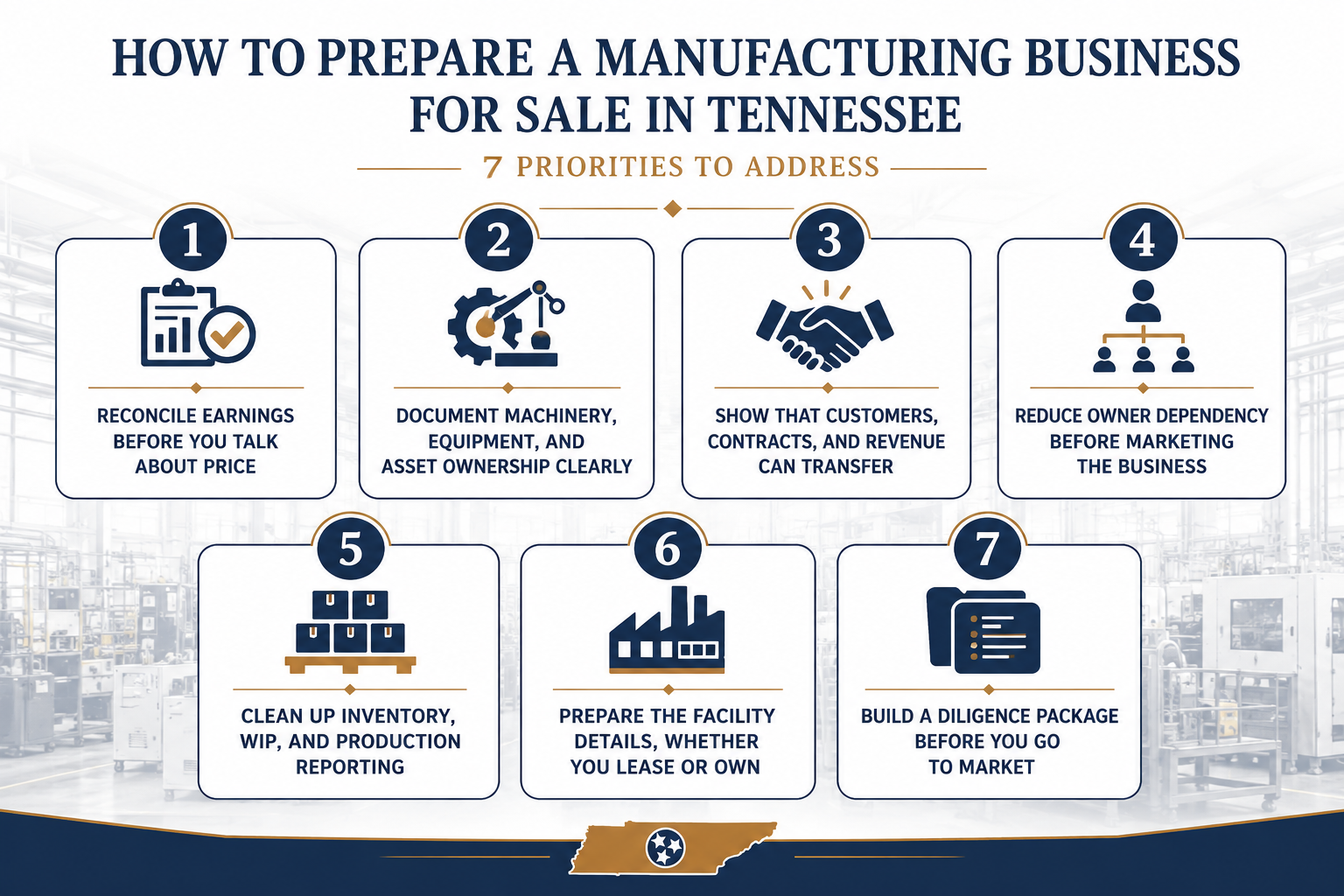
Preparation determines whether a buyer sees a transferable company or a risky handoff with unresolved questions. In manufacturing, price support depends on more than revenue and machinery. Buyers want evidence that cash flow is real, production can continue under new ownership, and liabilities are visible before the negotiation process gets expensive. If those records are weak, the sale of your business can slow down after the letter of intent, even if early interest looks strong.

A buyer will test whether reported earnings reflect dependable cash flow or a performance that only works under the current owner. That review usually starts with tax returns, internal financial statements, and the add-backs used in the valuation calculation. If those documents do not match, the asking price can quickly lose credibility.
Machinery plays a major role in shaping both valuation and deal structure in the manufacturing sector. Buyers are not just asking what equipment exists. They want to know what condition it is in, whether it is critical to production, whether it is financed, and how much near-term spending a new owner will face after closing.
A manufacturing company’s value depends on whether revenue stays in place after the owner exits. That is why buyer interest usually narrows around transferability, not just current sales. If one owner handles quoting, customer relationships, engineering changes, and production escalation calls, the buyer may see the company as less transferable even when revenue looks strong on paper.
Customer concentration is one of the first pressure points. A buyer will look at the percentage of revenue tied to the top five accounts, how long those accounts have been active, whether pricing has held, and whether work is governed by signed customer contracts, repeat purchase orders, or informal relationships. A business with a stable backlog, documented terms, and diversified accounts usually supports a stronger valuation than a plant where one customer can move the work with a phone call.
Contract assignability matters too. A manufacturing company may have supply agreements, blanket purchase orders, quality certifications, service commitments, or exclusivity language that requires notice or consent before transfer. If those rights do not move cleanly to a new owner, the buyer may lower the offer to account for revenue loss risk. That problem becomes even more important when strategic buyers or private equity groups evaluate an acquisition, because they tend to model post-close retention more rigorously.
Backlog and order history also need to be readable. Buyers want to see what is booked, what margin profile sits inside the backlog, and whether revenue depends on a small number of jobs with unusual pricing. If backlog is overstated, cancellation-prone, or disconnected from production capacity, the negotiation process can turn from price discussion into risk control.
A manufacturing business becomes easier to finance and easier to transfer when production, sales, and daily decisions do not rely on one person. If the owner still resolves scheduling bottlenecks, approves quality exceptions, quotes every major job, and manages key vendors personally, buyers will worry that performance and growth will fall after closing.
In manufacturing and fabrication businesses, inventory and work-in-progress can distort value quickly if records are outdated. A buyer does not want to inherit raw materials that no longer fit production demand or WIP reports that overstate profitable jobs. These items directly affect working capital targets, purchase price adjustments, and whether the financial statements reflect the real condition of the plant.
The facility matters because manufacturing companies cannot move casually. A buyer will review the site as part of transferability, not just occupancy cost. Utility capacity, loading access, zoning, maintenance responsibility, and environmental history all affect whether operations can continue under the new owner without immediate disruption or capital spending.
| Facility Structure | What Buyers Will Verify | What Weakness Usually Causes |
|---|---|---|
| Leased Facility | Assignment language, landlord consent rights, years remaining, renewal options, rent escalations, CAM charges, repair obligations, and any use restrictions tied to industrial activity | A short-term, difficult assignment clause, or rising occupancy cost, can reduce financing support and force renegotiation before closing |
| Owner-Occupied Real Estate | Whether real estate is included, leased back, or sold separately, plus appraisals, environmental history, deferred maintenance, utility capacity, dock access, and site fit for current manufacture | Unclear real estate terms can confuse valuation, create financing gaps, and delay the buyer’s operating plan |
| Specialized Production Site | Power requirements, compressed air, cranes, dust collection, wastewater handling, clear height, truck flow, and safety layout for current machinery and throughput | A facility that works only because of seller workarounds may trigger capex discounts or narrow the pool of strategic buyers |
A well-documented diligence package shortens the transaction process and gives the buyer fewer reasons to retrade after the LOI. It also helps a business broker or advisor present the manufacturing business effectively because the story behind the numbers is already supported by evidence. If the documents are incomplete, multiple buyers may show early interest but drop out once a deeper review begins.
Read Next: How to Sell Your Manufacturing Business: 5 Strategic Steps to Prepare for Exit
Manufacturing transactions can be delayed by tax exposure, liens, facility issues, permit questions, and transfer mechanics that only become visible once buyer counsel and lenders start their review. Those problems are expensive to fix late. They are much easier to address before you start marketing the company to sell your business.
This section is not legal or tax advice. It is a practical list of transaction issues that should be reviewed with Tennessee counsel, a CPA, and your sale team before the sale of your manufacturing business moves too far.

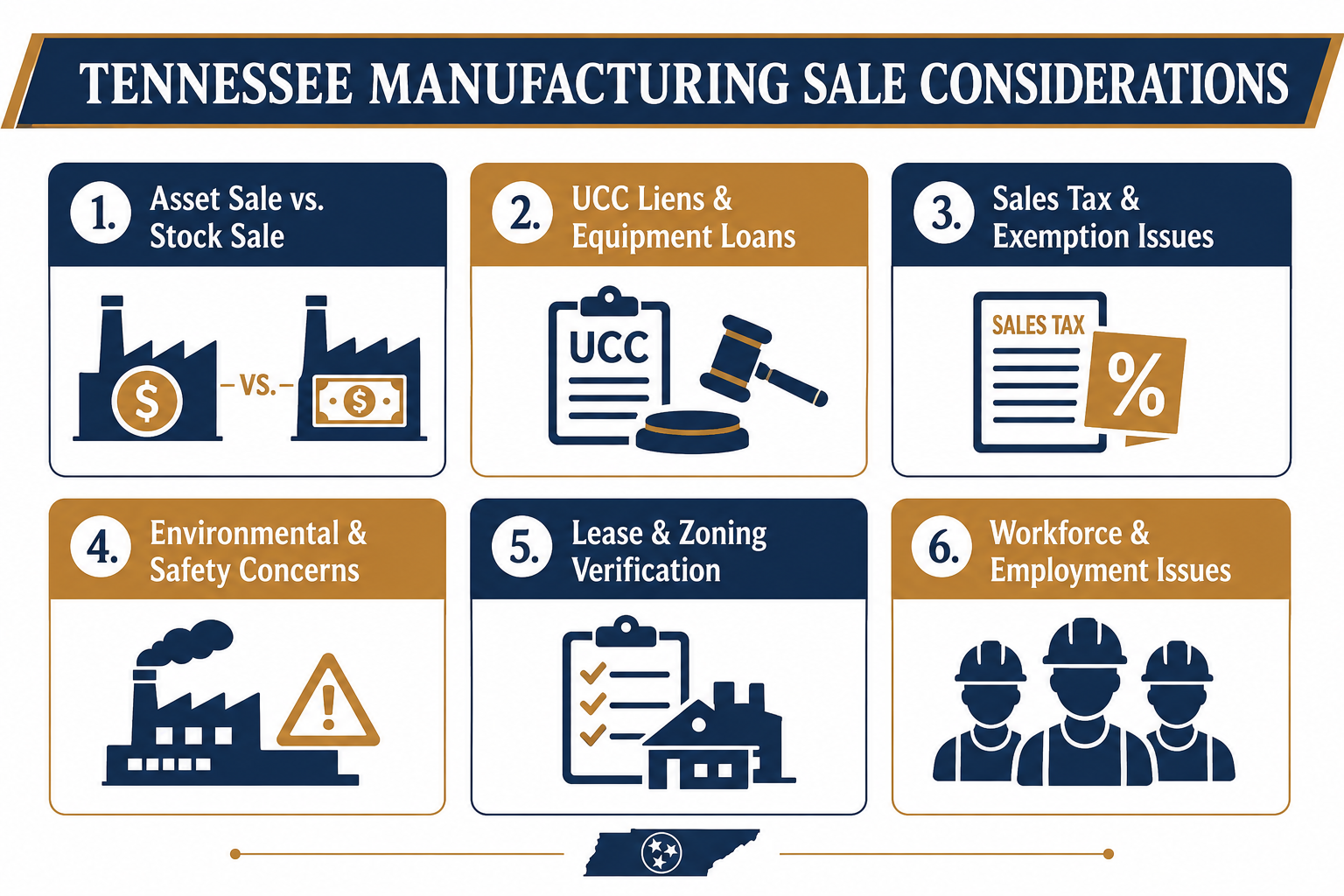
The structure of the business sale can change your net proceeds and the buyer’s risk profile even before price negotiations are finished. In many lower middle market manufacturing deals, buyers prefer an asset purchase because it lets them choose which liabilities they assume, step up certain assets for tax purposes, and avoid some legacy exposure. Sellers often focus first on the headline number, but a lower price with a cleaner structure can sometimes produce a better outcome than a higher price with heavier retained liability or difficult tax treatment.
That structural decision also affects transfer mechanics. Machinery, inventory, customer contracts, real estate leases, permits, intellectual property, and employee arrangements may move differently in an asset sale than in a stock sale or merger. If assignability is weak or liabilities are unclear, the buyer may push hard toward an asset deal even when the seller prefers otherwise. That is why an early advisor conversation should model structure, taxes, and liability allocation before the letter of intent sets expectations that are hard to unwind.
Liens and secured debt often surface late only because no one assembled the payoff and release path early enough. Buyers, lenders, and counsel will search for recorded security interests and want to know exactly what has to be released at closing.
A buyer looking at manufacturing companies in Tennessee will often test whether sales and use tax treatment has been handled consistently. Exposure can come from machinery purchases, consumables, taxable sales, exemption certificate management, or interstate transactions that were booked incorrectly. These issues matter because a buyer does not want hidden tax liability to become an indemnity fight after closing.
Environmental and workplace safety issues can change deal terms quickly because they affect both liability and continuity of operations. In manufacturing and fabrication settings, buyers usually want to understand what materials are used, how waste is handled, whether there have been spills or remediation issues, and how safety problems have been addressed over time. A company that uses coatings, solvents, metal finishing processes, cutting fluids, compressed gases, wastewater systems, or heavy machinery should expect closer review than a simpler service business.
The practical issue is not whether the plant has ever had a problem. Most buyers understand that long-running manufacturing operations have a history. The issue is whether that history is documented, understood, and reasonably controlled. Records tied to TDEC correspondence, waste disposal vendors, hazardous material handling, OSHA logs, inspection results, prior citations, or corrective actions help the buyer determine whether risk is manageable or whether additional escrows, indemnities, or site work may be needed.
Facility structure matters here, too. A leased site may include environmental representations, repair obligations, or use restrictions that become important during transfer. An owner-occupied property may raise questions about prior industrial use, drainage, storage practices, or historical contamination concerns. If these issues are discovered late, they can slow the closing, narrow the buyer pool, or create a stronger push toward an asset purchase structure designed to contain liability.
A manufacturing facility is part of the operating system. If the lease cannot be assigned, if industrial zoning is nonconforming, or if the site lacks the utility or truck access the buyer needs, the transaction can weaken quickly. That risk increases when the manufacturing business depends on a specialized floor layout, high amperage, loading docks, wastewater capacity, or storage configurations that are hard to replicate.
Lease review should cover assignment language, landlord approval rights, remaining term, renewal options, rent escalations, use clauses, repair obligations, and any relocation rights. Zoning and use should also be verified against the actual business operations, especially where outside storage, truck traffic, noise, emissions, or fabrication processes matter. A buyer may still proceed with a weak site, but it usually leads to a lower offer, added conditions, or a post-close relocation plan that changes how the deal is priced.
Manufacturing buyers know that a clean plant with weak workforce continuity is still a risky acquisition. Production supervisors, machinists, welders, maintenance staff, quality personnel, and customer-facing estimators often hold practical knowledge that does not sit in a procedure manual. A buyer will want to know whether that team is likely to stay and whether wage, overtime, and policy practices create hidden exposure.
Buyer type changes what gets emphasized in valuation, diligence, and negotiation. Some buyers care most about integration opportunities. Others care about clean cash flow, stable management, or financing support. Understanding that difference helps you position the manufacturing business for sale in a way that attracts the right conversations instead of wasting time with poor-fit inquiries.

Strategic buyers usually focus on how the acquisition fits an existing operation. They may want added capacity, access to a new customer set, complementary manufacturing and fabrication capability, vertical integration, or a better Tennessee footprint. Because of that, they often study customer contracts, machinery fit, production overlap, and post-close consolidation opportunities more closely than an individual buyer would.
These buyers can sometimes justify a stronger offer if the target fills a gap they already understand. At the same time, they are often disciplined about integration risk. If a manufacturing company’s margins depend on one owner relationship, one custom production line, or one unstable customer, a strategic buyer may become more cautious than expected.
Private equity-backed buyers and platform manufacturing companies tend to focus on scalable cash flow, management depth, and add-on fit. They are more likely to push for detailed earnings normalization, quality of earnings work, and well-documented KPI reporting. If they see strong performance and growth, recurring customers, a transferable management layer, and room to maximize value through expansion or operational discipline, they may move aggressively.
They also tend to be demanding during due diligence. Weak financial records, vague add-backs, unclear working capital, and undocumented liabilities will usually matter more with these buyers. A manufacturing company’s reporting quality often determines whether private equity sees a real platform or an overly owner-dependent operation.
Individual buyers often look for manufacturing businesses for sale that are understandable, financeable, and not overly dependent on the current owner. They may rely on bank or SBA-type financing structures where available, which makes clean financial statements, transferable customer relationships, and a realistic transition period especially important.
For smaller manufacturing businesses, this can be a strong buyer pool if the company is well-documented and operationally stable. If the plant only works because the seller handles quoting, troubleshooting, vendor pressure, and key customer calls personally, the business may still attract interest, but the buyer pool gets narrower, and the valuation usually becomes harder to defend.
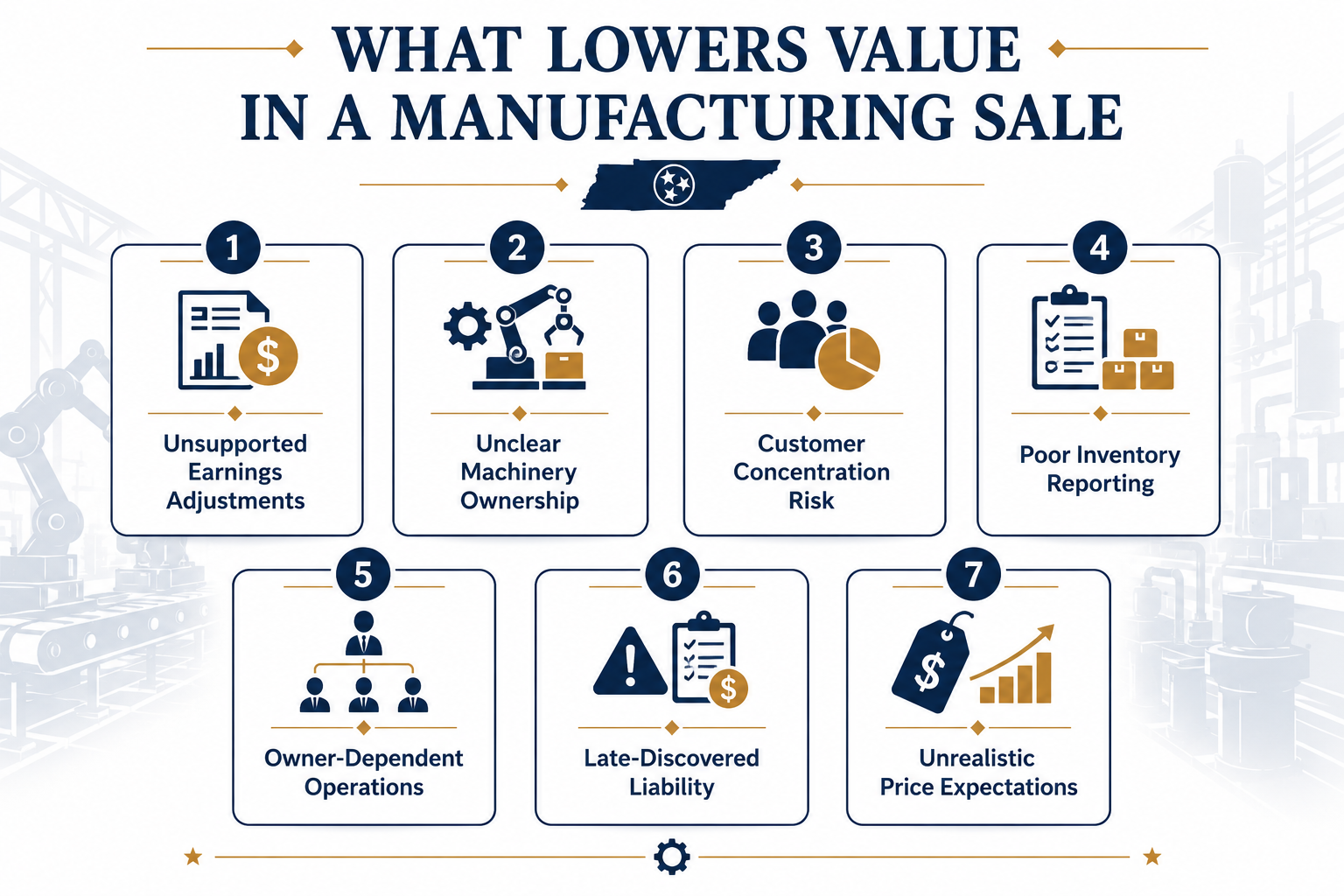
Most value loss in a manufacturing business sale comes from issues that could have been identified before going to market. Buyers do not expect perfection. They do expect clarity. If they find unclear asset ownership, weak reporting, hidden liability, or unrealistic pricing, the sale becomes harder to close, and the business value becomes harder to defend.

Read Next: What’s My Business Worth? Why You Can’t “Double Dip” on Equipment, Fixtures & Inventory
The best manufacturing exits usually start before the company is marketed. They start when the owner decides to test the numbers, clean up transfer risk, and determine whether the business should be sold now or after a defined preparation period. That approach produces a more credible sales process because the valuation, documents, and operating story are already aligned before the first buyer conversation begins.
At Legacy Entrepreneurs, we work with Tennessee business owners who need a clearer path through valuation, preparation, buyer screening, negotiation, and closing. Our business brokerage support and business valuation services are built to help you understand what your manufacturing company can support in the market and what needs to be fixed before a buyer starts diligence.
Get a manufacturing business valuation to clarify price support, identify deal risks early, and move toward a cleaner, more defensible manufacturing business sale.
The answer depends on normalized cash flow, customer concentration, machinery condition, management depth, working capital needs, and transferability. A rough market multiple without clean financial records, asset support, and buyer risk analysis is usually not enough. A credible business valuation should show how earnings were adjusted, what risks affect the range, and why the business value can or cannot support the target asking price.
Profitability varies widely by niche, capital intensity, customer mix, pricing power, labor model, and production discipline. For a business sale, buyers care less about generic industry rankings and more about whether your specific manufacturing business produces stable margins, repeat demand, and dependable cash flow. A lower-profile niche with clean reporting and strong customer retention can be more attractive than a larger category with volatile margins.
Yes. Tennessee has a large and diverse manufacturing base that includes automotive suppliers, metal fabrication, food production, packaging, industrial services, and specialty manufacturing companies. That matters in a sale because it creates a broader field of strategic buyers, operators, and investors who already understand the manufacturing industry and may want a Tennessee footprint.
Multiples vary based on size, earnings quality, customer concentration, management depth, capex burden, and buyer competition. Smaller owner-led manufacturing businesses often trade on a cash flow multiple, while larger operations may be evaluated more directly on EBITDA. The important point is that the multiple follows risk and transferability. It is not a shortcut that replaces due diligence or a real valuation.
Many manufacturing sales take several months from preparation through closing, and some take longer if documentation is weak, buyers need financing, or transfer issues emerge around leases, liens, environmental matters, or customer contracts. The timeline improves when financial statements are up-to-date, machinery records are organized, and the diligence package is built before buyer outreach starts.
Not every transaction requires the same support, but many manufacturing owners benefit from a business broker or business advisor because the process involves valuation, confidentiality, buyer screening, negotiation, diligence management, and closing coordination. Manufacturing deals also include technical issues around equipment, contracts, liability, and operational transfer that can become harder to manage without experienced transaction support.
For Tennessee landscaping owners, valuation is less about applying a simple revenue multiple and more about showing why the business can hold its...
Selling a logistics company in Tennessee requires proof that cash flow, contracts, fleet condition, and compliance can withstand buyer and lender...
Business valuation multiples are often treated as a shortcut to price, but in practice, they are only as reliable as the underlying business...