

Landscaping Business Valuation in Tennessee: Multiples, Risks, and Price Drivers
For Tennessee landscaping owners, valuation is less about applying a simple revenue multiple and more about showing why the business can hold its...
18 min read
Joseph Steigman : Updated on March 27, 2026
For Tennessee landscaping owners, valuation is less about applying a simple revenue multiple and more about showing why the business can hold its value through a sale. Buyers look at how reliably the company generates cash, how dependent operations are on the owner, whether contracts and customer relationships will transfer, and how well equipment, crews, and recurring work support future performance.
That matters more now because small business transactions still face tighter scrutiny on documentation, earnings quality, and lender support than many owners expect. In fact, BizBuySell’s 2025 Insight Report found that U.S. small-business transaction volume remained essentially flat year over year (totaling 9,586 deals, only a 0.46% increase from 2024).
A valuation that cannot be supported by clean financials, assignable contracts, fleet records, and a realistic transition plan usually gets cut during diligence, even if the business performs well day to day.
This guide covers:
P.S. Before you test a price for a landscaping business, it helps to know whether the earnings, contracts, and transfer risks will hold up under buyer review. At Legacy Entrepreneurs, we help Tennessee owners with business valuation work and sale preparation support tied to real market conditions, not inflated formulas.
Get a landscaping business valuation to identify pricing gaps, documentation problems, and transfer issues before they weaken buyer confidence or financing options.
| Valuation Factor | What Tennessee Buyers Actually Test |
|---|---|
| Earnings Method | Smaller owner-led companies are usually priced on SDE, while larger management-led firms may be priced on EBITDA if the books support a separate leadership structure. |
| Revenue Quality | Buyers separate recurring maintenance contracts from project-based install work because repeat route revenue is usually easier to finance and defend. |
| Owner Dependency | Heavy dependence on the owner for estimates, key accounts, crew oversight, or sales usually pushes the multiple down. |
| Customer Mix | Concentration in one HOA, one property management company, or a handful of commercial accounts raises retention risk after closing. |
| Equipment Condition | Trucks, trailers, mowers, and financed equipment are checked for age, title status, lien balance, and replacement needs before buyers accept the asking price. |
| Financial Cleanup | Tax returns, profit and loss statements, payroll detail, and add-back support must reconcile, or the valuation loses credibility quickly. |
| Transferability | Contract assignment terms, employee stability, and transition support affect whether the buyer can actually keep the revenue they are paying for. |
Landscaping companies are not valued by one simple benchmark. The number depends on the size of the company, the consistency of cash flow, the type of revenue you generate, how involved the owner is, and how transferable the customer relationships will be after a sale. Two similar landscaping companies with the same annual revenue can produce very different sale prices if one has recurring maintenance contracts, stable crews, and clean books, while the other relies on one owner, irregular project work, and unclear equipment ownership.
Tennessee buyers also look beyond the income statement. They want to see whether the business can survive a change in ownership without losing major accounts, breaking crew continuity, or triggering unexpected cleanup on taxes, titles, and contracts. That is why a realistic business valuation has to combine earnings analysis with transfer risk.

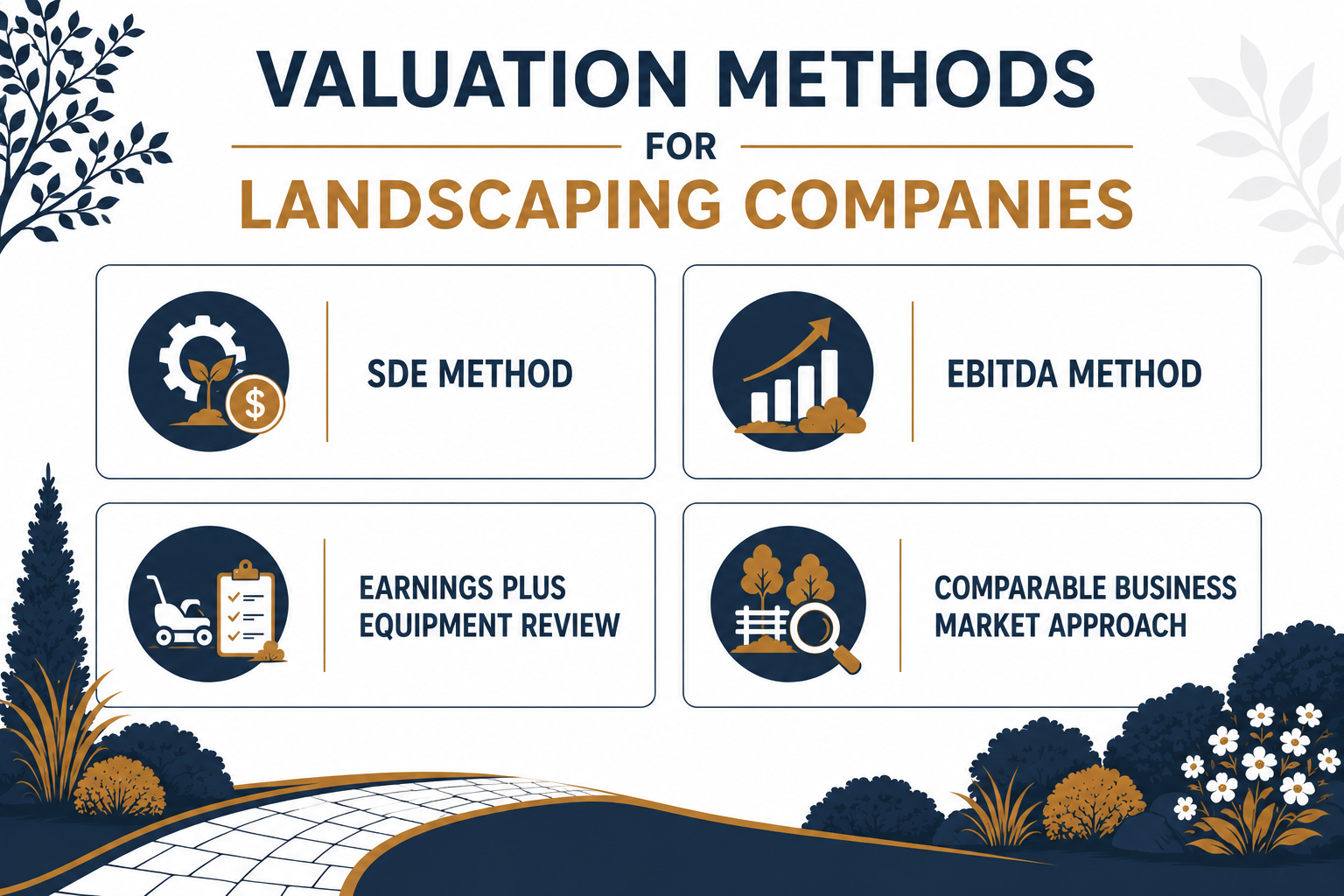
The right valuation method depends on how your company operates and how a buyer would step into it. A smaller owner-operated lawn care business is evaluated differently from a larger landscaping services business with production managers, office staff, and a sales layer. The method is not just an accounting choice. It shapes the buyer pool, financing path, and sale price range that can be defended in the market.
|
Valuation
Method
|
Best Fit for a
Landscaping Business
|
Key Items a
Buyer Will Test
|
Likely Impact on Value
If the Support Is Weak
|
|---|---|---|---|
| SDE Method | Owner-led companies where the owner still handles estimating, sales, scheduling, customer relationships, or crew oversight | Owner compensation, personal expenses run through the business, one-time costs, family payroll, discretionary add-backs, and how much revenue depends on the owner personally | Buyers may reject some add-backs, reduce the multiple, or view the business as riskier to transition |
| EBITDA Method | Larger landscaping businesses with managers in place, cleaner financial reporting, and less day-to-day owner involvement | Market-rate pay for managers, normalized overhead, true operating margins, documented org structure, and whether the company can run without a working owner | The valuation often falls back toward an SDE-style analysis if the business is not actually management-run |
| Earnings Plus Equipment Review | Businesses with meaningful fleet and equipment value, such as trucks, trailers, mowers, skid steers, loaders, or irrigation equipment | Asset lists, titles, lien balances, age and condition, maintenance records, replacement needs, and whether any equipment value is already captured in earnings | Sellers may overprice the business by double-counting equipment, or buyers may discount the value for deferred maintenance or debt-heavy assets |
| Comparable Business Market Approach | Companies with enough relevant deal data from similar landscaping, lawn care, or field-service businesses | Whether the comps match on size, service mix, recurring maintenance revenue, commercial vs. residential focus, margin profile, and local market conditions | The valuation range can become misleading if the comps are too generic, too large, or not comparable to Tennessee buyer expectations |
Most smaller landscaping companies in Tennessee are valued using seller’s discretionary earnings (SDE). That is because many buyers are not purchasing a passive investment. They are buying a business they expect to run themselves, either directly or with limited management in place. SDE is meant to show the total economic benefit the business provides to the owner-operator.
A strong SDE calculation is detailed, documented, and conservative. A weak one depends on broad claims like “owner perks” or “miscellaneous add-backs” without backup. That difference directly affects business value.
As a landscaping business grows, buyers stop looking only at what a working owner can take out of the company each year. They start looking more closely at the earnings of the business itself, separate from the current owner’s compensation and personal involvement. That is usually when EBITDA becomes more useful than SDE.
This usually applies when the company has a real operating layer below the owner. That may include an operations manager, production manager, estimator, office support, account management, and crew leaders who can keep the business running without the owner handling every critical function. If those roles exist mostly in title, but the owner still closes major accounts, solves field problems, dispatches crews, and manages key customer relationships personally, the company may still be valued more like an SDE business.
EBITDA also becomes more relevant when the financial reporting is strong enough to support that analysis. Buyers want cleaner books, clearer separation between owner pay and operating payroll, a more useful chart of accounts, and enough consistency to evaluate margins across maintenance, enhancements, irrigation, hardscape, and seasonal care services. If the financials cannot support that level of review, presenting the company on an EBITDA basis can make it seem more institutional than the market will accept.
For Tennessee sellers, the distinction matters because it affects both buyer fit and price expectations. A hands-on buyer looking at a smaller lawn care or landscaping company will usually focus on discretionary earnings and income replacement. A more strategic or better-capitalized buyer looking at a larger landscaping services company will focus more on margin stability, management continuity, and whether the business can keep performing without the owner at the center. Using the wrong framework can distort expectations before the company ever goes to market.
A multiple is not just a number pulled from the market. It reflects how a buyer weighs the durability of cash flow, the ease of transition, and the risk of earnings falling after closing. Before assigning a higher or lower multiple, buyers look at how the company actually operates, where the revenue comes from, how stable margins are, and how much it depends on the current owner.
Read Next: Bad Bookkeeping Kills Deals — Focus on These 4 Fixes
In a landscaping business sale, equipment value needs to be handled carefully because buyers do not simply add trucks, trailers, and mowers on top of an earnings-based price. Sellers often assume that if the company’s earnings support one value and the equipment has resale value, both numbers should be added together. In many cases, that overstates value because an earnings-based price already assumes the business includes the normal assets required to operate.
| Asset or Issue | What Buyers Check | How It Affects Value |
|---|---|---|
| Trucks and fleet vehicles | Ownership, title status, mileage, condition, maintenance history, payoff amounts, and whether the vehicles are owned by the business or personally by the seller | Personally owned vehicles, lien issues, or poor condition can complicate transfer and create near-term replacement costs |
| Trailers and other titled equipment | Titles, registrations, VIN records, lien status, and condition | Missing records or unclear ownership can delay diligence and create disputes over what is included in the sale |
| Core operating equipment | Age, usage, service history, replacement cycle, and whether the equipment can support current revenue levels | Strong earnings are less persuasive if the buyer expects to replace mowers, loaders, irrigation equipment, or other core assets soon after closing |
| Financed equipment and liens | Payoff letters, lender statements, UCC filings, and the process for releasing liens at closing | Debt tied to operating assets can reduce net proceeds and delay closing if it is not addressed early |
| Working capital | Normal levels of accounts receivable, accounts payable, payroll timing, customer deposits, accrued expenses, and seasonal cash needs | Buyers want the business delivered with enough working capital to keep operating after the sale, and disputes here can affect both price and deal structure |
| Included vs. excess assets | Whether the valuation already assumes a normal set of vehicles, equipment, and operating assets is included | Sellers can overstate value by counting the same operating assets twice instead of separating included assets from excess property |
Read Next: What’s My Business Worth? Why You Can’t “Double Dip” on Equipment, Fixtures & Inventory
A buyer is not paying for past revenue alone. The buyer is paying for revenue that is likely to continue after the sale. If customer accounts, contracts, employees, equipment, or required registrations do not carry over cleanly, the price usually comes down.
That is a real issue in landscaping because many companies are held together by habits and relationships that do not always show up clearly in the financials. A commercial account may renew because the owner has managed that property for years. A route may stay stable because the same crew lead knows the sites, the customer preferences, and the service schedule. Revenue can look durable on paper but become less secure once ownership changes.
Contracts are one part of that analysis, but they are not the whole story. Some agreements can be assigned easily. Others require consent, notice, or a new approval process before the buyer can take over. Even where a contract technically continues, the real question is whether the customer is staying with the company or with the owner. That matters with HOAs, retail centers, commercial properties, and property management groups, where service continuity and trust often drive retention as much as the written agreement.
Business records and asset ownership matter for the same reason. Buyers and lenders will want tax returns, payroll records, entity documents, vehicle titles, equipment records, and ownership information to match the business being sold. If trucks are titled personally, payroll treatment is inconsistent, or entity records do not line up with the financials, the buyer has more work to do to confirm what is actually being transferred. That uncertainty affects both timing and price.
Service-specific requirements can matter too. General landscaping is not sold like a licensed professional practice, but some services depend on pesticide credentials, irrigation-related qualifications, DOT-related fleet compliance, or local operating requirements tied to the work being performed. A buyer will want to know exactly what has to stay in place after closing for the revenue to continue without interruption.
For a Tennessee landscaping company, transferability is not an abstract valuation concept. It comes down to whether the buyer can take over the accounts, crews, equipment, and operating setup without losing momentum. If that handoff looks clean, the business is easier to finance and easier to defend at a stronger price. If it does not, buyers usually lower the multiple or push harder on deal terms.
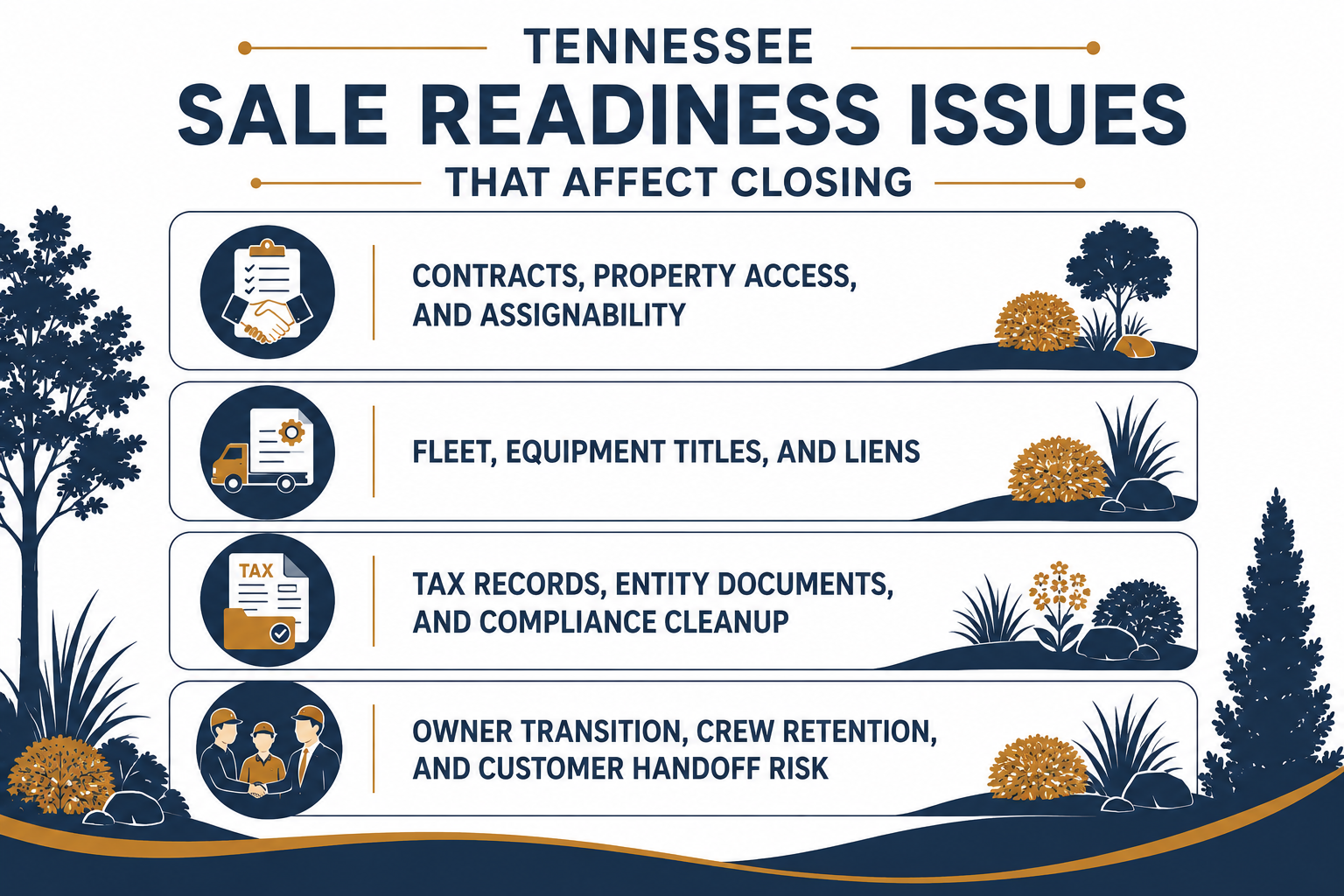
A realistic landscaping services business valuation should survive the sale process, not just look good in a spreadsheet. Closing risk often appears in the documents behind the number. In Tennessee transactions, buyers and lenders pay close attention to records that show whether contracts can transfer cleanly, whether fleet and equipment ownership is clear, and whether the legal and tax foundation of the company is consistent with what the seller is presenting.
This is why sales readiness deserves its own review. A business can have decent cash flow and still lose negotiating power if account agreements are weak, titles are unclear, or the owner cannot show who actually controls the customer relationships and operating assets.

Contracts do not all carry the same weight in a landscaping business. Buyers want to know whether recurring revenue is protected by signed agreements, easy renewal patterns, or simply long-term habits that could break after a change in ownership.
Fleet and equipment problems are common in deals because landscaping business owners often mix personal ownership, company use, and financed assets over time. That can be fixed, but it should be fixed before the business is marketed.
This part of diligence is rarely exciting, but it often controls whether the deal moves smoothly. Buyers want proof that the legal seller, the tax records, the financial statements, and the operating assets all belong to the same business being offered for sale.
| Record | What Buyers Verify | Why It Matters |
|---|---|---|
| Filed tax returns | At least three years of returns that reconcile reasonably to internal profit and loss statements, with owner pay and adjustments explained consistently | If tax returns and internal books tell different stories, buyers will question earnings quality and spend more time reworking cash flow |
| Secretary of State and entity records | Correct legal entity name, active status, ownership records, and registered information | If the entity records are inconsistent or outdated, the buyer has to stop and confirm who actually has the authority to sell your business |
| Payroll records and worker classification | Payroll tax filings, W-2 and 1099 treatment, and whether labor is being reported in a way that matches how the company actually uses crews | Misclassification risk or weak payroll support can create liability concerns and make buyers less comfortable with the labor model |
| Sales and use tax treatment | Whether the company handled taxes correctly on materials and other taxable purchases, and whether its records match Tennessee’s treatment of landscaping work | Tennessee says landscaping services to real property are generally not subject to sales tax, but contractors may still owe tax on materials and taxable purchases used in the work; weak treatment here can create diligence problems |
| Operating agreement, bylaws, or ownership documents | Ownership percentages, authority to sell, and any consent requirements | A deal can stall if the signer does not clearly have the authority to approve the transaction |
| Insurance, claims, and service-specific compliance records | Current policies, claims history, vehicle coverage, and any required pesticide, contractor, or related compliance records tied to the services offered | Missing coverage, a messy claims history, or missing credentials can raise buyer risk and delay lender approval; Tennessee separately regulates commercial pesticide applicators, and contractor licensing can apply to certain project work, including projects at or above stated thresholds |
Read Next: Why Buyers and Sellers Don’t Agree on Business Valuation — And What to Do About It
Many landscaping businesses are more owner-dependent than they first appear. The trucks may be branded, the routes may be organized, and the crews may be experienced, but key parts of retention can still sit with the owner. That includes bidding, estimating, solving field issues, handling account concerns, or making sure a property manager feels taken care of during service interruptions.
Buyers look closely at that because they are not just buying the current income statement. They are buying the likelihood that the same customers, crews, and field standards will stay in place after the transfer. If the owner is the person every major account calls, if no crew lead can run jobs without direct oversight, or if pricing knowledge lives only in the owner’s head, the business becomes harder to finance and harder to transfer at a strong multiple.
A strong transition plan reduces that risk. Buyers want to see who will introduce the new owner, how long the seller will stay involved, which employees are critical to retain, and how recurring route service will continue without disruption. That kind of preparation can support a better sale price because it makes the future cash flow more believable.
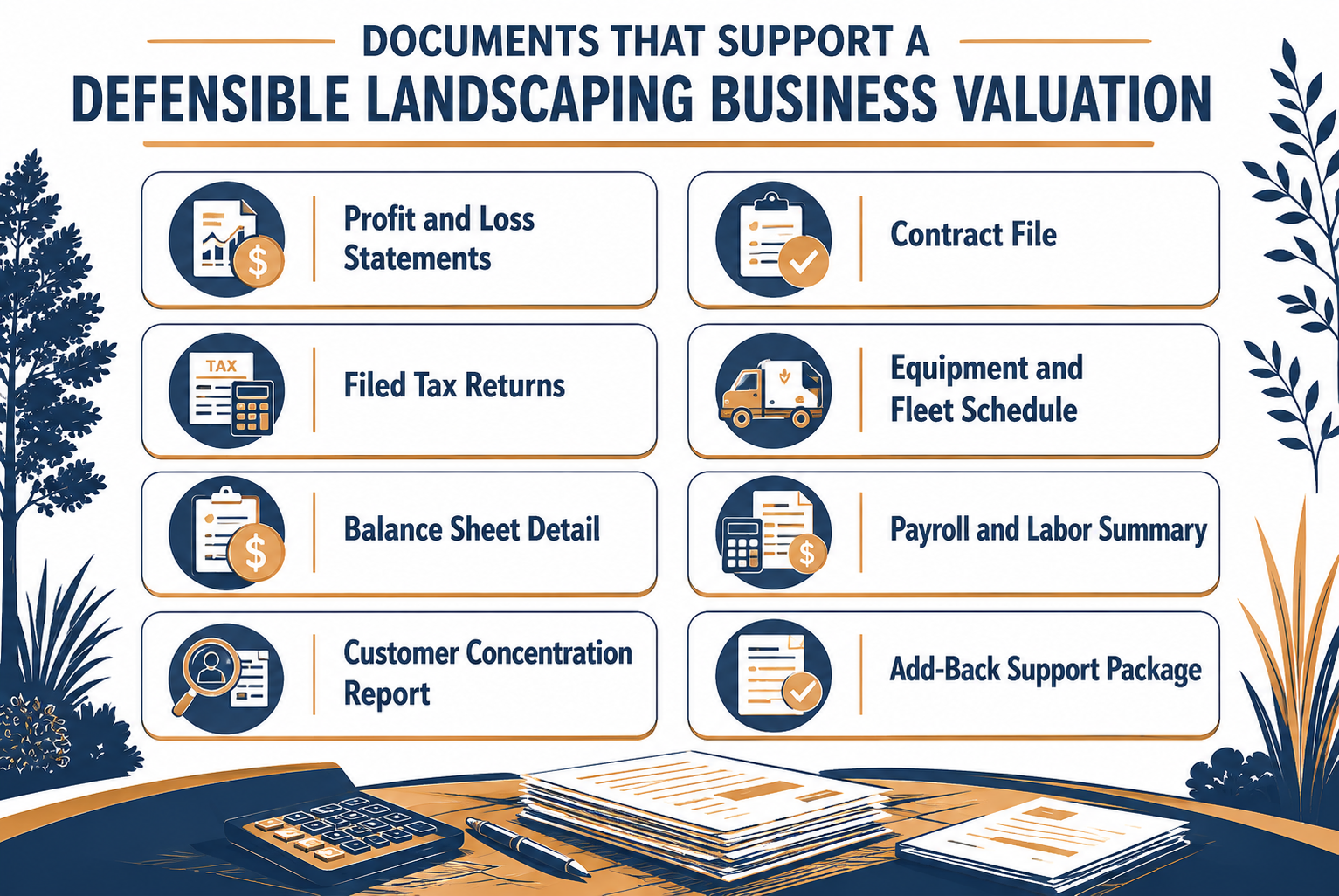
A valuation becomes more credible when the supporting records are already organized. Buyers, lenders, and valuation professionals are trying to determine the value of the business from evidence, not from broad descriptions. The documents below usually matter most because they connect financial performance to operations, asset quality, and transferability.

Read Next: Why a Strong Confidential Information Memorandum is Key to a Successful Business Sale
A valuation is more useful when it reflects what the market can support and what the seller can prove. The goal is not to make the business look perfect. The goal is to remove avoidable confusion that pushes buyers toward a lower number or a more cautious structure.
Read Next: Top 3 Reasons Business Owners Leave Money on the Table When Selling Their Business
A strong landscaping business valuation should help you make a decision, not just satisfy curiosity. The useful question is whether the number can survive buyer scrutiny, lender review, and the practical handoff of contracts, equipment, crews, and customer relationships. That is what separates a rough estimate from a business valuation that supports a successful sale.
From there, the smartest next step is to pressure-test the valuation before buyers do. At Legacy Entrepreneurs, we work with Tennessee owners who need a clearer view of what their business is worth, what can actually be defended in the market, and what needs to be fixed before the sale process begins. Our business valuation services are built for owners who want a more grounded view of pricing, transferability, and sale readiness.
Get a landscaping business valuation to clarify what your company can support in the Tennessee market, reduce avoidable deal friction, and move toward a cleaner sale process with better buyer confidence.
That question usually refers to property improvement, not the value of a landscaping business, so it is not the right benchmark for a business sale. To value a landscaping business, buyers look at EBITDA or SDE, then adjust the multiple based on recurring revenue, customer concentration, owner involvement, equipment condition, and transfer risk.
There is no single average that is useful for valuation because margins differ by service mix, crew structure, route density, and overhead discipline. A lawn care business with recurring maintenance routes may operate differently from a landscaping services company focused on installation or enhancement work, so buyers will care more about your actual normalized cash flow and net profit than the landscaping industry average.
Hourly pricing does not tell you much about business value by itself. Buyers care more about whether pricing produces stable gross margin, repeatable net profit, and customer retention across contracts and route work. A high hourly rate can support value if it is tied to strong service quality and durable accounts, but it can hurt retention if pricing is not competitive in the local market.
Most smaller landscaping companies are valued using SDE, while larger businesses may be valued on EBITDA if they have management depth and cleaner financial reporting. The valuation process usually starts with normalized earnings, then adjusts the multiple based on recurring revenue, customer concentration, equipment needs, owner dependency, and how transferable the business will be to a buyer.
A good margin is consistent, explainable, and supported by clean records. Buyers will compare labor efficiency, route density, overhead control, and service mix before deciding whether margins are durable or temporary. A strong margin with poor documentation or high owner dependency may still receive a weaker valuation than a slightly lower margin with cleaner transferability.
That depends on the type of work, the crew structure, pricing discipline, customer retention, and equipment spending required to keep operations going. Some landscaping companies show healthy cash flow because the owner carries too much of the workload personally, which means the reported profitability may not hold after a sale. Buyers, therefore, focus on normalized discretionary earnings or EBITDA, not just the current income statement.
For Tennessee landscaping owners, valuation is less about applying a simple revenue multiple and more about showing why the business can hold its...
Selling a logistics company in Tennessee requires proof that cash flow, contracts, fleet condition, and compliance can withstand buyer and lender...
Business valuation multiples are often treated as a shortcut to price, but in practice, they are only as reliable as the underlying business...