



15 min read

How to Sell Your Roofing Company in Tennessee: Positioning the Business for a Smoother Sale

How to Sell Your Roofing Company in Tennessee: Positioning the Business for a Smoother Sale

Selling a roofing company in Tennessee requires clean financials, transferable operations, and a sale process that can stand up to buyer and lender review.

Recent data suggests that roofing companies often sell in a range of about 4x to 7x EBITDA, which stands for earnings before interest, taxes, depreciation, and amortization. However, the exact multiple typically depends on the company’s growth, stability, and the broader roofing market conditions.

This makes preparation critical because buyers will test whether the company’s profitability is repeatable and whether the business can keep performing after the owner steps back.

This guide covers:

  • How buyers test earnings, backlog, and job-level profitability before making an offer
  • Which operational weaknesses reduce valuation, financing options, and buyer confidence in diligence
  • How to prepare documents, management structure, and process flow for a cleaner sale

P.S. Before you market a roofing business, it helps to know whether the valuation, financial records, and management structure will stand up to buyer review. At Legacy Entrepreneurs, we help Tennessee owners think through sale readiness, valuation, buyer positioning, and exit planning through our roofing business brokerage support and business valuation services.

Talk to a business broker to spot the issues most likely to reduce buyer confidence, weaken financing, or delay closing before they become deal problems.

TL;DR: What Buyers Will Want to See First

Decision Area What Needs To Be True
Earnings Quality Monthly profit and loss statements, three years of tax returns, and documented add-backs need to be reconciled so a buyer can trust EBITDA and not treat earnings as inflated.
Revenue Verification Accounting revenue should tie to invoices, deposits, CRM records, and completed job activity so the buyer can confirm sales were earned and not overstated by backlog assumptions.
Job Costing Gross profit by project type, such as residential replacement, commercial roofing, roof repairs, and new construction, should show where margin is consistently produced and where it leaks.
Owner Dependency Estimating, sales follow-up, vendor relationships, production scheduling, and collections should be handled by more than the owner, or the buyer may discount the value for transition risk.
Management Depth A production manager, office lead, sales manager, or GM with clear responsibilities gives the buyer evidence that the company can operate after closing without daily owner intervention.
Backlog Quality Signed jobs, expected revenue, expected gross profit, production timing, and cancellation exposure should be documented because backlog often supports the buyer’s view of near-term future cash flow.
Labor Structure W-2 versus 1099 crews, insurance coverage, crew leadership, and any reliance on a few subcontractors need to be clear because labor risk can affect both financing and closing terms.
Risk File Readiness Warranty claims, litigation, safety incidents, licensing records, and insurance history should be organized early because unresolved issues often lead to retrades or slower diligence.


6 Crucial Steps to Selling a Roofing Business in Tennessee

Selling a roofing company is a structured transaction. The buyer will test whether revenue is durable, whether profitability is real, and whether the business can keep performing after ownership changes.

If those points are weak, the buyer may still show interest, but the multiple financing options and negotiation leverage usually get worse. A disciplined process helps you set realistic expectations, position the company well, and avoid preventable problems during due diligence.

6 Crucial Steps to Selling a Roofing Business in Tennessee

#1) Know What Your Roofing Company Can Defend in the Market

Thinking about selling your roofing business? The first thing to understand is that valuation starts with earnings, but a buyer is not buying your past effort.

A buyer is buying expected future cash flow, transferability, and risk-adjusted performance. That's why two roofing companies with similar revenue can sell at very different multiples. One may have stable margins, diversified residential and commercial services, documented systems, and strong management. The other may depend on one owner, one referral source, or one storm-heavy revenue cycle.

For smaller roofing businesses, buyers often focus on seller earnings or adjusted cash flow. For larger operations, EBITDA becomes more important. In either case, the valuation has to be supported by evidence.

Roofing-specific factors matter too. A company with a healthy mix of roof repairs, replacements, service work, and commercial roofing may look more stable than a business driven almost entirely by insurance claims or one large builder relationship.

Similarly, a company offering a variety of roofing solutions, including metal roofing or specialty roofing systems, may be attractive to potential buyers if those services are profitable and repeatable. Specialty work only helps if the business can prove margins, crew capability, and repeat demand.

Selling price expectations also need to reflect how roofing revenue is actually produced. Buyers often look beyond top-line revenue and ask what the company earns by job type, by customer channel, and in some cases by price per square.

This matters because a roofing business focused on commercial retail, commercial insurance, residential retail, and residential insurance can show very different sales cycles, margin profiles, supplement exposure, and collection patterns across those segments. A company may post strong revenue, but if lower price per square, weak change-order control, or heavy insurance dependence is pressuring gross profit, the buyer will not value every dollar of revenue the same way.

A roofing company’s likely multiple also depends on where it sits in the market. A Main Street-sized roofing company is usually valued closer to 2 to 3 times adjusted cash flow or seller benefit. Higher multiples generally require stronger management depth, cleaner reporting, and earnings that look transferable after closing.

#2) Clean Up Financial Information Before You Go to Market

A roofing company for sale is evaluated based on how clearly it can support earnings quality. Buyers and lenders do not rely on summary claims alone. They want documents that reconcile and operating data that makes sense at the job level.

  • Profit and Loss Statements: Prepare at least three years of monthly profit and loss statements with materials, direct labor, subcontractors, commissions, overhead, and owner compensation separated clearly. Buyers use this to test margin consistency, seasonality, and whether reported profitability matches how the roofing business actually runs.
  • Tax Returns: Assemble three years of filed tax returns that reconcile to internal statements. If revenue, compensation, or expense categories do not tie back cleanly, the buyer may assume the company’s financial reporting is unreliable and reduce the offer.
  • Job Costing Reports: Pull job-level gross profit by project type, such as residential and commercial roofing, roof repairs, replacements, new construction, and commercial roofing work. This helps the buyer see whether profitability comes from repeatable execution or a few unusual jobs.
  • Revenue Reconciliation: Tie accounting revenue to deposits, invoices, CRM or estimating records, and production schedules. Buyers want to know whether reported revenue reflects completed work, deposits, or backlog assumptions that may not convert.
  • Add-Back Support: Document owner salary adjustments, personal expenses, one-time legal fees, unusual equipment purchases, or temporary relocation costs line by line. Unsupported add-backs are one of the fastest ways to create distrust in a valuation.
  • Accounts Receivable and Work in Progress: Show aging, open invoices, retainage if applicable, customer deposits, and jobs in progress. This matters because working capital expectations and future cash flow often become negotiation points late in the sale process.

#3) Reduce Business Owner Dependency Before You Sell Your Roofing Business

A buyer wants a roofing company, not a job that disappears when the owner leaves. If one roofing contractor owner controls estimating, major sales, supplier relationships, crew scheduling, customer complaints, and collections, the business may still sell, but the buyer will price that risk into the deal.

  • Sales Transferability: Document who handles inspections, estimates, proposals, follow-up, and close rates. If the owner still wins most of the work personally, the buyer may question whether revenue can be held after closing.
  • Management Depth: Clarify whether a production manager, office manager, sales manager, or general manager already handles meaningful decisions. Strong management makes the business more attractive to potential buyers because continuity is easier to prove.
  • Crew Structure: Show how crews are organized, who the field leaders are, how quality is supervised, and whether labor relies on a few key subcontractors. Buyers want confidence that production will not collapse during the transition.
  • Vendor Relationships: Document your distributor relationships, credit terms, and the primary roofing materials you rely on. If better pricing or availability depends only on the owner’s personal relationship, the buyer may discount those benefits.
  • Standard Operating Rhythm: Explain how leads are assigned, estimates are approved, jobs are scheduled, supplements are handled, and warranty issues are resolved. A well-run roofing business becomes increasingly attractive when the workflow is repeatable and not dependent on memory.
Know What a Buyer Will Question First


#4) Position the Business for the Right Buyer Type

The best buyer is not always the one who promises the highest number early. Different buyers evaluate roofing companies in different ways, and that affects valuation, diligence depth, and how much transition support they will expect from you.

Buyer Type What They Commonly Focus On What Happens If It Is Weak
Individual Buyer Seller’s discretionary earnings or cash flow support, tax returns, profit and loss statements, documented add-backs, backlog, labor structure, and how dependent revenue is on the owner’s personal selling or relationships SBA or other acquisition financing may become harder to secure, the buyer may lower the price, and the seller may face more pressure to carry a note or provide longer transition support.
Strategic Buyer Geographic fit, crew capacity, service-line fit, customer mix, production infrastructure, vendor relationships, and whether the company fills a market or capability gap in an existing operation The buyer may still move forward, but value often shifts toward specific synergies, crews, market access, or customer relationships rather than a full-company premium.
Private Equity Or Platform Buyer EBITDA scale, margin consistency, monthly reporting quality, management depth, lead generation reliability, and whether the business can be integrated or expanded through further acquisitions They often pass quickly if earnings are too small, too volatile, or too owner-dependent. When they do stay engaged, weak systems or leadership depth usually reduce valuation or shift the deal toward a smaller add-on thesis rather than a premium platform outcome.


A Tennessee roofing company with clean books, steady profitability, and strong management may appeal to more than one buyer type. Whereas a smaller owner-led business may fit best with an individual buyer or local strategic acquirer.

Setting realistic expectations about buyer fit keeps you from wasting time with buyers who were never likely to close.

#5) Run a Confidential Sale Process That Does Not Disrupt Operations

Confidentiality matters because a roofing business can be damaged before the sale ever closes. Employees may worry about job security, customers may hesitate to sign larger projects, competitors may use rumors against you, and suppliers may tighten terms if they think the company is unstable.

Therefore, the sale process should not start with broad public marketing. Serious buyers are usually screened first. They sign a confidentiality agreement before receiving identifying details. Financial information is released in stages, and sensitive customer or employee information is protected until the process is further along.

A broker helps manage that flow. Instead of letting every interested in purchasing party speak directly with the owner at the wrong time, the broker filters inquiries, checks whether the buyer has financial capacity, and controls how much information is shared. This protects operations while still creating buyer competition.

A strong Confidential Information Memorandum also helps. The CIM should explain the business clearly enough to attract serious buyers, but it should not expose details that can hurt you if confidentiality slips.

#6) Prepare for Due Diligence Before a Buyer Asks

Most transaction issues do not begin when the business goes to market. They surface when the buyer begins verifying the financial, operational, and contractual support for the business. Roofing deals are often retraded because the seller prepared diligence materials too late to identify and address issues earlier in the process.

  • Backlog Schedule: Build a backlog report showing signed jobs, expected revenue, projected gross margin, production timing, and any material cancellation risk. Buyers use backlog to assess near-term revenue visibility, workload coverage, and whether the forward pipeline is supported by executed work rather than informal estimates.
  • Customer Concentration: List top customers, builders, property managers, referral partners, and insurance-restoration channels. If too much revenue depends on one account or one lead source, the buyer may view future revenue as less durable after closing.
  • Labor Classification: Show whether crews are W-2 employees, 1099 subcontractors, or a mix, and organize payroll, subcontractor agreements, certificates of insurance, and worker-classification support. This matters because labor misclassification can create tax, insurance, and diligence risk, not just an operational issue.
  • Claims and Warranty History: Organize any litigation, warranty claims, callbacks, insurance disputes, and unresolved customer issues. Buyers review these records to assess whether future cash flow could be reduced by rework costs, settlement exposure, or reputation damage tied to past jobs.
  • Equipment and Fleet: Identify owned versus financed trucks, trailers, dumpsters, and specialty tools, and note any major replacement needs. This affects asset value, debt payoff, and the buyer’s view of how much near-term capital spending may be required.
  • Licensing, Safety, and Insurance: Keep contractor licensing records, workers’ compensation coverage, general liability coverage, claim history, and OSHA injury and illness records organized where required. Buyers use these materials to evaluate compliance, insurability, and whether the roofing business carries hidden operational risk.

Read Next:

What Buyers Will Scrutinize Before They Acquire a Roofing Business

Buyers do not pay a premium just because a roofing company has been around a long time or has strong local recognition. They want proof that the business can keep producing revenue and profit after ownership changes. In the roofing industry, this means looking beyond annual sales and into how the work is won, delivered, staffed, and collected. Some issues can be fixed early. Others become expensive once a buyer has already started diligence.

Earnings Quality and Margin Stability

A buyer will test whether profitability is repeatable. Roofing companies can show strong revenue while still carrying weak margins, volatile collections, or a project mix that is difficult to sustain. One year boosted by storm work or a few unusually profitable commercial jobs does not carry the same weight as three years of consistent performance.

This is why monthly data matters. Buyers want to see gross margin trends, material cost movement, labor percentages, commission burden, and overhead control. They also want to understand unusual periods. If profitability dropped because of a supplier disruption, labor shortage, or a deliberate investment in management, that may be understandable if the records explain it. If the numbers simply swing without context, the buyer may conclude the future cash flow is too hard to predict.

The strongest roofing companies for sale can show earnings before interest, taxes, depreciation, and amortization or adjusted cash flow that matches the operating story. The weakest ones force the buyer to guess.

Revenue Mix, Service Lines, and Market Exposure

Revenue mix affects both valuation and buyer confidence because not all roofing revenue carries the same risk. Buyers want to understand which services produce repeatable margin, which channels are seasonal or storm-driven, and whether the company is exposed to one narrow part of the market.

They also compare how each service line performs operationally, because high revenue with weak job control does not support the same multiple as disciplined, documented earnings. A roofing business with several service lines can look stronger, but only if the reporting shows which ones actually generate dependable profit.

Revenue Area What A Buyer Checks Why It Matters
Residential Replacement Lead source mix, close rate, insurance versus retail percentage, average job size, cancellation patterns, and gross margin by crew or sales rep Heavy dependence on storm work, one referral source, or low-quality leads can make revenue less durable after the sale
Commercial Roofing Contract size, bid-hit ratio, estimated versus actual gross margin, project manager oversight, retainage exposure, and how often jobs finish on budget Commercial roofing can support scale and stronger EBITDA, but weak cost control or bid discipline can erase profit quickly
Roof Repairs And Service Frequency of repeat calls, dispatch workflow, technician utilization, average ticket, response time, and percentage of customers who convert into larger replacement work Smaller service work often improves stability and referral flow, which can make future cash flow look more defensible
New Construction Builder concentration, payment timing, margin profile, change-order discipline, backlog aging, and whether work is tied to a few general contractors Large volume can help revenue, but customer concentration and slow collections often make this segment riskier than it first appears
Specialty Offerings Margin and volume for metal roofing, specialty roofing systems, green roofs, or other niche work, plus crew capability and local demand support Specialty services help value only when the company can prove repeat demand, pricing power, and the ability to execute without quality issues


A company that handles residential and commercial services, including metal roofing, may look stronger if each line has its own economics and reporting. A variety of roofing services only supports a better outcome when the buyer can see exactly which segments are stable, profitable, and transferable.

Operational Transferability

Operational transferability is the buyer’s test for whether the business can survive the handoff. This matters even more in a roofing business because the work depends on estimates, production scheduling, crew discipline, and quick response when issues arise.

  • Sales Process Documentation: Buyers want to see how leads move from inquiry to inspection to proposal to signed work. If the process lives only in the owner’s head, the buyer has to rebuild it after closing.
  • Production Execution: Scheduling, material ordering, permitting, job launch, change-order handling, and punch-list resolution should be documented. This shows whether the company can deliver work consistently across many roofing jobs.
  • Management Bench: Buyers look for people who can lead sales, production, admin, and customer communication. Strong management lowers integration risk and supports a cleaner transition.
  • Reputation Infrastructure: Reviews, referral channels, complaint patterns, and warranty follow-up matter because reputation affects conversion, not just branding.
  • Software And Reporting: CRM, estimating tools, accounting systems, and KPI reporting help a buyer step in without losing visibility. A business that tracks production and collections clearly is easier to finance and operate.

Read Next:

Risks That Can Reduce the Multiple or Kill the Deal — A Checklist

Buyers expect some imperfections in an owner-led roofing business. What they do not tolerate well is uncertainty around earnings, labor exposure, or whether the business can keep performing after the transition.

Some issues lead to a lower offer, while others cause the buyer, lender, or advisor to question whether the acquisition should move forward at all. The key is to identify which problems are simple cleanup items and which ones affect valuation, financing, or closing certainty.

  • Poor Bookkeeping: Monthly financial statements that do not reconcile to tax returns, bank activity, payroll records, or job costing reports create immediate doubt about revenue and profitability. Once the buyer questions the company’s financial information, valuation support weakens, and the deal often shifts into a lower offer or a slower diligence process.
  • Owner-Centric Sales: If the owner still handles the major estimates, closes the largest jobs, maintains the strongest referral relationships, and resolves sales objections personally, the buyer may assume revenue will drop after closing. That usually leads to pressure for a longer transition period, seller financing, an earnout, or a reduced multiple.
  • Labor Exposure: Heavy reliance on undocumented subcontractor crews, unclear W-2 versus 1099 classification, or weak insurance support can trigger legal and operational concerns. Buyers and lenders review this closely because labor problems can create post-close liability and disrupt production continuity.
  • Revenue Volatility: Sharp swings in monthly revenue or gross margin without a clear explanation, such as storm timing, material price shocks, or unusual project mix, make future cash flow harder to trust. When the buyer cannot understand why earnings moved, they often lower their valuation assumptions.
  • Legal And Warranty Problems: Open disputes, repeated callbacks, weak workmanship records, warranty claim history, or unresolved customer complaints can reduce confidence in both the company’s reputation and future earnings. Even if the business is still profitable, quality-control concerns can make the buyer question what hidden liabilities may surface later.
  • Weak Backlog Quality: Open jobs that are unsigned, low margin, delayed, poorly scoped, or highly exposed to cancellation do not support a strong valuation the way sellers often expect. Buyers examine backlog closely because it affects near-term cash flow and can reveal whether reported pipeline strength is actually dependable.

Read Next: Bad Bookkeeping Kills Deals — Focus on These 4 Fixes

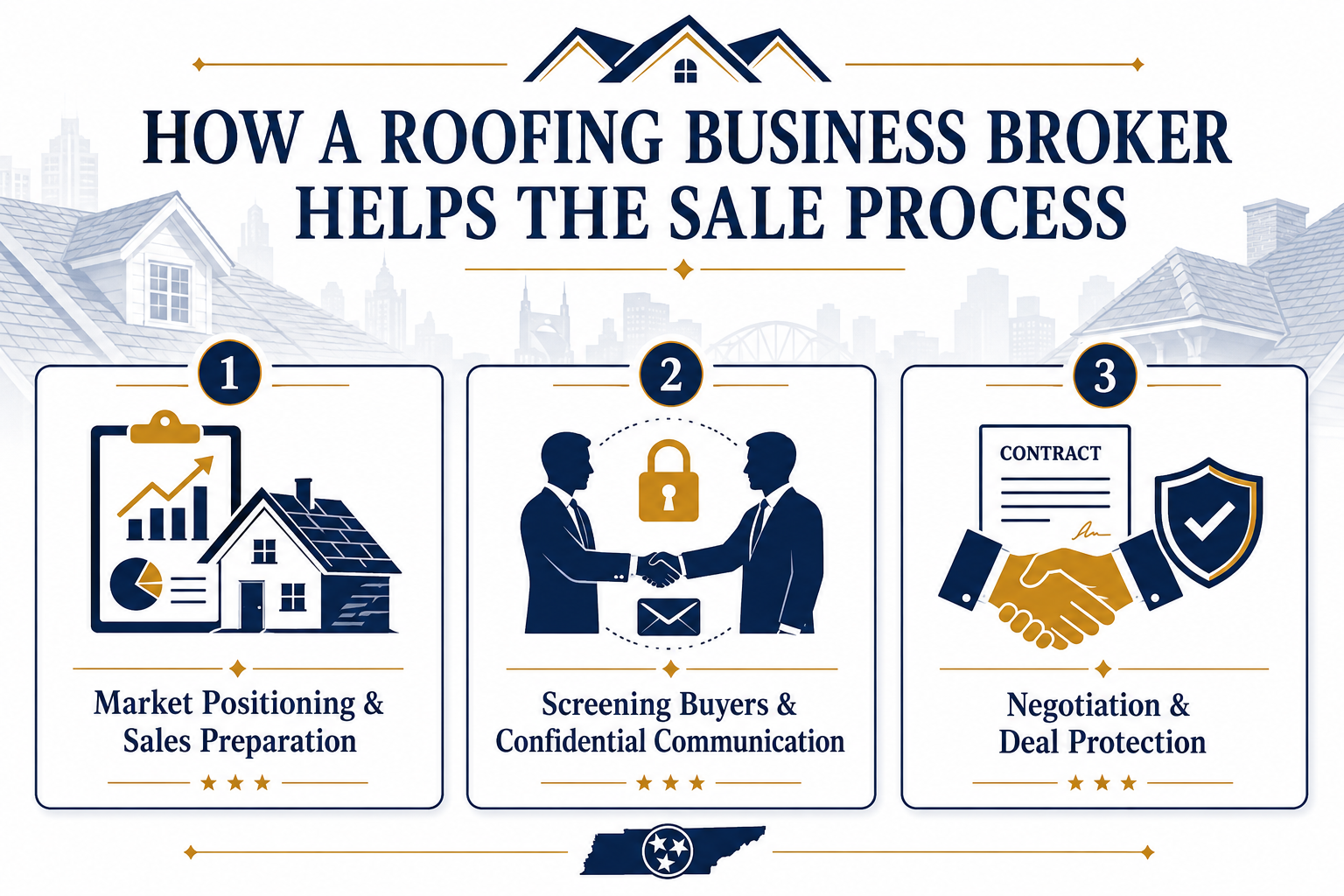
How a Roofing Business Broker Can Help in the Sale Process

Many owners assume a broker mainly lists the company and brings a buyer. In practice, the more valuable work usually happens before and after that point. A disciplined broker helps prepare your business, position it credibly, screen buyers, manage negotiation, and keep the process moving once diligence begins. This matters in roofing because valuation, buyer fit, and transferability are often tied to details that a casual buyer will misunderstand or challenge.

Market Positioning and Sales Preparation

Positioning a roofing business for sale means building the case that the company is durable, profitable, and transferable. This usually includes organizing financial information, preparing a credible narrative around revenue mix and service lines, and showing what makes the company well-run.

If the business serves both residential and commercial markets, the broker should help present the difference between the two economies instead of blending them into one vague growth story.

A broker also helps set realistic expectations. Owners often focus on what they want from the sale a few years from now or what they heard another roofing company sold for. A usable valuation has to reflect this company’s earnings, risk profile, and current marketability.

Screening for Potential Buyers and Confidential Communication

Not every buyer who asks about a company for sale should get full access. The broker’s job is to screen for financial capacity, seriousness, fit, and ability to close. This is important because the wrong buyer wastes time, creates confidentiality risk, and can distract the owner from running the company.

A strong screening process also improves negotiation. When a buyer knows the process is organized and confidential, they are more likely to treat the opportunity seriously. When the seller talks directly with every prospect, the process can become noisy and reactive.

Negotiation and Deal Protection

Negotiation is not just about the headline price. Buyers and sellers often disagree over working capital, seller financing, earnouts, transition support, fleet payoff, and what happens to open jobs. A broker helps frame those issues before they become deal killers.

That is especially important after the LOI. Once the buyer starts reviewing the company’s financial performance, payroll, contracts, and backlog, they may try to renegotiate if the evidence is weaker than expected. A broker helps the seller respond with facts, structure the discussion, and protect the seller’s interests without escalating every issue into conflict.

Read Next: The Ultimate Guide to Choosing a Business Broker to Sell Your Company in Tennessee

Selling a Roofing Company Is Easier With the Right Support

The roofing companies that close well are usually not the ones with the strongest sales pitch. They are the ones that can prove earnings, explain risk, and show that the business will keep operating effectively after the owner steps back. That is what supports valuation, builds buyer confidence, and gives you more control over price and terms.

  • Start With Evidence: Pull tax returns, monthly P&Ls, job costing, and backlog reports now so valuation discussions are grounded in records a buyer can trust.
  • Fix Transferability Issues: Reduce owner dependency in sales, production, and customer communication because that is one of the clearest ways to become more attractive to potential buyers.
  • Choose The Process Carefully: Use a confidential, staged sale process with qualified buyer screening, so you protect operations while improving the odds of a successful sale.

The preparation work is where many sellers either protect value or quietly lose it.

At Legacy Entrepreneurs, we work one-on-one with Tennessee owners who need help with valuation, sale preparation, buyer screening, negotiation, and closing. Our roofing business brokerage support and business valuation services are built for owners who want clearer expectations and a more disciplined process.

Talk to a business broker to clarify your roofing business's value, prepare for buyer scrutiny, and move toward a cleaner sale process with fewer surprises.

Is Your Roofing Business Sellable?


Frequently Asked Questions

How much can I sell my roofing company for?

The answer depends on the company’s adjusted earnings, management depth, customer mix, and how transferable the business is after closing. Many owners focus on a target multiple, but the usable valuation depends on whether the financial information supports that number in diligence. A roofing company with stable profitability, strong job costing, and low owner dependency will usually defend a better price than one with similar revenue but weaker systems.

How do you sell your roofing company?

You can sell your business by preparing financial records, building a defendable valuation, organizing a confidential marketing process, screening qualified buyers, negotiating terms, and preparing for due diligence before the buyer asks for documents. The strongest process also addresses business owner dependency, backlog quality, labor structure, and transition planning before going to market.

What are the trends for roofing in 2025?

Current roofing trends include continued interest in durable materials, strong attention to margin control, and buyer focus on whether companies can manage labor, materials, and production consistently. For a seller, the practical takeaway is that buyer interest in roofing companies remains tied to execution quality, not just industry momentum or headline growth.

What is the 25% rule in roofing?

The 25% rule is a project-level guideline used in roofing work, not a business sale valuation rule. It generally refers to the idea that if more than 25% of a roof area requires repair, a full replacement may be more practical than patching. It does not determine what a roofing company is worth, though it may affect the mix of repair versus replacement work in the business.

What is the 10/50/50 rule?

The 10/50/50 rule usually refers to a roofing sales commission structure. It is an operating compensation concept, not a transaction rule for selling a roofing company. If your roofing business uses that model, a buyer may review it during diligence because the commission structure affects gross margin, sales behavior, and profitability.

What is the biggest roofing company in the U.S. in 2025?

Industry rankings in 2025 placed very large national operators such as Tecta America and CentiMark near the top of the U.S. market. For most Tennessee owners, the more relevant issue is not national rank. It is how your roofing company compares on earnings quality, management depth, service mix, and transferability within the buyer market that would realistically acquire it.

How to Sell a Restaurant in Tennessee: A Practical Guide for Owners

How to Sell a Restaurant in Tennessee: A Practical Guide for Owners

Selling a restaurant in Tennessee comes down to preparation. Buyers will look closely at your financials, lease terms, licenses, payroll, and...

Read More
How to Sell Your Roofing Company in Tennessee: Positioning the Business for a Smoother Sale

How to Sell Your Roofing Company in Tennessee: Positioning the Business for a Smoother Sale

Selling a roofing company in Tennessee requires clean financials, transferable operations, and a sale process that can stand up to buyer and lender...

Read More
Selling a Restaurant in Tennessee: A Practical Guide

Selling a Restaurant in Tennessee: A Practical Guide

Selling a restaurant is one of the most significant decisions an owner can make. Whether you’re ready to retire, pivot to a new business, or simply...

Read More