


Due Diligence Checklist for Sellers: How to Prepare Your Business for Buyers
A due diligence checklist for sellers identifies the financial, legal, tax, and operational records a buyer will examine before purchasing a...
11 min read
Joe Steigman is the Founder of Legacy Entrepreneurs, a boutique business brokerage and exit advisory firm focused on helping business owners maximize value and transition their companies with confidence. With a background that combines operational leadership, corporate consulting, finance, and entrepreneurship, Joe brings a practical, owner-focused perspective to business sales and acquisitions. Joe is a Certified Business Intermediary (CBI), a designation awarded by the International Business B...
Joseph Steigman
Updated on July 21, 2026
A due diligence checklist for sellers identifies the financial, legal, tax, and operational records a buyer will examine before purchasing a business. Organizing these materials before going to market helps the seller answer buyer questions promptly, address potential liabilities, and prevent avoidable delays or price negotiations.
Preparation matters because many businesses that enter the market never complete a sale. According to figures from the Exit Planning Institute reported by Kiplinger in 2026, only 20% to 30% of businesses taken to market ultimately sell. Incomplete financial records, undocumented operations, customer concentration, and unresolved legal issues can make buyers question the valuation or withdraw from the transaction.
This guide explains the documents buyers typically request, the risks those documents may uncover, and the steps sellers can take to prepare for due diligence.
Start Before You Go to Market: Prepare your due diligence materials before listing your business. Early preparation gives you time to resolve issues that could delay closing or affect your negotiating position.
Organize Your Financial Records: Buyers will review your profit and loss statements, balance sheets, cash flow statements, tax returns, and supporting financial records to verify earnings and assess the business's financial health.
Gather Legal and Operational Documents: Corporate records, contracts, leases, licenses, insurance policies, and documented operating procedures help buyers understand how the business is structured and operated.
Identify Potential Red Flags: Customer concentration, owner dependence, unresolved legal matters, inconsistent financial reporting, and compliance issues can affect buyer confidence and influence deal terms.
Evaluate Transferability: Buyers want confidence that the business can continue operating successfully after the transition. Strong management, documented systems, and diversified revenue generally reduce perceived risk.
Use Due Diligence to Validate Value: A well-organized business supports the valuation you've established and gives buyers fewer reasons to renegotiate the purchase price during the due diligence phase.
Think Like a Buyer: Every document you provide should answer a buyer's questions before they're asked. Being prepared demonstrates professionalism, builds trust, and helps keep the transaction moving toward closing.
Due diligence is a buyer's opportunity to verify that your business matches the story you've presented during the sale process. By the time this stage begins, they've already seen your financial performance, reviewed high-level information, and decided your business is worth investigating further. Due diligence is where they confirm those assumptions before committing to the purchase.
Buyers aren't simply collecting documents. They're looking for evidence that the business can continue operating as expected after the transaction closes. That means validating revenue, understanding cash flow, identifying legal or financial liabilities, evaluating operational risks, and determining whether the business can succeed without relying heavily on the current owner.
Every document you provide helps answer one or more of these questions:
| Buyer Question | Why It Matters | What Buyers Review |
|---|---|---|
| Are the financial results accurate? | Confirms the business is generating the earnings used to support the valuation. | Profit and loss statements, balance sheets, cash flow statements, tax returns, general ledger |
| Are there legal or compliance risks? | Identifies obligations or liabilities that could transfer to the buyer. | Corporate records, contracts, licenses, permits, insurance policies, pending litigation |
| Can the business operate after the owner leaves? | Evaluates transferability and continuity following the sale. | Organizational chart, employee agreements, documented procedures, customer relationships |
| Are there risks that could affect future performance? | Helps buyers determine whether additional protections or price adjustments are needed. | Customer concentration, supplier agreements, lease terms, outstanding debt, contingent liabilities |
A well-prepared due diligence package gives buyers confidence that your information is complete, organized, and reliable. Missing records, inconsistent financials, or undocumented processes rarely end a deal on their own, but they create delays, prompt additional questions, and give buyers more leverage during negotiations.
Due diligence preparation is about making your business easy to evaluate. Buyers need to verify financial performance, understand how the business operates, and assess potential risks. The sections below cover the documents buyers typically request and explain why each one matters during the sale process.
No two business sales are identical, but most buyers request the same core categories of information during due diligence. The goal is to verify your financial performance, understand how the business operates, identify potential liabilities, and evaluate whether the company can continue performing after the transition.
Preparing these materials before going to market gives you time to correct inconsistencies, locate missing records, and respond to buyer requests without slowing the transaction.
The checklist below outlines the documents buyers commonly request and explains why each category matters during the due diligence process.
| Due Diligence Category | What Buyers Are Verifying | Why It Matters |
|---|---|---|
| Financial Records | Revenue, profitability, cash flow, and the accuracy of reported earnings | Supports the valuation and reduces the likelihood of price renegotiations. |
| Legal Documentation | Ownership, contractual obligations, and regulatory compliance | Helps identify legal risks that could delay or complicate the transaction. |
| Tax Compliance | Tax filings, payment history, and outstanding liabilities | Confirms compliance and uncovers tax obligations that may affect the deal structure. |
| Customer & Revenue Information | Revenue quality, customer concentration, and recurring income | Measures the sustainability and predictability of future cash flow. |
| Operations & Business Processes | Documented systems, workflows, and operational continuity | Determines whether the business can operate successfully after the owner's transition. |
| Employees & Management | Organizational structure, key personnel, and management depth | Evaluates transition risk and the business's dependence on the current owner. |
| Technology, Intellectual Property, & Business Assets | Ownership and condition of the assets required to run the business | Confirms the buyer will receive the resources needed to continue operations. |
Financial records are usually the first thing buyers review because they show whether the business performs as presented. Buyers want to confirm that revenue is consistent, expenses are accurate, and cash flow supports the asking price.
Incomplete or inconsistent records slow the process. Buyers often request additional reports, involve their accountants, or reassess the assumptions behind the valuation. Even a strong business can lose credibility if the financial documentation is difficult to verify.
Before going to market, organize at least three years of profit and loss statements, balance sheets, cash flow statements, tax returns, and supporting financial records. If you've adjusted earnings to calculate Seller's Discretionary Earnings (SDE) or EBITDA, keep documentation that supports every adjustment.
When buyers can verify your financial performance quickly, they spend less time resolving questions and more time evaluating the business itself. If you haven't established a realistic asking price, obtaining a Professional Business Valuation before going to market can help support your pricing expectations and provide buyers with greater confidence in the figures they're reviewing.
Read More: How to Increase Business Value Before Selling: 8 Proven Strategies
Legal due diligence helps buyers confirm that the business is properly organized, compliant with applicable regulations, and capable of being transferred without unexpected complications. Buyers and their advisors review legal records to identify obligations that may continue after closing, determine whether third-party approvals are required, and uncover any issues that could affect the transaction.
Preparing these documents before going to market gives you time to resolve expired agreements, locate missing records, and address compliance issues before they become negotiating points. Even relatively minor gaps can slow the due diligence process if buyers have to wait for supporting documentation.
| Legal Document | Why Buyers Review It |
|---|---|
| Articles of Incorporation or Organization | Confirms the business is legally formed and authorized to operate. |
| Operating Agreement or Corporate Bylaws | Verifies ownership structure and decision-making authority. |
| Business Licenses or Permits | Confirms the business complies with applicable regulations. |
| Customer and Vendor Agreements | Identifies contractual obligations that may transfer after closing. |
| Commercial Leases | Reviews lease terms, assignment requirements, and remaining lease term. |
| Insurance Policies | Evaluates existing coverage and historical claims. |
| Litigation or Claims History | Identifies legal disputes and potential liabilities. |
| Intellectual Property Records | Confirms ownership of trademarks, copyrights, patents, or proprietary assets. |
Every transaction is different, so buyers may request additional legal documents depending on the industry, deal structure, or financing involved. Organizing these records in advance makes it easier to respond quickly and helps maintain momentum once due diligence begins.
Additional Resource: The U.S. Small Business Administration (SBA) provides guidance on preparing a business for sale, including documentation and legal considerations that often arise during transactions.
Tax records provide another way for buyers to verify the financial information presented during the sale process. They compare tax filings with financial statements to confirm reported earnings, identify outstanding obligations, and assess whether any unresolved tax matters could become liabilities after closing.
Tax issues don't automatically derail a transaction, but they almost always require explanation. Addressing discrepancies before marketing the business is typically easier than answering questions while under contract.
| Tax Record | What Buyers Are Confirming |
|---|---|
| Federal Income Tax Returns | Reported earnings align with financial statements. |
| State Income Tax Returns | State filing obligations have been met. |
| Payroll Tax Filings | Employee tax obligations have been properly reported and paid. |
| Sales and Use Tax Returns | Applicable sales tax has been collected and remitted. |
| Property Tax Records | Business-owned property is current on tax obligations. |
| Tax Notices or Payment Agreements | Outstanding tax matters have been disclosed and addressed. |
The IRS recommends maintaining organized business records that clearly document income, expenses, assets, payroll, and other financial transactions. Good record-keeping not only supports tax compliance but also makes it easier to respond to buyer requests during financial due diligence.
Revenue tells buyers how much a business earns. Customer information helps them understand how reliable those earnings are likely to be after the acquisition.
During due diligence, buyers look beyond total sales to evaluate the quality and durability of revenue. They want to know where revenue comes from, whether it's recurring or project-based, how dependent the business is on a small number of customers, and whether key relationships are likely to continue after closing.
One of the most common areas of focus is customer concentration. A business that generates a large percentage of its revenue from one or two customers may face greater scrutiny because the loss of a single account could materially affect future cash flow. That doesn't necessarily make the business less attractive, but buyers will often factor that risk into their valuation or proposed deal structure.
Because revenue quality is a major factor in determining business valuation, buyers often examine customer concentration and recurring revenue in greater detail than total sales alone.
To prepare for this review, organize customer contracts, recurring revenue agreements, sales reports, accounts receivable aging reports, and revenue by customer. If a significant portion of revenue comes from a handful of customers, be prepared to explain the history of those relationships, contract terms, and why they're expected to continue after the sale.
Read Next: What's My Business Worth? Why You Can't "Double-Dip" on Equipment, Fixtures, and Inventory
A profitable business isn't automatically a transferable business. Buyers want to understand how the company operates on a day-to-day basis and whether those operations can continue without constant involvement from the current owner.
Businesses with documented processes are generally easier to evaluate because buyers can see how work is performed, how employees are trained, and how customers are served. Well-documented operating procedures also reduce the amount of knowledge that exists only in the owner's head.
This part of the due diligence process often focuses on the systems that keep the business running.
| Operational Area | What Buyers Want to Understand |
|---|---|
| Standard Operating Procedures (SOPs) | Whether day-to-day tasks are documented and repeatable. |
| Inventory Management | How inventory is tracked, valued, and replenished. |
| Production or Service Delivery | Whether products or services can be delivered consistently. |
| Vendor Relationships | Dependence on key suppliers and continuity after closing. |
| Quality Control | How the business maintains product or service standards. |
| Internal Workflows | Whether critical processes rely on the owner or are delegated to employees. |
Buyers aren't necessarily looking for perfect documentation, but they do want confidence that the business can continue operating without significant disruption after closing. Operational maturity also supports business valuation. A company with repeatable systems and clearly defined processes is generally viewed as less risky than one that depends heavily on informal knowledge or owner oversight.
For many buyers, acquiring a business also means acquiring the team that keeps it running. During due diligence, they evaluate whether the existing workforce can support a smooth ownership transition and whether key employees are likely to remain after closing.
Buyers typically review organizational charts, employee roles, compensation structures, employment agreements, and benefit plans. They'll also want to understand who makes day-to-day decisions, who manages customer relationships, and whether specialized knowledge is concentrated in just one or two individuals.
Owner dependence receives particular attention. If the owner is responsible for sales, operations, estimating, customer service, or other core functions, buyers may perceive additional transition risk. Businesses with experienced managers and clearly defined leadership responsibilities are often easier to transfer because buyers have greater confidence that operations won't change dramatically after the sale.
This doesn't mean every business needs a formal executive team before going to market. However, documenting responsibilities and reducing reliance on the owner where practical can strengthen buyer confidence and make the transition more predictable.
Technology and intellectual property often receive less attention from sellers than financial or legal records, but buyers still want to confirm that the business owns—or has the legal right to use—the systems and assets required to operate.
Depending on the business, buyers may request documentation for:
Software licenses and subscriptions
Customer relationship management (CRM) platforms
Accounting and payroll systems
Website domains and hosting accounts
Social media accounts and digital marketing assets
Trademarks, copyrights, patents, or trade secrets
Equipment, vehicles, machinery, and other fixed assets
Asset maintenance records and warranties
Equipment leases or financing agreements
Cybersecurity policies and data backup procedures
Rather than reviewing these items individually, buyers are trying to answer a broader question: Can the business continue operating without interruption after ownership changes?
For example, if a website domain is registered under the owner's personal account, software licenses aren't transferable, or key equipment lacks maintenance records, buyers may ask for additional documentation before moving forward. These issues are often straightforward to resolve, but identifying them early helps prevent unnecessary delays during due diligence.
Creating an inventory of your technology, intellectual property, and physical assets before going to market also makes it easier to define exactly what's included in the sale and reduces the likelihood of last-minute surprises before closing.
By the time buyers have reviewed your financial records, legal documents, customer relationships, operations, employees, and business assets, they usually have a clear understanding of how the company functions. The next step is identifying the issues that could affect the transaction itself. Some concerns are relatively minor and easily resolved, while others may influence valuation, financing, or the structure of the deal. The following section examines the most common red flags buyers uncover during due diligence and how sellers can address them before they become obstacles.
Most due diligence issues are easier to address before your business goes to market than during active negotiations. Taking time to prepare your records in advance can help buyers review the business more efficiently and reduce avoidable delays.
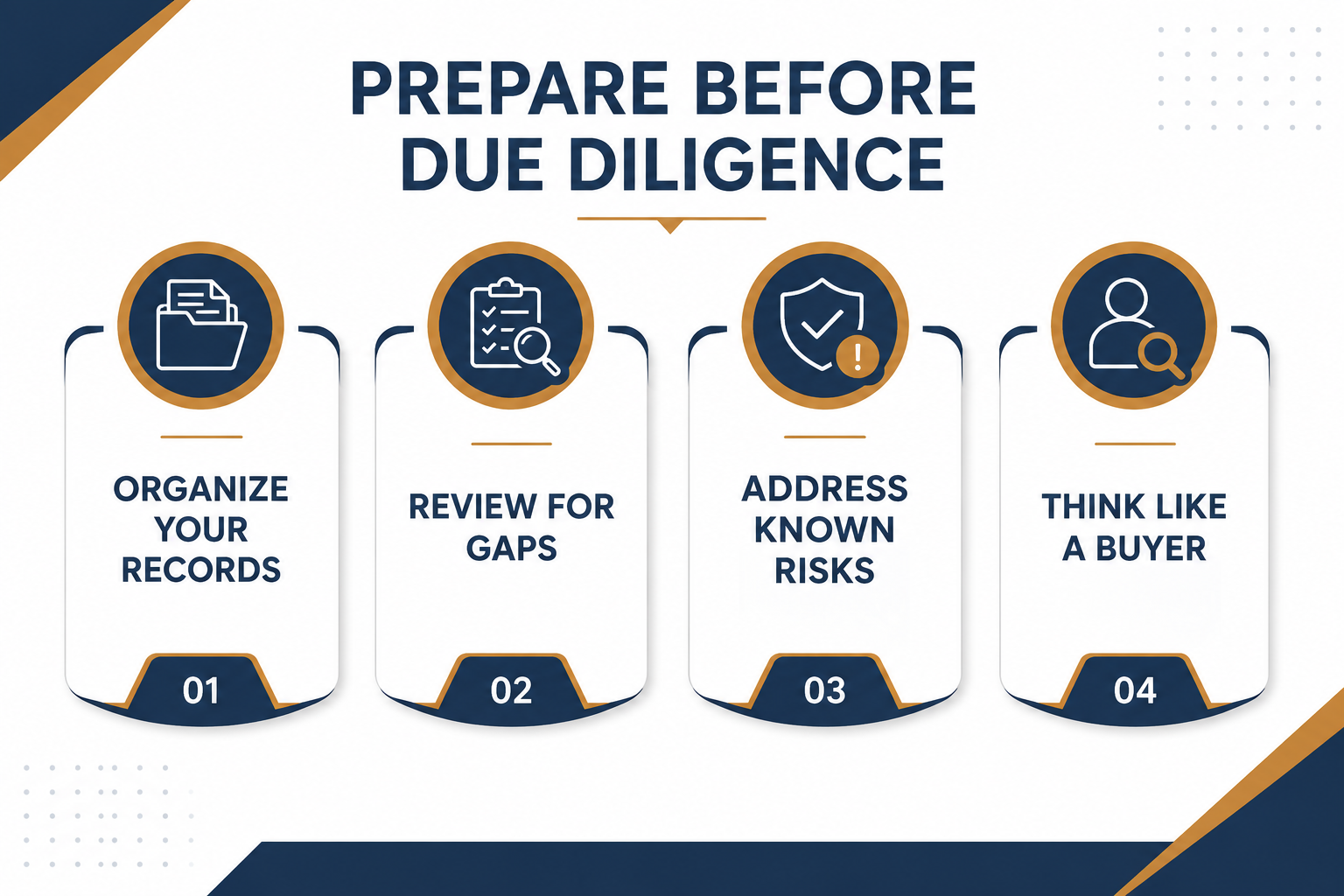
Before listing your business for sale:

Organize your records. Keep financial statements, tax returns, contracts, employee information, and operational documents in one secure location so they're easy to access when requested.
Review your documentation for gaps. Look for missing agreements, expired licenses, inconsistent financial records, or other issues that could prompt additional buyer questions.
Address known risks where possible. Customer concentration, owner dependence, unresolved legal matters, or aging equipment may not prevent a sale, but they're easier to discuss when you've prepared supporting information.
Work with your advisors early. Your broker, CPA, and attorney can help identify issues before buyers do and ensure your information is consistent throughout the transaction.
Look at the business from a buyer's perspective. Ask yourself whether someone unfamiliar with the business could understand its financial performance, operations, and risks using the information you've prepared.
Preparing for due diligence before receiving buyer requests gives you more time to resolve issues, respond with confidence, and keep the sale process moving. Owners planning on selling their business often find that addressing these issues before going to market leads to a smoother transaction.
Read Next: How to Sell Your Manufacturing Business in Tennessee for Maximum Value
Preparing for due diligence takes time, especially when you're also running the business. Missing records, inconsistent financials, or unanswered buyer questions can slow the sale process and shift negotiations in the buyer's favor.
Legacy ETA works with business owners before they go to market to identify potential issues, organize key documentation, and prepare the information buyers expect to see during due diligence. Our goal is to help sellers present a business that buyers can evaluate efficiently and with confidence.
Our team can help you:
Review financial and operational records before listing your business.
Identify documentation gaps that could delay due diligence.
Coordinate with your CPA and attorney to prepare supporting information.
Organize buyer materials into a secure, structured format.
Guide you through buyer requests and questions throughout the transaction.
Every business is different, and the scope of due diligence varies by industry, deal size, and buyer. Preparing early gives you more control over the process and reduces the likelihood of avoidable delays once negotiations begin.
Read More: How to Choose the Best Business Brokers in Nashville
If you're preparing for an exit, our Guide to Selling Your Business provides additional practical guidance to help you organize your business before going to market.
The documents required for due diligence typically include financial statements, tax returns, corporate records, customer and vendor contracts, employee information, leases, licenses, insurance policies, and documentation for business assets and intellectual property. The exact list depends on the size of the business, the industry, and the buyer's due diligence requirements.
For most small and mid-sized business sales, the due diligence process lasts 30 to 90 days after a letter of intent is signed. The timeline depends on the complexity of the business, the availability of documentation, and how quickly buyers receive answers to their requests. Well-organized records often help keep the transaction on schedule.
Sell-side due diligence is the process of reviewing your own business before it goes to market. Instead of waiting for a potential buyer to uncover issues, sellers identify gaps in financial records, legal documentation, operations, or compliance in advance. This preparation can reduce delays, support the asking price, and make it easier to respond to buyer questions.
Yes. Regardless of industry or transaction size, buyers typically conduct both legal and financial due diligence before completing an acquisition. Depending on the business, the review may also include operations, technology, employee matters, customer relationships, and supply chain risks as part of a broader risk assessment.
Due diligence allows buyers to verify the information presented during the sale process before completing the transaction. It helps them confirm the business's financial performance, evaluate potential risks and liabilities, and determine whether the business can continue operating after the ownership transition. For sellers, thorough preparation builds credibility and reduces the likelihood of delays or price renegotiations.
Read Next: Seller Financing, SBA Loans & Small Business Purchase in TN
A due diligence checklist for sellers identifies the financial, legal, tax, and operational records a buyer will examine before purchasing a...
Your roofing company's sale price comes down to one question a buyer is always asking: how much money will this business make me, and how confident...
SDE stands for Seller's Discretionary Earnings. It is the total financial benefit a single owner-operator receives from a business in a year. It...