


2 min read

What’s My Business Worth? Why You Can’t “Double Dip” on Equipment, Fixtures & Inventory

Written by Updated March 10, 2026
Picture of Joseph Steigman
Joseph Steigman

Joe Steigman is the Founder of Legacy Entrepreneurs, a boutique business brokerage and exit advisory firm focused on helping business owners maximize value and transition their companies with confidence. With a background that combines operational leadership, corporate consulting, finance, and entrepreneurship, Joe brings a practical, owner-focused perspective to business sales and acquisitions. Joe is a Certified Business Intermediary (CBI), a designation awarded by the International Business B...

What’s My Business Worth? Why You Can’t “Double Dip” on Equipment, Fixtures & Inventory

Many business owners begin the selling process by asking:
“What’s my business worth?”

That’s a smart question—but the wrong answer can lead to overpricing and lost deals.

One of the biggest misunderstandings in business valuation is trying to add the value of equipment, fixtures, and inventory on top of a cash flow-based price.

That’s called double dipping—and it’s one of the fastest ways to lose a serious buyer.

Two Ways to Value a Business

As a Nashville business broker, I often explain that business value comes from one of two sources:

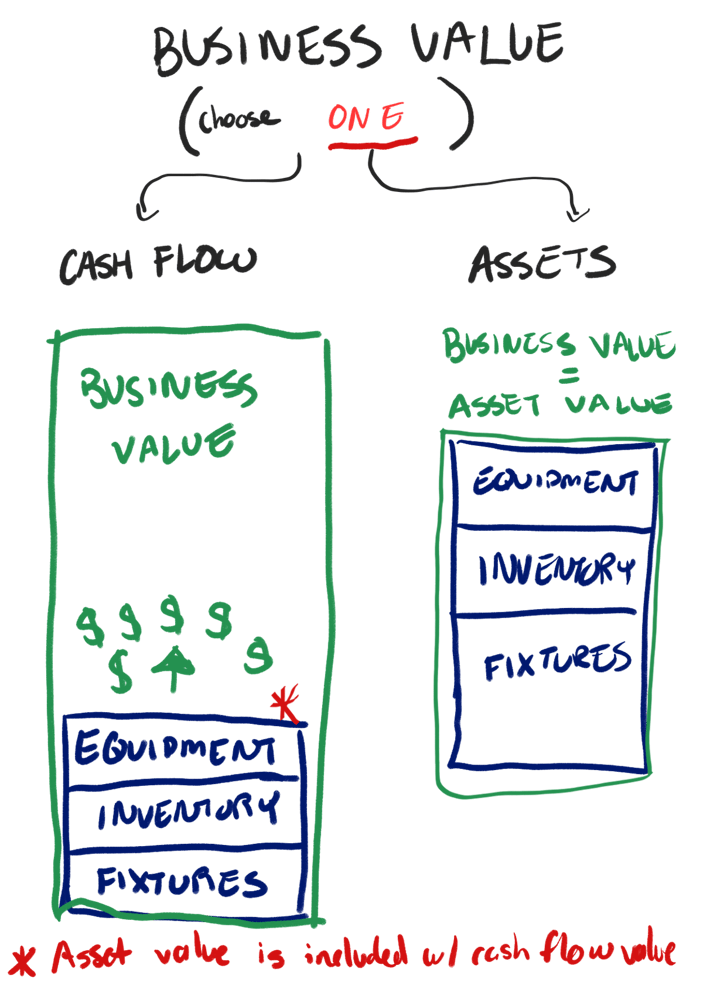
A two-column diagram comparing cash flow valuation versus asset-based valuation. The left column shows that a business value based on cash flow already includes equipment, inventory, and fixtures. The right column shows that an asset-based valuation equals the combined value of equipment, inventory, and fixtures. A red asterisk notes that asset value is included with the cash flow valuation.

Business value isn’t a buffet.
If you’re pricing your business based on cash flow (SDE or EBITDA), that already includes equipment, inventory, and fixtures. You can’t add them again on top—you have to choose ONE valuation method.

1. Cash Flow Valuation (SDE or EBITDA)

This method values the business based on its earning – some measure of cash flow. This is usually worth more than if someone just bought the equipment, machines and inventory. This price includes all assets. If your business is very profitable, it is usually better to value the business based on cash flow.

2. Asset-Based Valuation

This model prices the business based on the fair market value (FMV) of:

  • Equipment
  • Fixtures
  • Inventory

But it does not include any premium for cash flow, customer base, or brand goodwill. This is usually done because a business is not very profitable and the value of the equipment is greater than a multiple of cash flow. A manufacturer that has been winding down its business, for example, may have greater value in the remaining equipment and machines than in the cash flow its generating.

A Common Myth in Asset Valuation: “My Equipment is Worth Hundreds of Thousands!”

Maybe it was when you bought it, but an asset based valuation is usually based on fair market value. Which means it is usually worth much less than what you bought it for or what can be bought new today. If you have fully depreciated the equipment on your balance sheet, do not expect a high fair market value on your equipment.

🚫 You Can’t Have Both

Trying to price your business using a multiple on earnings and then add separate charges for inventory or equipment is a mistake. It’s like charging for the same thing twice.

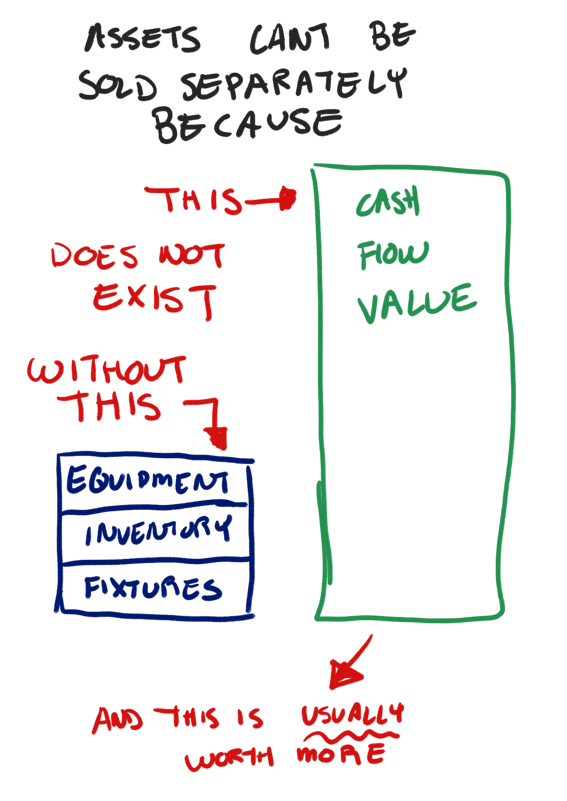
A diagram showing that cash flow value doesn’t exist without core business assets—equipment, inventory, and fixtures. Arrows point from these assets to the cash flow value, emphasizing that one depends on the other. A note at the bottom says cash flow value is usually worth more.

Cash flow doesn’t exist in a vacuum.
You can’t sell a business for its earnings and charge separately for the equipment that generates those earnings. The cash flow value depends on the assets being included—and it’s usually worth more.

That kind of pricing:

  • Turns off experienced buyers
  • Leads to re-negotiation
  • Creates distrust
  • Often kills the deal entirely

What’s My Business Worth? It Usually Depends on Cash Flow

I like to call cash flow your “in your pocket money.” When figuring out what your business is worth we need need to determine profitability, and the value of other benefits your business provides to you. What else do you expense through your business that we can add back?

Work With a Trusted Nashville Business Broker

At Legacy Entrepreneurs, I help owners understand what their business is worth, avoid double dipping, and walk into negotiations with confidence.

The Insider Guide to How Trucking Companies Are Valued in Tennessee

The Insider Guide to How Trucking Companies Are Valued in Tennessee

Tennessee trucking companies are valued based on adjusted cash flow, fleet quality, contract stability, safety records, and how much the business...

Read More
How Roofing Companies Can Add $1 Million in Sales Without Breaking the Business

How Roofing Companies Can Add $1 Million in Sales Without Breaking the Business

A lot of roofing company owners ask the same question: How do we add another million dollars in sales without creating more chaos inside the business?

Read More
Legacy Entrepreneurs vs Viking Mergers & Acquisitions: A Guide for Tennessee Business Owners

Legacy Entrepreneurs vs Viking Mergers & Acquisitions: A Guide for Tennessee Business Owners

Choosing the right business broker in Nashville affects more than transaction speed. It shapes how your business gets positioned, which buyers see...

Read More