.jpeg?width=7008&height=4672&name=AdobeStock_2105687813%20(1).jpeg)
What Drives the Value of a Home Health Business?
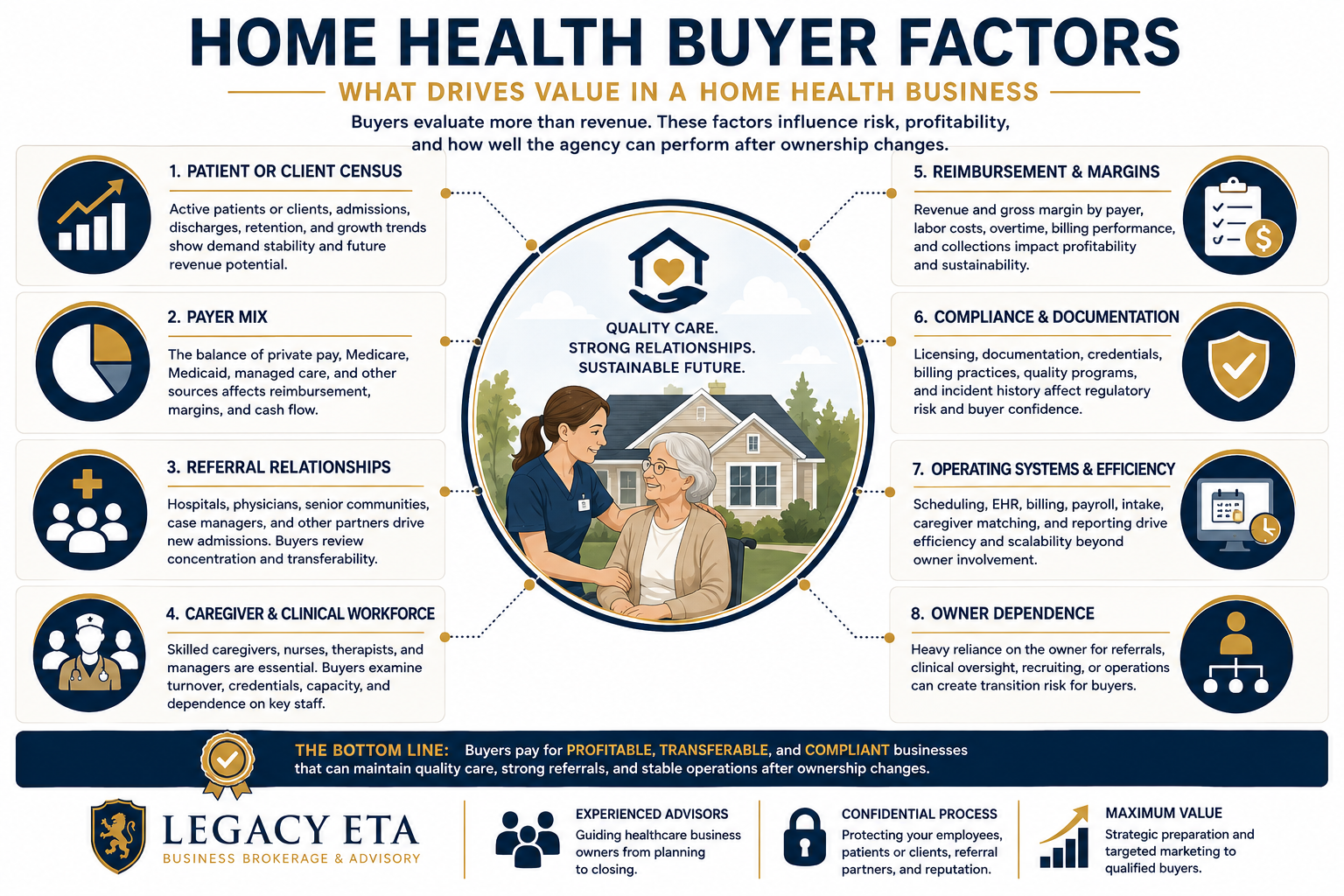
Buyers generally evaluate a home health company based on the quality and durability of its earnings, the stability of its patient or client base, the strength of its workforce, and the risks associated with reimbursement, compliance, and service delivery. Revenue matters, but payer mix, referral relationships, staffing, margins, and owner dependence can materially influence buyer interest.
Patient or Client Census
Buyers may review active patient or client counts, historical census trends, average length of service, admission activity, discharges, and overall retention. Stable or growing census can help demonstrate consistent demand and provide visibility into future revenue.
Payer Mix
The balance between private pay, Medicare, Medicaid, managed care, long-term care insurance, veterans programs, or other payment sources can affect margins, administrative requirements, reimbursement risk, and cash flow. Buyers may evaluate both the diversity and profitability of the payer base.
Referral Relationships
Hospitals, physicians, rehabilitation facilities, senior communities, case managers, discharge planners, families, and other referral sources can drive new admissions. Buyers may examine referral concentration, historical consistency, relationship ownership, and whether referrals are likely to continue after ownership changes.
Caregiver and Clinical Workforce
Nurses, therapists, aides, caregivers, schedulers, clinical managers, and administrative staff can be critical to continuity. Buyers may review employee and contractor mix, turnover, recruiting, compensation, credentials, utilization, scheduling capacity, and dependence on key clinical leaders.
Reimbursement and Margins
Buyers may evaluate revenue and gross margin by payer and service type, labor costs, overtime, visit economics, authorization requirements, billing performance, and accounts receivable. Sustainable margins can be particularly important in labor-intensive care businesses.
Compliance and Documentation
Licensing, credentialing, clinical documentation, background checks, billing practices, patient records, quality programs, incident history, and regulatory compliance may receive significant attention during due diligence. Organized records can help buyers understand operational and regulatory risk.
Scheduling and Operating Systems
Scheduling, electronic health records, billing systems, payroll, caregiver matching, documentation, intake, quality assurance, and reporting processes can affect both efficiency and scalability. Buyers may look for systems that allow the business to operate consistently without constant owner intervention.
Owner Dependence
If the owner personally manages major referral sources, recruiting, clinical oversight, scheduling, billing, or key administrative decisions, a buyer may see additional transition risk. Strong management and documented procedures can make the agency easier to transfer.
What Do Buyers Look for in a Home Health Agency?
A prospective buyer generally wants to determine whether patient or client demand is durable, referral sources are transferable, staffing is sufficient, compliance risks are understood, and the agency can continue delivering care without the seller.
| Buyer Focus | What They May Review | Why It Matters |
|---|---|---|
| Census | Active clients, admissions, discharges, retention, growth | Helps buyers assess demand and future revenue visibility. |
| Payer Mix | Private pay, government programs, managed care, insurance | Can influence reimbursement risk, margins, and cash flow. |
| Referrals | Hospitals, physicians, facilities, communities, concentration | Shows where new clients come from and how transferable demand may be. |
| Workforce | Caregivers, nurses, clinicians, schedulers, turnover | Indicates whether service capacity can continue after a sale. |
| Margins | Labor costs, reimbursement, overtime, billing, collections | Helps buyers understand earnings quality and operating efficiency. |
| Compliance | Licensing, documentation, credentials, incidents, quality controls | Can affect regulatory risk, liability, and buyer confidence. |
How to Prepare a Home Health Business for Sale
Home health transactions can involve detailed review of financial performance, referral activity, staffing, clinical or service records, payer relationships, licensing, and compliance. Preparing those areas before going to market can reduce uncertainty during the transaction.
- Organize financial records. Prepare historical financial statements, tax returns, normalized earnings schedules, payer-level revenue, and working-capital information.
- Document census and service trends. Prepare historical patient or client counts, admissions, discharges, hours or visits, retention, and service mix.
- Analyze payer mix. Document revenue, reimbursement, margins, payment terms, and concentration across major payer categories.
- Review referral concentration. Identify the largest referral sources and understand how much new business each channel contributes.
- Document the workforce. Prepare information on caregivers, clinicians, managers, schedulers, compensation, turnover, credentials, and staffing capacity.
- Organize compliance documentation. Prepare licenses, certifications, background-check procedures, clinical or service documentation, incident records, billing processes, and quality information.
- Clarify the owner's role. Identify referral, recruiting, clinical, scheduling, financial, and management responsibilities that will need to transition.
What Does the Sale Process Look Like?
Selling a home health business typically involves valuation, preparation, confidential marketing, buyer qualification, regulatory and financial due diligence, closing, and a structured transition of employees, patients or clients, referral relationships, and operating responsibilities.
1. Define Your Exit Goals
Consider your desired timing, financial objectives, employee concerns, patient or client continuity, referral relationships, transition expectations, and whether you want to remain involved after closing.
2. Understand What the Business May Be Worth
A valuation can help establish realistic expectations and identify census, payer, staffing, margin, referral, compliance, and owner-dependence factors that may influence buyer interest.
3. Prepare the Agency for Buyer Review
Organize financial statements, census information, payer data, referral reports, employee records, licenses, contracts, compliance documentation, technology information, and operating procedures before serious discussions begin.
4. Market the Opportunity Confidentially
A controlled process can help identify qualified buyers while protecting sensitive information about patients or clients, employees, referral partners, payers, financial performance, and operations.
5. Evaluate Offers and Complete Due Diligence
Buyers may review financial, clinical or service, payer, employee, referral, licensing, compliance, insurance, legal, and operational information before finalizing a transaction. Purchase price, structure, working capital, regulatory requirements, contingencies, and transition terms should all be considered.
6. Close and Transition
Once agreements and required closing conditions are satisfied, the transaction proceeds toward closing and the agreed transition of employees, referral sources, patients or clients, systems, and management responsibilities begins.
Considering Selling Your Home Health Business?
Legacy ETA helps owners understand what their business may be worth, prepare for buyers, protect confidentiality, and navigate the transaction from initial planning through closing.
Talk With Legacy ETAHow Is a Home Health Business Valued?
Home health businesses are generally evaluated using normalized earnings together with the durability and transferability of their patient or client base, referral relationships, workforce, and payer mix.
Buyers may consider historical growth, census, payer concentration, reimbursement, margins, referral concentration, caregiver and clinical staffing, turnover, compliance history, management depth, working capital, owner dependence, and the quality of financial and operating records.
Important: Revenue or census alone does not determine value. Buyers are evaluating the profitability and durability of that revenue, staffing stability, reimbursement risk, compliance, referral continuity, and whether the agency can maintain service quality after ownership changes.
How Legacy ETA Helps Home Health Business Owners
Selling a healthcare services business can involve financial, regulatory, workforce, payer, referral, confidentiality, and transition considerations. Legacy ETA helps owners prepare the agency for market, understand value, evaluate prospective buyers, navigate negotiations, coordinate due diligence, and work toward a successful closing.
- Business valuation and market-readiness guidance
- Preparation of financial and operating information
- Confidential buyer outreach and screening
- Offer evaluation and negotiation support
- Due diligence coordination
- Closing and transition support
Frequently Asked Questions
How do I sell my home health business?
Start by understanding what the agency may be worth and organizing financial statements, census information, payer data, referral reports, staffing information, licenses, compliance documentation, and operating procedures. The process generally includes valuation, preparation, confidential marketing, negotiations, due diligence, closing, and transition.
How is a home health agency valued?
Valuation generally begins with normalized earnings and then considers census, payer mix, referral concentration, reimbursement, margins, caregiver and clinical staffing, compliance, management depth, owner dependence, growth, and overall transferability.
Why does payer mix matter when selling a home health business?
Different payer sources can have different reimbursement rates, authorization requirements, payment timing, margins, and regulatory obligations. Buyers may therefore evaluate both the concentration and profitability of the agency's payer mix.
Do referral relationships affect home health business value?
They can. Hospitals, physicians, senior communities, case managers, and other referral sources may contribute meaningful new patient or client volume. Buyers may review referral concentration, historical consistency, and whether those relationships can transfer after the seller exits.
Does caregiver or clinician turnover affect value?
Yes. High turnover can create recruiting costs, scheduling challenges, service disruption, and growth limitations. Buyers may examine retention, staffing capacity, compensation, credentialing, recruiting processes, and dependence on key clinicians or managers.
Does compliance history affect the sale of a home health agency?
It can. Buyers may review licensing, billing practices, documentation, credentialing, quality controls, incident history, payer audits, and other compliance-related records. Strong documentation can help reduce uncertainty during due diligence.
Can I sell my home health business if I still manage major referrals and operations?
Yes, but significant owner involvement can increase transition risk. Developing managers, distributing referral relationships, documenting workflows, and strengthening recruiting, scheduling, and financial processes can make the business easier for a buyer to transition.
Can the sale of my home health agency remain confidential?
A controlled sale process can limit disclosure until prospective buyers have been screened and confidentiality protections are in place. This can help reduce unnecessary disruption with employees, referral partners, patients or clients, payers, vendors, and competitors.