.jpeg?width=5504&height=3072&name=AdobeStock_2008046910%20(1).jpeg)
What Drives the Value of an Auto Body Shop?
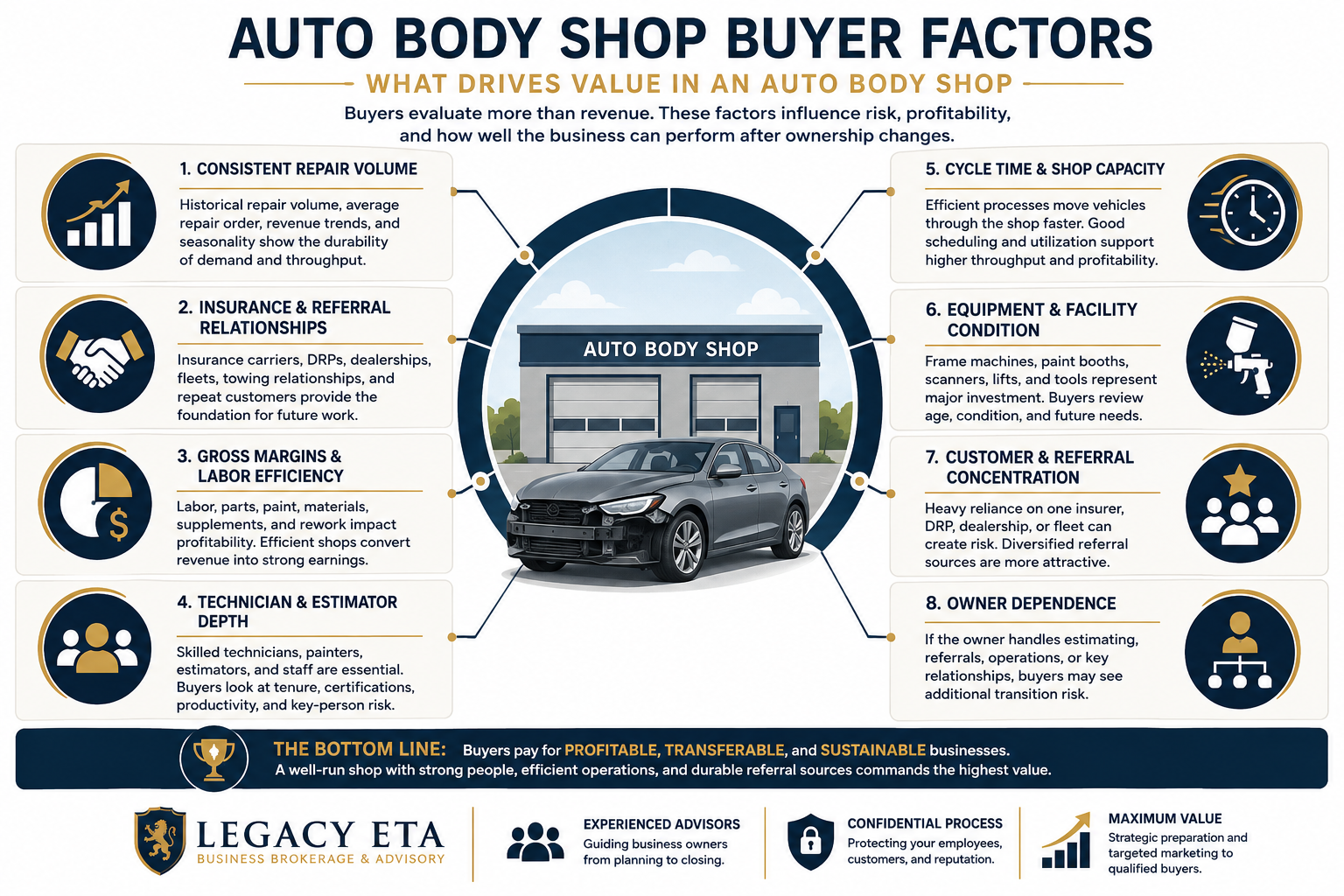
Buyers generally evaluate an auto body shop based on the quality and consistency of its earnings, the durability of its referral sources, and the strength of its technicians, estimators, equipment, and operating systems. Two shops with similar revenue can receive very different buyer reactions depending on margins, repair mix, facility utilization, workforce depth, and owner involvement.
Consistent Repair Volume
Buyers may review historical repair volume, average repair order, revenue trends, seasonal patterns, and the number and type of jobs completed. Consistent throughput can help demonstrate the durability of demand and the shop's ability to keep technicians and equipment productive.
Insurance and Referral Relationships
Insurance carrier relationships, direct repair program participation, dealership referrals, fleet accounts, towing relationships, and repeat customers can all contribute to repair volume. Buyers may evaluate the quality, concentration, and transferability of those referral channels.
Gross Margins and Labor Efficiency
Parts margins, labor margins, paint and materials costs, subcontracting, supplements, rework, and technician productivity can materially affect earnings. Buyers may examine profitability by repair category and whether the shop consistently converts revenue into healthy operating cash flow.
Technician and Estimator Depth
Experienced body technicians, painters, estimators, parts personnel, production managers, and front-office staff can be difficult to replace. Buyers may review tenure, compensation, certifications, workload, productivity, and dependence on a small number of key employees.
Cycle Time and Shop Capacity
Buyers may review how quickly vehicles move through estimating, parts, repair, paint, reassembly, and delivery. Efficient cycle times, disciplined scheduling, and good facility utilization can support stronger throughput without requiring immediate expansion.
Equipment and Facility Condition
Frame machines, paint booths, measuring systems, welders, lifts, scanning and calibration equipment, compressors, tools, and facility infrastructure can represent significant capital investment. Buyers may review age, condition, maintenance, ownership, financing, and expected replacement needs.
Customer and Referral Concentration
A shop that relies heavily on one insurer, dealership, fleet, or referral partner may present greater revenue risk. Buyers may examine how much repair volume and revenue are tied to the largest referral sources.
Owner Dependence
If the owner personally handles estimating, insurer relationships, production management, quality control, hiring, or major customer issues, a buyer may see additional transition risk. A capable management team and documented processes can make the shop easier to transfer.
What Do Buyers Look for in an Auto Body Shop?
A prospective buyer generally wants to determine whether the shop can maintain repair volume, margins, technician productivity, and referral relationships after the seller exits.
| Buyer Focus | What They May Review | Why It Matters |
|---|---|---|
| Repair Volume | Cars repaired, average repair order, revenue trends | Helps buyers assess demand and throughput. |
| Referral Sources | Insurers, DRPs, dealerships, fleets, towing relationships | Shows where future repair volume comes from. |
| Margins | Labor, parts, paint, materials, supplements, rework | Helps buyers understand earnings quality. |
| Workforce | Technicians, estimators, painters, managers, certifications | Indicates whether production can continue after a sale. |
| Operations | Cycle time, scheduling, supplements, shop utilization | Shows how efficiently the business converts work into revenue. |
| Assets | Paint booth, frame equipment, tools, scanners, facility | Helps identify future capital requirements and capacity. |
How to Prepare an Auto Body Shop for Sale
Preparing the shop before buyers begin due diligence can help demonstrate the strength of its repair volume, workforce, equipment, and referral relationships while identifying operational issues that may affect value.
- Organize financial records. Prepare historical financial statements, tax returns, normalized earnings schedules, and supporting documentation.
- Document repair volume and mix. Organize repair-order data, average ticket size, revenue by payer or referral source, and historical production trends.
- Review referral concentration. Identify how much revenue comes from major insurers, DRPs, dealerships, fleets, and other referral channels.
- Analyze margins and cycle time. Prepare information on labor, parts, paint and materials, supplements, rework, technician efficiency, and repair throughput.
- Document the team. Prepare information on technicians, estimators, painters, managers, certifications, compensation, productivity, and tenure.
- Prepare an equipment schedule. Document major equipment, age, condition, maintenance, ownership, financing, and expected replacement needs.
- Clarify the owner's role. Identify insurer, estimating, production, quality-control, hiring, and management responsibilities that will need to transfer.
What Does the Sale Process Look Like?
Selling an auto body shop typically involves valuation, preparation, confidential buyer outreach, offer evaluation, due diligence, closing, and a structured transition of employees, insurers, referral partners, and operations.
1. Define Your Exit Goals
Consider your desired timing, financial objectives, employee concerns, referral relationships, transition expectations, and whether you want to remain involved after closing.
2. Understand What the Shop May Be Worth
A valuation can help establish realistic expectations and identify profitability, workforce, referral, equipment, and owner-dependence factors that may influence buyer interest.
3. Prepare the Business for Buyer Review
Organize financial statements, repair data, referral information, employee records, equipment schedules, insurance information, leases, certifications, and operating procedures before serious discussions begin.
4. Market the Opportunity Confidentially
A controlled process can help identify qualified buyers while protecting sensitive information about employees, insurers, referral partners, pricing, margins, and operating performance.
5. Evaluate Offers and Complete Due Diligence
Buyers may review financial, employee, referral, equipment, lease, insurance, environmental, legal, and operational information before finalizing a transaction. Purchase price, structure, equipment obligations, working capital, contingencies, and transition terms should all be considered.
6. Close and Transition
Once agreements are complete, the transaction proceeds toward closing and the agreed transition of employees, insurers, referral partners, customers, and operating responsibilities begins.
Considering Selling Your Auto Body Shop?
Legacy ETA helps owners understand what their shop may be worth, prepare for buyers, protect confidentiality, and navigate the transaction from initial planning through closing.
Talk With Legacy ETAHow Is an Auto Body Shop Valued?
Auto body shops are generally evaluated using normalized earnings together with the durability of repair volume and the operational infrastructure required to produce those earnings.
Buyers may consider historical revenue and earnings, repair volume, average repair order, gross margins, referral concentration, technician retention, cycle time, facility capacity, equipment condition, insurance relationships, growth, owner dependence, and the quality of financial reporting.
Important: Revenue alone does not determine value. Buyers are evaluating how profitably the shop converts repair volume into earnings, whether referral sources are durable, and whether the workforce and facility can continue operating after the seller exits.
How Legacy ETA Helps Auto Body Shop Owners
Selling a collision repair business can involve financial, workforce, referral, equipment, facility, environmental, confidentiality, and transition considerations. Legacy ETA helps owners prepare the shop for market, understand value, evaluate prospective buyers, navigate negotiations, coordinate due diligence, and work toward a successful closing.
- Business valuation and market-readiness guidance
- Preparation of financial and operating information
- Confidential buyer outreach and screening
- Offer evaluation and negotiation support
- Due diligence coordination
- Closing and transition support
Frequently Asked Questions
How do I sell my auto body shop?
Start by understanding what the shop may be worth and organizing financial statements, repair-order data, referral information, employee records, equipment schedules, leases, and operating procedures. The process generally includes valuation, preparation, confidential marketing, negotiations, due diligence, closing, and transition.
How is an auto body shop valued?
Valuation generally begins with normalized earnings and then considers repair volume, gross margins, referral concentration, technician depth, cycle time, equipment condition, facility capacity, insurance relationships, owner dependence, and overall transferability.
Do insurance relationships affect the value of a body shop?
They can. Insurance and direct repair relationships may contribute meaningful repair volume, but buyers will generally examine concentration, performance requirements, retention history, and whether those relationships are likely to continue after ownership changes.
Does technician retention affect auto body shop value?
Yes. Skilled technicians, painters, estimators, and managers are essential to maintaining repair capacity and quality. Buyers may review employee tenure, compensation, certifications, productivity, and whether the shop can retain key personnel after a sale.
Does equipment condition affect body shop value?
It can. Buyers may review paint booths, frame equipment, welders, lifts, scanning tools, compressors, and other major assets to determine whether significant maintenance or replacement spending may be required after closing.
Can I sell my collision repair shop if I still run daily operations?
Yes, but heavy owner involvement may increase transition risk. Developing production and office leadership, documenting estimating and repair workflows, and distributing insurer and referral relationships can make the business easier for a buyer to transition.
Can the sale of my auto body shop remain confidential?
A controlled sale process can limit disclosure until prospective buyers have been screened and confidentiality protections are in place. This can help reduce unnecessary disruption with employees, insurers, referral partners, vendors, customers, and competitors.