Buyers may look closely at financial performance, lead sources, inspection and estimating processes, reputation, crew structure, warranty obligations, geographic coverage, and how dependent the company is on the current owner. Understanding those factors before going to market can help you prepare for buyer questions and position the business more effectively.
What Drives the Value of a Foundation Repair Business?
Buyers typically evaluate the quality and durability of a foundation repair company's earnings rather than focusing on revenue alone. A company with strong margins, repeatable lead generation, experienced crews, and systems that do not depend entirely on the owner may be easier for a buyer to operate and grow.
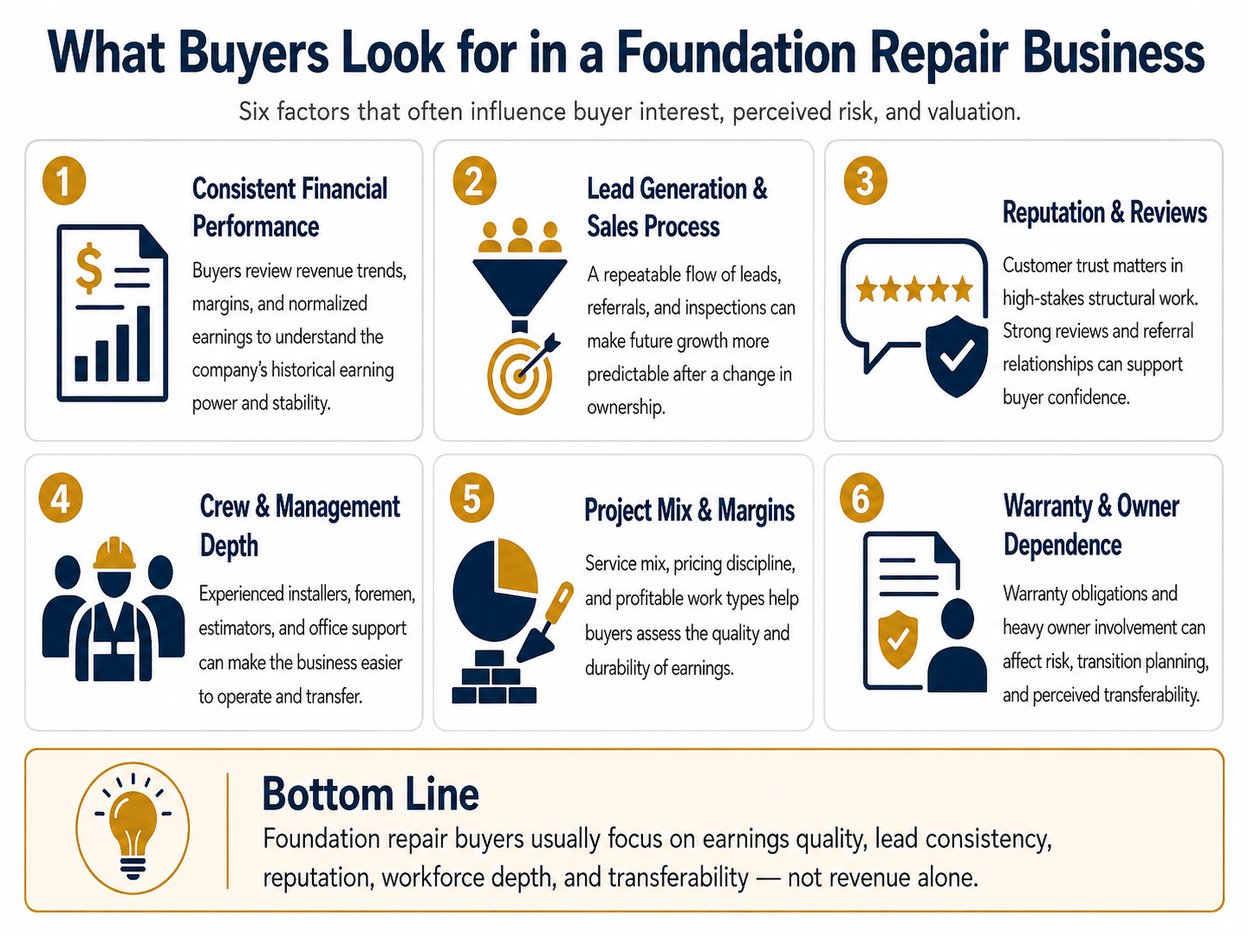
Consistent Financial Performance
Historical revenue, gross margins, operating expenses, normalized earnings, and year-over-year performance help buyers understand the company's financial stability. Clean financial statements and clearly documented owner-related adjustments can make the business easier to evaluate.
Lead Generation and Sales Process
Foundation repair companies often depend on a steady flow of homeowner inquiries, referrals, digital marketing, partnerships, and inspection opportunities. Buyers may examine where leads come from, what they cost to acquire, conversion rates, and whether the sales process can continue without the current owner.
Reputation and Reviews
Because foundation work is high-trust and often represents a significant expense for the customer, reputation can be an important asset. Strong reviews, referral relationships, an established local presence, and a history of resolving customer issues professionally can strengthen buyer confidence.
Crew and Management Depth
Buyers may prefer companies with trained installers, experienced foremen, estimators, inspectors, office support, and managers who can continue operating the business after a sale. Dependence on a small number of key employees can create additional transition risk.
Project Mix and Margins
The mix of foundation stabilization, waterproofing, crawl space work, structural repair, drainage solutions, and related services can affect margins and revenue predictability. Buyers will often want to understand which services generate the strongest returns and how consistently those projects are sold and completed.
Warranty and Liability Exposure
Foundation repair work may involve warranties, callbacks, insurance requirements, and potential liability. Buyers may review historical claims, warranty terms, unresolved customer issues, and the systems used to document completed work.
Owner Dependence
If the owner personally manages inspections, closes most sales, maintains referral relationships, supervises crews, or handles major customer issues, a buyer may see additional transition risk. Documented processes and capable employees can help reduce that dependence.
What Do Buyers Look for in a Foundation Repair Company?
A prospective buyer will usually look beyond the company's equipment and current backlog. The goal is to understand whether the business has a reliable way to generate leads, convert opportunities, complete projects profitably, and maintain its reputation after the seller exits.
| Buyer Focus | What They May Review | Why It Matters |
|---|---|---|
| Earnings | Revenue, margins, normalized EBITDA or SDE, add-backs | Helps establish the company's historical earning capacity. |
| Lead Generation | Lead sources, marketing spend, referrals, conversion rates | Shows whether new opportunities can continue after ownership changes. |
| Workforce | Installers, foremen, inspectors, estimators, managers | Helps buyers assess operational continuity and recruiting risk. |
| Reputation | Reviews, referrals, complaints, brand presence | Customer trust can directly influence lead flow and close rates. |
| Warranty Exposure | Warranty terms, claims history, callbacks, documentation | Helps buyers understand potential future obligations. |
| Owner Role | Sales, inspections, relationships, operations, supervision | Indicates how difficult the business may be to transition. |
How to Prepare a Foundation Repair Business for Sale
Many issues that slow down a transaction are easier to address before buyers begin due diligence. Organizing the business in advance can help you answer questions more efficiently and identify potential risks before they affect negotiations.
- Organize financial records. Prepare historical profit-and-loss statements, balance sheets, tax returns, and documentation supporting normalization adjustments.
- Document lead sources. Show where opportunities originate, how much marketing costs, and how leads convert into inspections and completed projects.
- Review warranty obligations. Organize warranty terms, claims history, callbacks, and any unresolved customer matters.
- Document your workforce. Prepare information on installers, inspectors, foremen, managers, compensation, tenure, and required qualifications.
- Clarify the owner's responsibilities. Identify sales, estimating, operational, and relationship-management duties that will need to transfer.
- Organize equipment and assets. Prepare schedules for vehicles, installation equipment, leases, software, facilities, and other material operating assets.
What Does the Sale Process Look Like?
Selling a foundation repair company is a process rather than a single event. Although every transaction is different, most business sales move through several common stages.
1. Define Your Exit Goals
Determine your desired timing, financial objectives, transition preferences, employee considerations, and what you want life after the transaction to look like.
2. Understand What the Business May Be Worth
A valuation can help establish realistic expectations and identify financial or operational factors that could influence how buyers view the company.
3. Prepare the Business for Buyer Review
Organize financial statements, employee information, equipment schedules, lead-generation data, warranty information, customer records, and other documents buyers are likely to request.
4. Market the Opportunity Confidentially
A controlled process can help protect sensitive information while introducing the opportunity to qualified individual, strategic, or investment-backed buyers.
5. Evaluate Offers and Complete Due Diligence
The highest headline price is not always the strongest offer. Deal structure, financing, contingencies, working-capital expectations, transition requirements, and closing certainty can all matter.
6. Close and Transition the Business
After due diligence and definitive agreements are completed, the transaction moves toward closing and the agreed transition period begins.
Considering Selling Your Foundation Repair Business?
Legacy ETA helps owners understand what their business may be worth, prepare for the market, connect with qualified buyers, and navigate the transaction from initial planning through closing.
Talk With Legacy ETAHow Is a Foundation Repair Business Valued?
Foundation repair businesses are generally valued based on normalized earnings together with the risks, strengths, and growth characteristics of the company. A valuation should account for what a buyer is actually acquiring and how likely those earnings are to continue after the sale.
Revenue trends, margins, lead-generation efficiency, customer concentration, reputation, workforce stability, warranty obligations, service mix, owner dependence, and the quality of financial reporting can all affect buyer perception.
Important: Two foundation repair companies with the same revenue may not have the same value. Buyers are evaluating the quality and transferability of the earnings, not simply the company's top-line sales.
How Legacy ETA Helps Foundation Repair Business Owners
Selling an established contracting business involves more than putting the company on the market. Owners need to understand valuation, prepare financial and operating information, protect confidentiality, evaluate buyers, negotiate terms, navigate due diligence, and manage the transition.
- Business valuation and market-readiness guidance
- Preparation of financial and operating information
- Confidential buyer outreach and screening
- Offer evaluation and negotiation support
- Due diligence coordination
- Closing and transition support
Frequently Asked Questions
How do I sell my foundation repair business?
Start by understanding what the business may be worth and preparing the financial, operational, workforce, warranty, and customer information buyers are likely to review. The sale process typically includes valuation, preparation, confidential marketing, buyer screening, negotiations, due diligence, closing, and transition.
How is a foundation repair company valued?
Valuation generally begins with normalized earnings and then considers factors such as margins, historical growth, lead-generation quality, reputation, workforce depth, owner dependence, warranty exposure, and the ability of the business to continue performing after a change in ownership.
What makes a foundation repair business attractive to buyers?
Buyers may favor companies with consistent earnings, strong margins, a reliable lead-generation system, a good reputation, experienced crews, documented processes, manageable warranty exposure, and limited dependence on the current owner.
Do warranties affect the sale of a foundation repair company?
They can. Buyers may review warranty terms, historical claims, callback rates, transfer provisions, and potential future obligations. Clear documentation can make it easier for a buyer to understand the company's exposure.
Can I sell the company if I still handle most inspections and sales?
Yes, but a buyer may view significant owner dependence as a transition risk. Documenting the sales and inspection process and developing employees who can assume key responsibilities can make the transition easier to evaluate.
What documents should I prepare before selling?
Buyers commonly request financial statements, tax returns, payroll information, employee records, equipment schedules, lead-generation data, customer information, warranty documentation, leases, insurance information, and details supporting any owner add-backs or normalization adjustments.
Can the sale of my foundation repair business remain confidential?
A controlled sale process can limit the disclosure of sensitive information until prospective buyers have been screened and confidentiality protections are in place. This can help reduce unnecessary disruption with employees, customers, vendors, and competitors.