Commercial HVAC businesses can attract interest from individual buyers, strategic operators, and investment-backed groups because they serve an essential function for offices, industrial facilities, institutional properties, multifamily buildings, and other commercial customers.
But two companies with similar revenue can receive very different reactions from buyers. The quality of earnings, customer base, service agreements, team structure, project backlog, and dependence on the owner can all influence perceived risk and ultimately affect valuation.
What matters most? Buyers are generally looking for a business that can continue operating after the owner exits. Consistent earnings, recurring service revenue, a capable team, diversified commercial accounts, and documented systems can make a company easier to evaluate and potentially easier to transfer.
What Drives the Value of a Commercial HVAC Business?
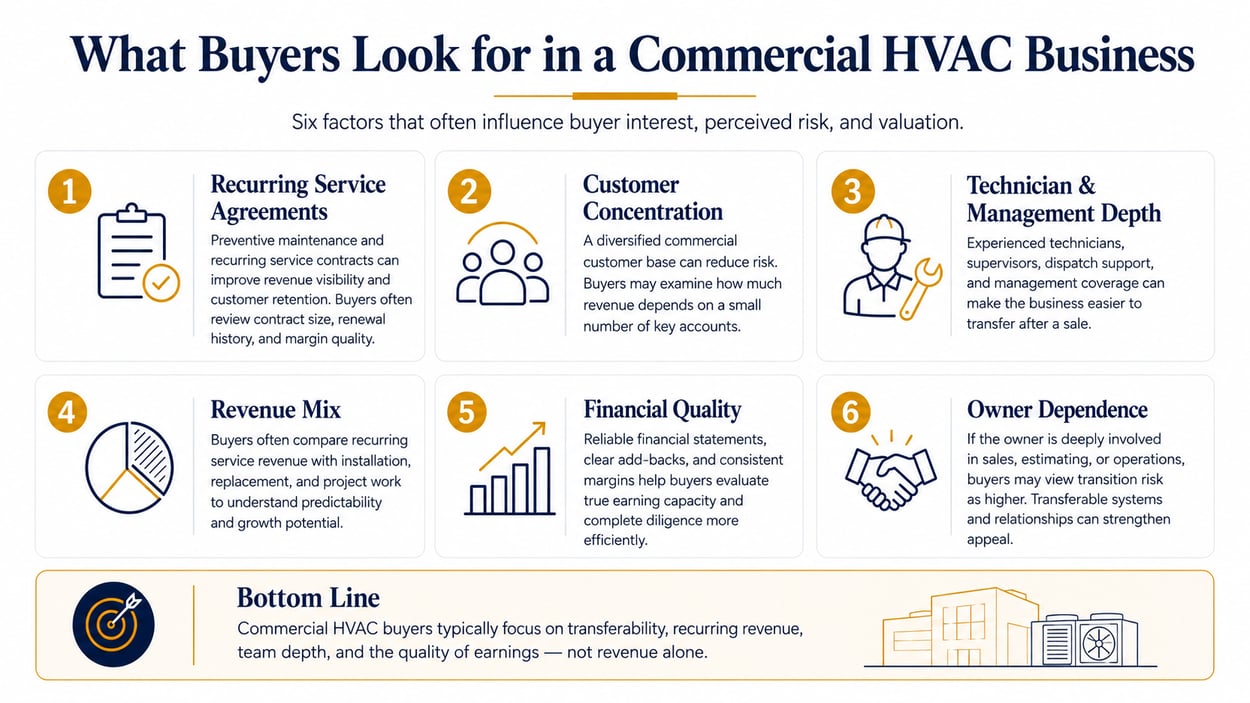
Buyers rarely evaluate a commercial HVAC company based on revenue alone. They look at the durability and quality of the earnings behind that revenue, along with the operating risks they may inherit after closing.
Recurring Service Agreements
Preventive maintenance and recurring service agreements can provide more predictable revenue and strengthen customer retention. Buyers may review the size of the contract base, renewal history, contract terms, margins, and whether those relationships are likely to continue after a change in ownership.
Customer Concentration
A diversified portfolio of commercial accounts can reduce the risk associated with losing one major customer. Buyers will often examine the percentage of revenue generated by the company's largest accounts and the industries those customers represent.
Technician and Management Depth
Experienced technicians, dispatch capabilities, supervisors, estimators, and managers can make a commercial HVAC business less dependent on the owner and easier for a buyer to operate after closing.
Service Versus Project Revenue
Buyers may evaluate the balance between recurring service work, replacements, installations, retrofit projects, and other project-based revenue. A more predictable revenue mix can reduce uncertainty, while project work may provide additional growth opportunities.
Financial Quality
Reliable financial statements, clear normalization adjustments, consistent margins, and well-documented expenses help buyers understand the company's true earning capacity and can make due diligence more efficient.
Owner Dependence
A company that relies heavily on the owner for sales, estimating, key accounts, field supervision, or day-to-day decisions may require more transition planning. Businesses with transferable relationships and established management systems can be easier for buyers to evaluate.
What Do Buyers Look for in a Commercial HVAC Company?
Different buyers may prioritize different characteristics, but many of the same questions tend to appear during valuation, buyer screening, and due diligence.
| Buyer Focus | What They May Review | Why It Matters |
|---|---|---|
| Recurring Revenue | Maintenance agreements, renewal history, service contracts | Helps buyers assess revenue predictability and customer retention. |
| Customer Base | Top customers, contract terms, industries served, concentration | Shows whether earnings depend too heavily on a small number of accounts. |
| Workforce | Technicians, managers, licensing, tenure, compensation | Indicates whether the business can continue operating after ownership changes. |
| Financial Performance | Revenue trends, margins, normalized EBITDA or SDE, working capital | Provides the financial foundation for valuation and deal structure. |
| Owner Role | Sales, estimating, key accounts, operations, field supervision | Helps determine transition risk and post-closing support requirements. |
| Operations | Dispatch, systems, fleet, service territory, backlog | Helps buyers determine how scalable and transferable the company is. |
How to Prepare a Commercial HVAC Business for Sale
Preparation can make the sale process easier for both the seller and prospective buyers. Ideally, owners should begin organizing the business before confidential marketing begins.
- Organize financial records. Prepare clean profit-and-loss statements, balance sheets, tax returns, and supporting schedules.
- Document recurring revenue. Compile maintenance agreements, contract terms, renewal history, and customer retention information.
- Review customer concentration. Understand how much revenue comes from the company's largest commercial accounts.
- Clarify the owner's role. Identify responsibilities that may need to be delegated or transitioned.
- Document the team. Prepare information on technicians, managers, licensing, compensation, and tenure.
- Review operating assets. Organize fleet, equipment, leases, software, and other operational information buyers may request.
What Does the Sale Process Look Like?
Every transaction is different, but most commercial HVAC sales follow a similar sequence. Understanding the process in advance can help owners make better decisions before they are under the pressure of an active transaction.
1. Define Your Exit Goals
Start with the outcome you want to achieve, including timing, financial objectives, transition preferences, employee considerations, and your desired role after closing.
2. Understand the Business's Value
A professional valuation can help determine whether current market value aligns with your personal and financial goals and identify factors that may affect buyer perception.
3. Prepare the Business for Market
Financial records, customer information, operating documentation, and other materials should be organized before serious buyers begin their review.
4. Market the Opportunity Confidentially
A controlled process helps protect sensitive information while identifying buyers with the financial capacity and strategic fit to pursue the transaction.
5. Negotiate and Complete Due Diligence
Buyers will typically review financial, operational, legal, employee, customer, and contractual information before moving toward closing.
6. Close and Transition
The final stage includes definitive agreements, financing or funding conditions, closing requirements, and the owner's transition to the buyer.
Considering Selling Your Commercial HVAC Business?
Legacy ETA helps business owners understand value, prepare for the market, identify qualified buyers, and navigate the transaction from initial planning through closing.
Talk With Legacy ETAHow Is a Commercial HVAC Business Valued?
Valuation typically begins with normalized earnings and then considers the quality, durability, and risk of those earnings. There is no single multiple that applies to every commercial HVAC company.
Factors such as recurring revenue, customer concentration, growth, management depth, technician retention, owner dependency, margins, project backlog, and financial reporting can influence the multiple a buyer is willing to consider.
Important: Revenue alone does not determine value. Buyers are ultimately evaluating the cash flow they expect the business to generate after the transaction and the risks associated with maintaining that cash flow.
How Legacy ETA Helps Commercial HVAC Owners
Selling a privately held business involves valuation, preparation, confidential marketing, buyer qualification, negotiation, due diligence, and transition planning. Legacy ETA helps owners navigate those stages with a process designed around the realities of selling an established operating business.
- Business valuation and market-readiness guidance
- Preparation of financial and operating information
- Confidential buyer outreach and screening
- Offer evaluation and negotiation support
- Due diligence coordination
- Closing and transition support
Frequently Asked Questions
How do I sell my commercial HVAC business?
Start by determining what the business may be worth and whether it is ready for buyer scrutiny. The process typically includes preparing financial and operating information, confidential marketing, screening buyers, negotiating an offer, completing due diligence, and managing closing and transition.
How is a commercial HVAC company valued?
Commercial HVAC companies are generally evaluated using normalized earnings together with factors such as recurring service revenue, customer concentration, management and technician depth, margins, owner dependency, growth, and overall transferability.
Do service contracts make a commercial HVAC business more valuable?
Recurring service and maintenance agreements can make revenue more predictable and may improve customer retention. Buyers will still evaluate contract terms, renewal history, account concentration, profitability, and how dependent those relationships are on the owner.
Can I sell a commercial HVAC business if I am still heavily involved?
Yes, but heavy owner involvement may affect how a buyer evaluates transition risk. Clearly documenting the owner's responsibilities and strengthening management coverage can help buyers understand how the company will operate after a sale.
What financial records will buyers want to see?
Buyers commonly review historical profit-and-loss statements, balance sheets, tax returns, payroll information, customer concentration, contract revenue, working capital, and documentation supporting any normalization adjustments.
Can the sale of my commercial HVAC company remain confidential?
A controlled sale process can limit disclosure of sensitive information until a buyer has been screened and appropriate confidentiality protections are in place. This can reduce unnecessary disruption with employees, customers, vendors, and competitors.