.jpeg?width=1000&height=527&name=AdobeStock_2113126507%20(1).jpeg)
What Drives the Value of a Technology Business?
Buyers evaluating a technology company are purchasing more than code, software, or customer accounts. They are acquiring an operating business that must continue retaining customers, maintaining systems, supporting users, developing products, and generating sustainable profit after ownership changes.
The strongest technology businesses generally combine recurring or repeatable revenue with healthy margins, strong customer retention, defensible products or services, capable technical teams, secure systems, and limited dependence on the owner.
Recurring Revenue
Recurring revenue can provide buyers with greater visibility into future performance. Depending on the business model, this may include software subscriptions, managed services, support agreements, maintenance contracts, hosting, licensing, or other ongoing customer relationships.
Buyers may review monthly or annual recurring revenue, contract terms, renewal behavior, pricing, expansion revenue, and the percentage of total revenue that is predictable rather than project-based.
Customer Retention
Buyers want to understand how consistently customers remain with the business over time. Strong retention can signal product value, service quality, and durable customer relationships.
They may evaluate churn, renewal rates, customer tenure, usage trends, support activity, contract history, and whether revenue expands or declines within existing accounts.
Gross Margins and Profitability
Technology companies can have very different cost structures depending on whether they sell software, services, hardware, implementation, support, or a combination of offerings.
Buyers may review gross margins by product or service line, normalized earnings, payroll, hosting, software costs, contractor expenses, sales and marketing costs, and other operating expenses.
Customer Concentration
A large customer can contribute meaningful revenue, but excessive concentration can create risk if losing one account would materially affect the company.
Buyers may review revenue by customer, contract terms, account tenure, profitability, renewal history, and the strength of the broader customer pipeline.
Intellectual Property and Product Ownership
Buyers want clarity around who owns the code, software, trademarks, proprietary processes, databases, documentation, and other intellectual property used by the business.
Clean ownership records, contractor agreements, employee IP assignments, and well-organized documentation can reduce uncertainty during due diligence.
Product and Platform Dependence
Technology businesses may depend on cloud platforms, APIs, software vendors, marketplaces, app stores, data providers, or other third-party systems.
Buyers want to understand which external platforms are critical to the business, how easily they could be replaced, and whether changes in pricing or access could materially affect operations.
Technical Team and Management Depth
Developers, engineers, technical support staff, product leaders, project managers, and other key employees can be central to product continuity and customer retention.
Buyers may review employee tenure, responsibilities, compensation, turnover, recruiting, documentation, and whether critical technical knowledge is concentrated in one person.
Cybersecurity and Data Practices
Buyers may review cybersecurity policies, access controls, backups, incident history, customer data handling, privacy practices, and how vulnerabilities are identified and addressed.
Organized security practices can reduce operational and reputational risk and make the business easier to evaluate.
Growth Efficiency
Buyers want to understand not only whether the company is growing but also what it costs to generate that growth.
They may evaluate sales productivity, customer acquisition costs, marketing efficiency, pipeline conversion, upsell opportunities, product adoption, and whether growth depends on unusually high spending.
Owner Dependence
Technology companies can become highly dependent on owners who manage product strategy, write code, oversee major customers, lead sales, maintain infrastructure, or hold critical technical knowledge.
Buyers generally prefer a company where those responsibilities are distributed among capable employees and supported by documentation, systems, and repeatable processes.
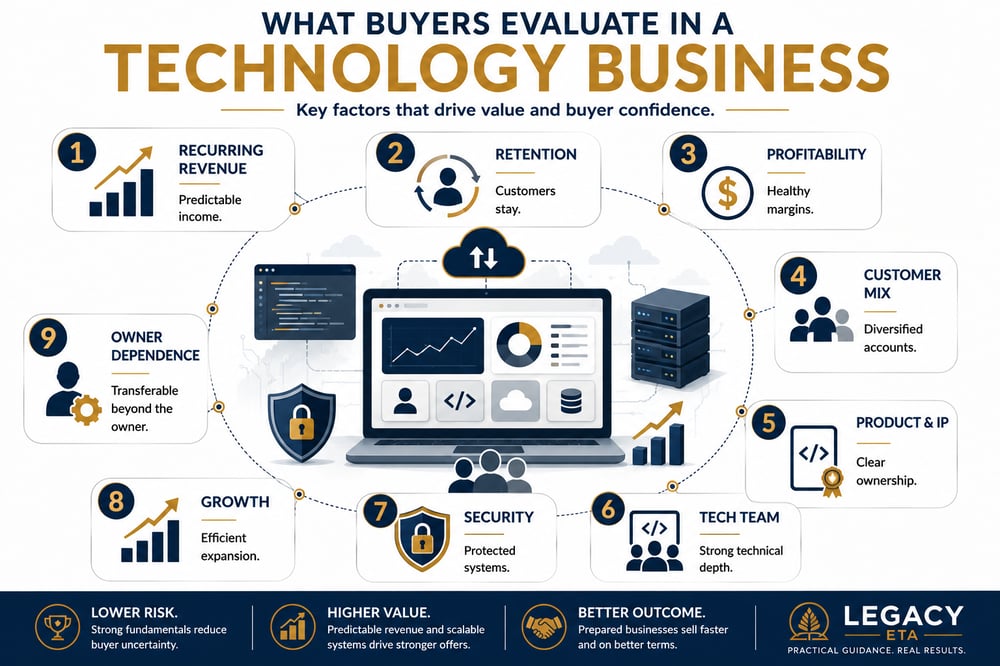
What Do Buyers Look for in a Technology Company?
Buyers evaluate technology businesses through both a financial and operational lens. They want confidence that customers, products, technical systems, and key employees can remain stable after ownership changes.
| Area Buyers Review | What They Evaluate | Why It Matters |
|---|---|---|
| Revenue Quality | Recurring revenue, contracts, retention, churn, pricing, and customer tenure | Helps buyers assess predictability and durability. |
| Financial Performance | Revenue, normalized earnings, gross margins, payroll, hosting, and operating costs | Shows the quality and sustainability of earnings. |
| Customers | Concentration, retention, contracts, usage, and account growth | Helps buyers evaluate customer risk. |
| Product & IP | Code ownership, documentation, trademarks, systems, and third-party dependencies | Shows whether the core technology is transferable and defensible. |
| Technical Team | Developers, engineers, support staff, leadership, retention, and knowledge concentration | Indicates whether technical operations can continue after a sale. |
| Security & Systems | Cybersecurity, data practices, access, backups, infrastructure, and documentation | Helps buyers assess operational and compliance risk. |
| Owner Role | Product, coding, sales, customers, infrastructure, and strategic decision-making | Helps buyers assess transition risk. |
How to Prepare a Technology Business for Sale
Technology due diligence can become detailed quickly. Preparing before going to market gives you time to organize financial, customer, technical, security, and intellectual-property information and identify potential concerns before a buyer does.
- Organize financial records. Prepare tax returns, profit-and-loss statements, balance sheets, recurring-revenue reports, and supporting schedules.
- Document recurring revenue and retention. Organize subscription, contract, renewal, churn, and customer-retention data.
- Review customer concentration. Understand revenue and profitability by major account and document contract terms and renewal history.
- Organize intellectual-property records. Confirm ownership of code, trademarks, documentation, databases, and other proprietary assets.
- Document the technical environment. Organize architecture, infrastructure, cloud systems, integrations, third-party dependencies, backups, and operating documentation.
- Review cybersecurity practices. Document access controls, incident history, backups, security policies, and relevant data-handling practices.
- Document key employees. Identify developers, engineers, support personnel, salespeople, product leaders, and managers important to continuity.
- Clarify the owner's role. Identify technical, product, sales, customer, and strategic responsibilities that depend on you personally.
What Does the Sale Process Look Like?
Every technology business sale is different, but most transactions move through a similar sequence. Preparing early can help reduce friction when buyers begin detailed financial and technical due diligence.
1. Define Your Exit Goals
Determine your preferred timing, financial objectives, employee considerations, transition expectations, and desired involvement after a sale.
2. Understand the Business's Value
Review recurring revenue, retention, margins, customer concentration, product ownership, technical systems, workforce, growth, and owner dependence.
3. Prepare the Business for Market
Organize financial records, contracts, customer metrics, IP documentation, technical information, employee records, and security materials.
4. Identify and Qualify Buyers
Potential buyers may include strategic technology companies, competitors, larger service providers, individual operators, or investment groups seeking established technology businesses.
5. Negotiate and Complete Due Diligence
Once an acceptable proposal is reached, the buyer may review financial, customer, contract, technical, security, employee, IP, legal, and operational information in detail.
6. Close and Transition the Business
Final agreements are completed and ownership transitions to the buyer. Depending on the transaction, the seller may remain involved for a period to transfer customer relationships, technical knowledge, product strategy, or management responsibilities.
Considering Selling Your Technology Business?
A confidential conversation can help you understand your options, how buyers may evaluate your company, and what you can do now to prepare for a successful transition.
Talk With Legacy ETAHow Is a Technology Business Valued?
A technology business valuation generally begins with financial performance, but buyers also want to understand the quality, predictability, and scalability of those earnings.
Depending on the business model, buyers may analyze normalized cash flow or EBITDA alongside recurring revenue, retention, gross margins, customer concentration, growth efficiency, intellectual property, technical team depth, product risk, and future investment requirements.
Businesses with subscription or recurring-revenue models may require additional analysis of churn, renewals, expansion revenue, and customer cohort performance.
A professional valuation can help establish realistic expectations before speaking with buyers and identify the factors that may strengthen or reduce buyer confidence.
How Legacy ETA Helps Technology Business Owners
Selling a technology company involves more than finding someone willing to purchase software, customer contracts, or intellectual property. Owners need to understand value, prepare detailed financial and technical information, protect confidentiality, identify qualified buyers, compare offers, manage due diligence, and plan for a smooth transition.
Legacy ETA helps technology business owners navigate that process with practical guidance from preparation through closing.
- Business valuation and market-positioning guidance
- Preparation of financial and operational information
- Confidential marketing and buyer outreach
- Buyer qualification and offer evaluation
- Support through negotiations and due diligence
- Coordination through closing and ownership transition
Frequently Asked Questions About Selling a Technology Business
How much is my technology business worth?
The value of a technology business depends on factors including normalized earnings, recurring revenue, customer retention, gross margins, customer concentration, intellectual property, technical team depth, growth efficiency, and owner dependence. A valuation should reflect the company's specific revenue model and operating structure rather than rely on a generic industry multiple.
What makes a technology company attractive to buyers?
Buyers generally look for predictable revenue, strong customer retention, healthy margins, diversified customers, clear intellectual-property ownership, capable technical employees, documented systems, strong cybersecurity practices, and limited owner dependence.
How important is recurring revenue when selling a technology company?
Recurring revenue can give buyers greater visibility into future performance. Buyers may also evaluate churn, renewals, pricing, customer tenure, expansion revenue, and contract terms to understand how durable that revenue is.
How does customer concentration affect a technology business sale?
Significant dependence on one or two customers can increase buyer risk. Buyers typically want to understand the percentage of revenue associated with major accounts, contract terms, renewal history, and how difficult lost revenue would be to replace.
Do buyers review software code and intellectual property?
Buyers may review ownership, documentation, third-party code, contractor agreements, integrations, technical architecture, and other information needed to confirm that important technology assets can transfer with the business.
Can I sell my technology company if I am still the primary technical expert?
Yes, but significant dependence on the owner for product knowledge, coding, infrastructure, customers, or strategy can create transition risk. Buyers will want to understand how those responsibilities and knowledge can be transferred to employees or documented systems.
How long does it take to sell a technology business?
The timeline varies based on preparation, business complexity, buyer interest, financing, technical due diligence, intellectual-property review, negotiations, and transaction structure. Preparing documentation before going to market can reduce avoidable delays.
Should I get a valuation before selling my technology company?
A valuation can help establish realistic expectations and identify factors that may influence buyer interest before you begin an active sale process. It may also highlight issues such as churn, concentration, margins, technical dependence, or owner dependence that deserve attention before going to market.