.jpeg?width=4096&height=2160&name=AdobeStock_1671261290%20(1).jpeg)
What Drives the Value of an MSP or IT Services Business?
Buyers generally want to understand how much of the company's revenue is recurring, how durable customer relationships are, and whether the technical and operational team can continue delivering service after the seller exits. Contract structure, concentration, margins, employee retention, service processes, and security practices can all influence buyer interest and perceived risk.
Monthly Recurring Revenue
Managed services agreements can provide predictable recurring revenue and greater visibility into future cash flow. Buyers may review monthly recurring revenue, contract terms, pricing, service scope, renewal history, churn, and how consistently recurring customers generate additional project or consulting work.
Client Retention and Contract Quality
Long-term customer relationships can strengthen buyer confidence, particularly when clients rely on the MSP for critical technology support. Buyers may evaluate contract duration, termination provisions, renewal rates, client tenure, service-level commitments, and historical retention.
Customer Concentration
Heavy dependence on one or two major accounts can increase perceived revenue risk. Buyers may examine the percentage of revenue and recurring revenue generated by the largest clients, the industries those clients represent, and whether those relationships are tied personally to the owner.
Gross Margins and Service Efficiency
Buyers may review gross margins across managed services, support, cybersecurity, cloud services, hardware, licensing, consulting, and project work. Technician utilization, ticket volume, automation, vendor costs, and service-delivery efficiency can all affect the quality of earnings.
Technician and Management Depth
Engineers, help-desk staff, account managers, service managers, project personnel, and technical leaders can be critical to continuity. Buyers may examine certifications, tenure, compensation, turnover, workload, management coverage, and dependence on a small number of key employees.
Service Delivery Systems
Documented onboarding, ticketing, monitoring, escalation, billing, security, reporting, and account-management processes can make an MSP easier to transfer. Buyers may also review the company's PSA, RMM, documentation, backup, security, and vendor-management systems.
Cybersecurity and Operational Risk
Buyers may review the company's own security controls as well as how it manages customer environments, credentials, backups, vendor access, incident response, cyber insurance, and contractual responsibilities. Strong documentation and disciplined security practices can help reduce uncertainty during due diligence.
Owner Dependence
If the owner personally controls sales, technical architecture, key accounts, vendor relationships, escalations, or business development, a buyer may view the company as more difficult to transition. A strong leadership team and documented operating processes can reduce that risk.
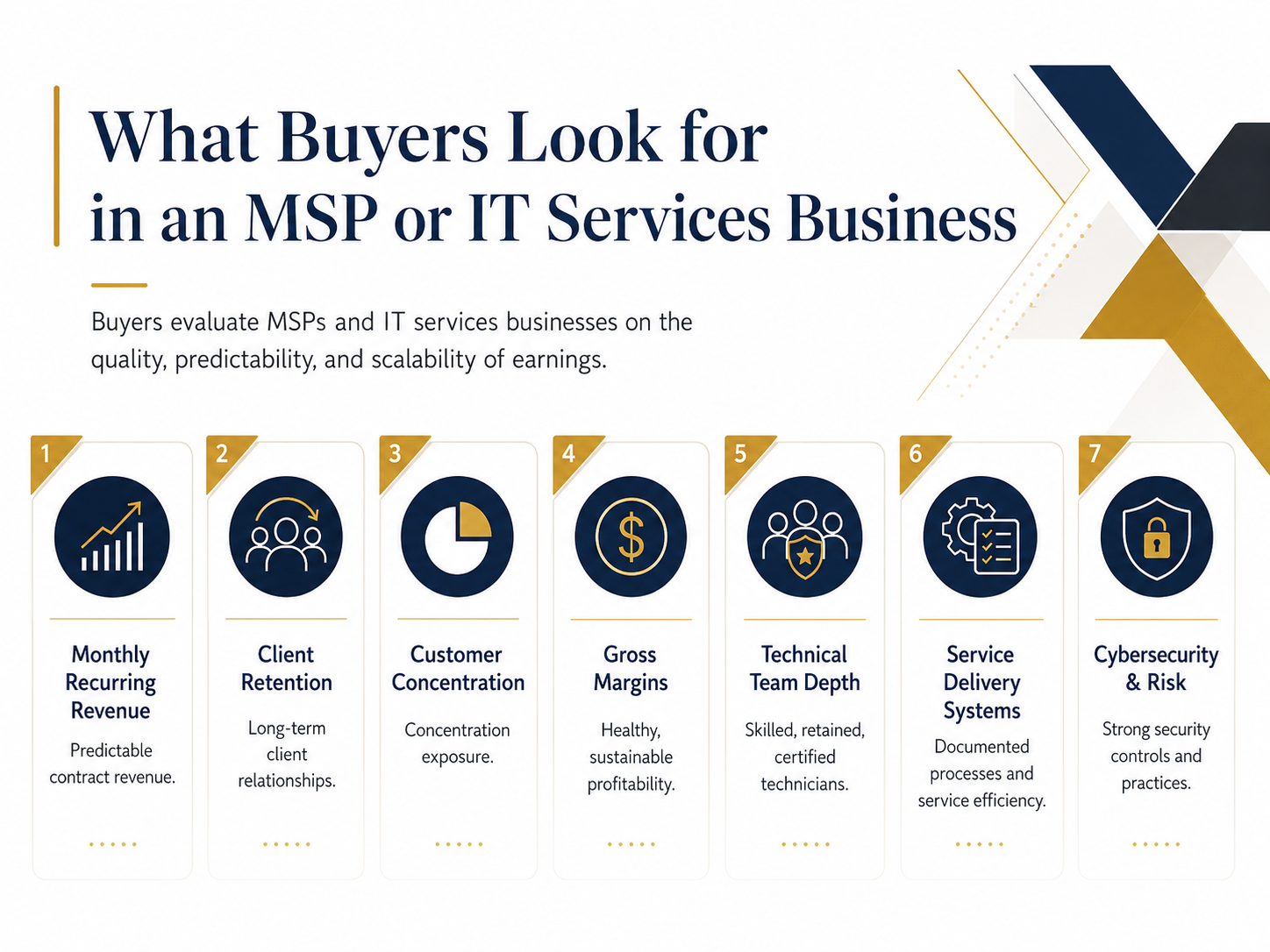
What Do Buyers Look for in an MSP or IT Services Company?
Buyers generally want to determine whether recurring contracts are durable, clients are likely to remain, service delivery is efficient, and the company has enough technical and management depth to continue operating without the seller.
| Buyer Focus | What They May Review | Why It Matters |
|---|---|---|
| Recurring Revenue | MRR, managed-service agreements, renewals, pricing | Helps buyers assess revenue predictability and durability. |
| Clients | Retention, churn, top accounts, contract terms, concentration | Shows whether future revenue depends heavily on a few relationships. |
| Margins | Gross margin by service, labor efficiency, vendor costs | Helps buyers understand the quality of recurring earnings. |
| Technical Team | Engineers, help desk, certifications, tenure, management | Indicates whether service quality can continue after a sale. |
| Service Systems | PSA, RMM, documentation, ticketing, monitoring, reporting | Shows how repeatable, scalable, and transferable operations are. |
| Security & Risk | Cyber controls, backups, insurance, incidents, policies | Can affect liability, client trust, and buyer confidence. |
How to Prepare an MSP or IT Services Business for Sale
Buyers may conduct detailed due diligence on an MSP because recurring contracts, customer environments, technical employees, software platforms, vendor agreements, and security responsibilities can all affect risk and value. Preparing key documentation before the process begins can make buyer review more efficient.
- Organize financial records. Prepare historical financial statements, tax returns, normalized earnings schedules, recurring-revenue reporting, and working-capital information.
- Document recurring contracts. Compile managed-service agreements, renewal dates, pricing, service scope, termination provisions, and historical churn.
- Review customer concentration. Identify the largest clients and understand how much revenue and MRR each relationship represents.
- Analyze margins by service line. Separate managed services, cybersecurity, cloud, support, projects, hardware, licensing, and other significant revenue streams where possible.
- Document the technical team. Prepare information on engineers, technicians, help-desk staff, certifications, compensation, tenure, utilization, and key responsibilities.
- Organize systems and security documentation. Document PSA, RMM, backup, documentation, monitoring, cybersecurity, access-control, vendor, and incident-response processes.
- Clarify the owner's role. Identify major sales, technical, customer, vendor, security, and management responsibilities that will need to transfer.
What Does the Sale Process Look Like?
Selling an MSP or IT services company typically involves valuation, preparation, confidential buyer outreach, negotiations, due diligence, closing, and transition. Because customers rely on the business for critical technology services, preserving continuity and confidentiality can be particularly important.
1. Define Your Exit Goals
Consider your preferred timing, financial objectives, employee concerns, customer commitments, transition expectations, and whether you are willing to remain involved after closing.
2. Understand What the Business May Be Worth
A valuation can help establish realistic expectations and identify recurring-revenue, customer, margin, workforce, and operating characteristics that could influence buyer interest.
3. Prepare the Business for Buyer Review
Organize financial statements, recurring contracts, customer information, service metrics, employee records, vendor agreements, security documentation, and operating procedures before serious discussions begin.
4. Market the Opportunity Confidentially
A controlled process can help identify qualified buyers while protecting sensitive information about customers, technology environments, employees, pricing, security practices, and business performance.
5. Evaluate Offers and Complete Due Diligence
Buyers may review financial, contract, customer, employee, cybersecurity, technology, insurance, vendor, legal, and operational information before finalizing a transaction. Price, structure, working capital, retention risk, contingencies, and transition terms should all be considered.
6. Close and Transition
Once due diligence and definitive agreements are complete, the transaction moves toward closing and the agreed transition of clients, employees, systems, vendor relationships, and management responsibilities begins.
Considering Selling Your MSP or IT Services Business?
Legacy ETA helps owners understand what their business may be worth, prepare for buyers, protect confidentiality, and navigate the transaction from initial planning through closing.
Talk With Legacy ETAHow Is an MSP or IT Services Business Valued?
MSP and IT services businesses are generally evaluated using normalized earnings together with the quality, durability, and transferability of recurring revenue. Buyers often distinguish between contracted managed-service revenue and more variable project, hardware, or consulting revenue.
Buyers may consider monthly recurring revenue, contract retention, customer concentration, gross margins, growth, technician retention, service efficiency, management depth, cybersecurity exposure, vendor dependencies, owner involvement, working capital, and the quality of financial reporting.
Important: Revenue alone does not determine value. Buyers are evaluating the predictability and profitability of recurring revenue, client retention, technical continuity, security risk, and whether the operation can continue performing after the seller exits.
How Legacy ETA Helps MSP and IT Services Business Owners
Selling a recurring-revenue technology services business can involve financial, customer, contract, workforce, cybersecurity, technology, and transition considerations. Legacy ETA helps owners prepare the company for market, understand value, evaluate prospective buyers, navigate negotiations, coordinate due diligence, and work toward a successful closing.
- Business valuation and market-readiness guidance
- Preparation of financial and operating information
- Confidential buyer outreach and screening
- Offer evaluation and negotiation support
- Due diligence coordination
- Closing and transition support
Frequently Asked Questions
How do I sell my MSP business?
Start by understanding what the company may be worth and organizing financial statements, recurring contracts, customer information, employee records, service metrics, vendor agreements, and cybersecurity documentation. The process generally includes valuation, preparation, confidential marketing, negotiations, due diligence, closing, and transition.
How is an MSP or IT services company valued?
Valuation generally begins with normalized earnings and then considers monthly recurring revenue, contract quality, customer retention, concentration, gross margins, technician depth, service efficiency, security risk, management depth, owner dependence, and overall transferability.
Why is monthly recurring revenue important to MSP buyers?
Monthly recurring revenue can provide greater visibility into future cash flow and make customer relationships easier to evaluate. Buyers will also examine contract terms, pricing, gross margins, retention, churn, and whether recurring services can continue after ownership changes.
Does customer concentration affect MSP business value?
It can. A company that relies heavily on one or two customers may present greater revenue risk. Buyers typically review the percentage of total and recurring revenue tied to major accounts, contract terms, client tenure, and the likelihood those relationships will continue.
Does cybersecurity affect the sale of an MSP?
Yes. Buyers may review the MSP's own cybersecurity controls, customer-access practices, backups, incident history, insurance, documentation, vendor security, and contractual obligations. Security weaknesses may create operational, legal, insurance, or customer-retention concerns.
Can I sell my MSP if I still manage major clients and technical decisions?
Yes, but significant owner involvement can increase transition risk. Developing service leadership, documenting technical standards, distributing client relationships, and formalizing escalation and sales processes can make the company easier for a buyer to transition.
Can the sale of my MSP or IT services business remain confidential?
A controlled sale process can limit disclosure of sensitive information until prospective buyers have been screened and confidentiality protections are in place. This can help reduce unnecessary disruption with customers, employees, vendors, and competitors.