What Drives the Value of a Home Services Business?
Buyers evaluating a home services company are purchasing more than trucks, equipment, and a customer list. They are acquiring a local operating business that must continue generating leads, scheduling work, retaining skilled employees, serving customers, and producing sustainable profit after ownership changes.
The strongest home services businesses generally combine healthy financial performance with dependable demand, repeat or recurring revenue, strong local visibility, a capable team, organized systems, and limited dependence on the owner.
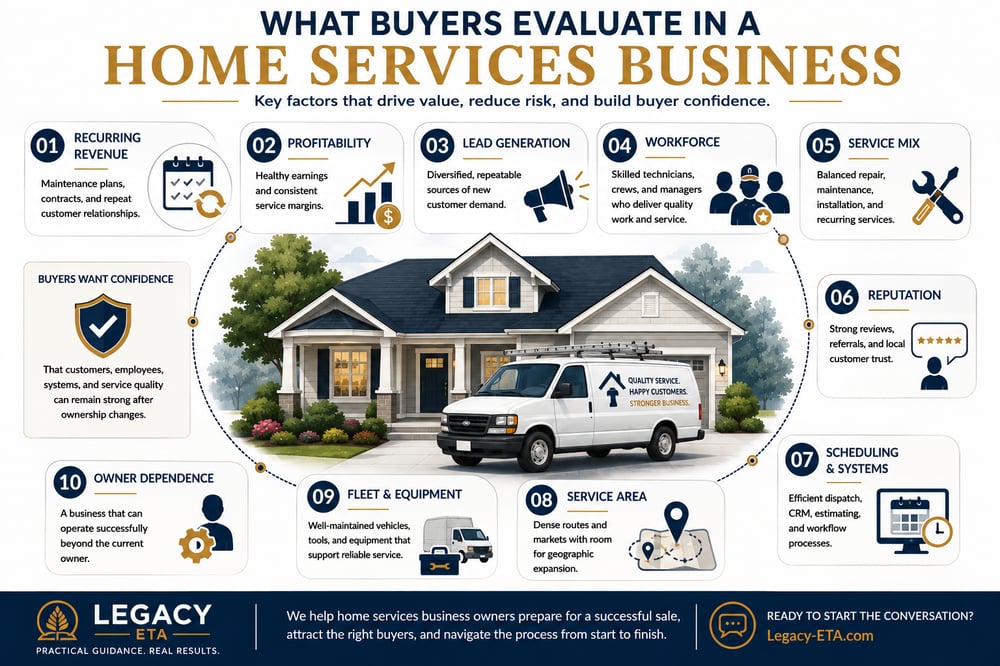
Recurring and Repeat Revenue
Repeat customers and recurring service agreements can provide buyers with greater visibility into future demand. Depending on the trade, this may include maintenance plans, inspection agreements, recurring treatments, cleaning contracts, seasonal service, or repeat repair work.
Buyers may review retention, contract terms, service frequency, average customer value, and the percentage of revenue that comes from predictable relationships rather than one-time projects.
Profitability and Service Margins
Revenue alone does not tell a buyer whether a home service company is performing well. Buyers want to understand what remains after technician wages, materials, vehicles, insurance, marketing, software, overhead, and other operating expenses.
Clear job costing and consistent margins by service line can help demonstrate which parts of the business create the most value.
Lead Generation and Customer Acquisition
Buyers want to understand where new customers come from and whether those lead sources are repeatable after the owner exits.
Local search, referrals, repeat customers, service agreements, paid advertising, property managers, commercial accounts, builders, and other channels may all contribute to demand. A diversified lead engine can reduce dependence on any one source.
Technicians, Crews, and Management Depth
Skilled technicians, installers, field crews, supervisors, dispatchers, estimators, and managers are often among the most important assets in a home services company.
Buyers may evaluate employee tenure, turnover, compensation, certifications, recruiting practices, crew capacity, and whether managers can oversee the business without constant owner involvement.
Service Mix
Many home services companies combine repair, maintenance, installation, emergency service, recurring contracts, or project-based work. Buyers want to understand how each service line contributes to revenue and profit.
A balanced mix can help reduce dependence on one type of work and may create opportunities for cross-selling or expansion.
Local Reputation and Customer Reviews
Reputation directly affects the ability of many home services companies to generate leads. Buyers may review online ratings, referral activity, callbacks, complaint history, warranties, and customer retention.
A recognizable local brand that belongs to the company rather than only to the owner can make the business easier to transfer.
Scheduling, Dispatch, and Operating Systems
Strong systems help service businesses schedule technicians efficiently, respond quickly to customers, track jobs, invoice accurately, manage memberships, and measure performance.
Buyers may evaluate CRM systems, dispatch software, field-service platforms, call handling, estimating, reporting, inventory controls, and documented operating procedures.
Geographic Density and Service Area
Route density and geographic coverage can affect technician productivity, travel time, fuel expense, scheduling efficiency, and the ability to add additional customers.
Buyers may look for a well-developed core market with room to expand into nearby territories without creating excessive operating complexity.
Vehicles, Tools, and Equipment
Service vehicles, specialized tools, equipment, and inventory can represent meaningful operating capacity. Buyers may review age, condition, maintenance, ownership, financing, utilization, and expected replacement needs.
Owner Dependence
Many home services businesses are built around owners who handle sales, estimating, technical questions, staffing, dispatch, customer relationships, or major operational decisions.
Buyers generally prefer businesses where those responsibilities are distributed among capable employees and supported by documented processes. Reducing unnecessary owner dependence can make the company easier to transfer.
What Do Buyers Look for in a Home Services Company?
Buyers evaluate home services businesses through both a financial and operational lens. They want confidence that customer demand, employees, service quality, and operating systems can remain stable after ownership changes.
| Area Buyers Review | What They Evaluate | Why It Matters |
|---|---|---|
| Financial Performance | Revenue, normalized earnings, service margins, overhead, and historical trends | Helps buyers assess earnings quality and sustainability. |
| Recurring & Repeat Revenue | Maintenance agreements, repeat customers, contracts, retention, and service frequency | Provides visibility into future demand. |
| Lead Generation | Referrals, local search, advertising, repeat customers, and commercial relationships | Shows whether demand can continue after the owner exits. |
| Workforce | Technicians, crews, supervisors, managers, turnover, certifications, and recruiting | Indicates whether the company has the people needed to continue serving customers. |
| Reputation | Reviews, referrals, customer retention, callbacks, and local brand visibility | Helps buyers understand the durability of customer demand. |
| Systems | Scheduling, dispatch, CRM, field service, estimating, reporting, and documented procedures | Helps demonstrate that operations are scalable and transferable. |
| Owner Role | Sales, estimating, technical oversight, staffing, customer relationships, and daily management | Helps buyers assess transition risk. |
Explore Specialized Home Service Industries
Different trades have different revenue models, workforce needs, buyer considerations, and value drivers. Explore our dedicated guidance for individual home service industries.
HVAC
Service and installation businesses with recurring maintenance agreements, skilled technicians, and consistent demand.
Explore HVAC →Plumbing
Essential service businesses driven by repeat customers, emergency demand, local reputation, and reliable technicians.
Explore Plumbing →Electrical
Project and service businesses where backlog, skilled employees, contracts, and operational depth influence buyer interest.
Explore Electrical →Pest Control
Recurring-revenue businesses where retention, route density, service schedules, and technician capacity matter.
Explore Pest Control →Landscaping
Maintenance and project businesses with recurring contracts, scalable crews, route density, and seasonal considerations.
Explore Landscaping →Garage Doors
Installation and repair businesses with local demand, fast-response service, technicians, and repeat referral channels.
Explore Garage Doors →Cleaning & Janitorial
Contract and recurring-service businesses where retention, staffing, customer concentration, and route efficiency matter.
Explore Cleaning & Janitorial →How to Prepare a Home Services Business for Sale
Many issues buyers identify during due diligence are easier to address before the business goes to market. Preparing early gives you time to organize records, understand your service economics, document recurring revenue, and reduce unnecessary owner dependence.
- Organize financial records. Prepare tax returns, profit-and-loss statements, balance sheets, job-cost reports, and supporting schedules.
- Document recurring and repeat revenue. Organize maintenance agreements, contracts, customer retention, and historical repeat-service information.
- Review service-line profitability. Understand margins across repair, maintenance, installation, emergency, recurring, and project work.
- Document lead sources. Identify where customers come from and how dependent the company is on any individual referral source or marketing channel.
- Document technicians and key employees. Prepare information on tenure, responsibilities, certifications, compensation, and management structure.
- Review vehicles and equipment. Organize information on age, condition, financing, maintenance, and expected replacement needs.
- Document operating systems. Organize scheduling, dispatch, CRM, estimating, reporting, inventory, and customer-service processes.
- Clarify the owner's role. Identify sales, technical, customer, staffing, and management responsibilities that depend on you personally.
What Does the Sale Process Look Like?
Every home services business sale is different, but most transactions move through a similar sequence. Understanding that process before going to market can help you prepare for buyer questions and make informed decisions.
1. Define Your Exit Goals
Determine your preferred timeline, financial objectives, employee considerations, transition expectations, and desired involvement after a sale.
2. Understand the Business's Value
Review earnings, recurring revenue, margins, lead sources, workforce, customer retention, systems, equipment, and owner dependence.
3. Prepare the Business for Market
Organize financial statements, customer data, recurring agreements, employee information, fleet records, and operating documentation.
4. Identify and Qualify Buyers
Potential buyers may include other service companies, strategic consolidators, individual operators, multi-location businesses, or investment groups seeking established service companies.
5. Negotiate and Complete Due Diligence
Once an acceptable proposal is reached, the buyer typically reviews financial, customer, employee, recurring revenue, vehicle, insurance, legal, and operational information in detail.
6. Close and Transition the Business
Final agreements are completed and ownership transitions to the buyer. Depending on the transaction, the seller may remain involved for a period to transfer customer relationships, technical knowledge, employee responsibilities, or operational leadership.
Considering Selling Your Home Services Business?
A confidential conversation can help you understand your options, how buyers may evaluate your company, and what you can do now to prepare for a successful transition.
Talk With Legacy ETAHow Is a Home Services Business Valued?
A home services business valuation generally begins with financial performance, but buyers also want to understand the quality and durability of those earnings.
Depending on the size and structure of the company, buyers may analyze normalized cash flow or EBITDA alongside recurring revenue, service margins, customer retention, lead generation, workforce stability, route or service density, equipment needs, management depth, and growth opportunities.
Different home service trades have different operating models, so the relative importance of recurring contracts, project backlog, licensing, equipment, route density, and other factors will vary by industry.
A professional valuation can help establish realistic expectations before speaking with buyers and identify the factors that may strengthen or reduce buyer confidence.
How Legacy ETA Helps Home Services Business Owners
Selling a home services company involves more than finding someone willing to purchase vehicles, equipment, and a customer list. Owners need to understand value, prepare information buyers can evaluate, protect confidentiality, identify qualified prospects, compare offers, manage due diligence, and plan for a smooth transition.
Legacy ETA helps service business owners navigate that process with practical guidance from preparation through closing.
- Business valuation and market-positioning guidance
- Preparation of financial and operational information
- Confidential marketing and buyer outreach
- Buyer qualification and offer evaluation
- Support through negotiations and due diligence
- Coordination through closing and ownership transition
Frequently Asked Questions About Selling a Home Services Business
How much is my home services business worth?
The value of a home services company depends on factors including normalized earnings, recurring and repeat revenue, service margins, customer retention, lead generation, workforce stability, reputation, operating systems, growth opportunities, and owner dependence. A valuation should account for the company's specific trade and operating model rather than rely on a generic multiple.
What makes a home services business attractive to buyers?
Buyers generally look for consistent profitability, recurring or repeat demand, strong lead generation, skilled employees, a good local reputation, efficient scheduling and dispatch, capable management, and operations that are not overly dependent on the owner.
Is recurring revenue important when selling a home service company?
Recurring service agreements and repeat customer relationships can provide buyers with greater visibility into future demand. Their importance varies by trade, but buyers generally want to understand retention, contract terms, service frequency, and historical renewal behavior.
How important are technicians and crews during a sale?
Skilled employees can be critical because they maintain customer service and operating capacity after ownership changes. Buyers may review tenure, turnover, certifications, compensation, management structure, and recruiting processes during due diligence.
Does local reputation affect the value of a home services business?
Local reputation can strongly influence lead flow and repeat business. Buyers may consider online reviews, referrals, complaint history, customer retention, and whether the brand is associated with the company rather than only with the current owner.
Can I sell my home services company if I still manage most operations?
Yes, but significant owner dependence can increase transition risk. Buyers will want to understand which sales, technical, staffing, scheduling, customer, and management responsibilities depend on you and how those responsibilities can be transferred.
How long does it take to sell a home services business?
The timeline varies based on preparation, business size, buyer interest, financing, due diligence, licensing or contract matters, and negotiations. Organizing documentation before going to market can help reduce avoidable delays.
Should I get a valuation before selling my home services company?
A valuation can help establish realistic expectations and identify factors that may influence buyer interest before you begin an active sale process. It may also highlight areas such as recurring revenue, workforce stability, lead concentration, margins, or owner dependence that deserve attention.