What Drives the Value of a Restoration Business?
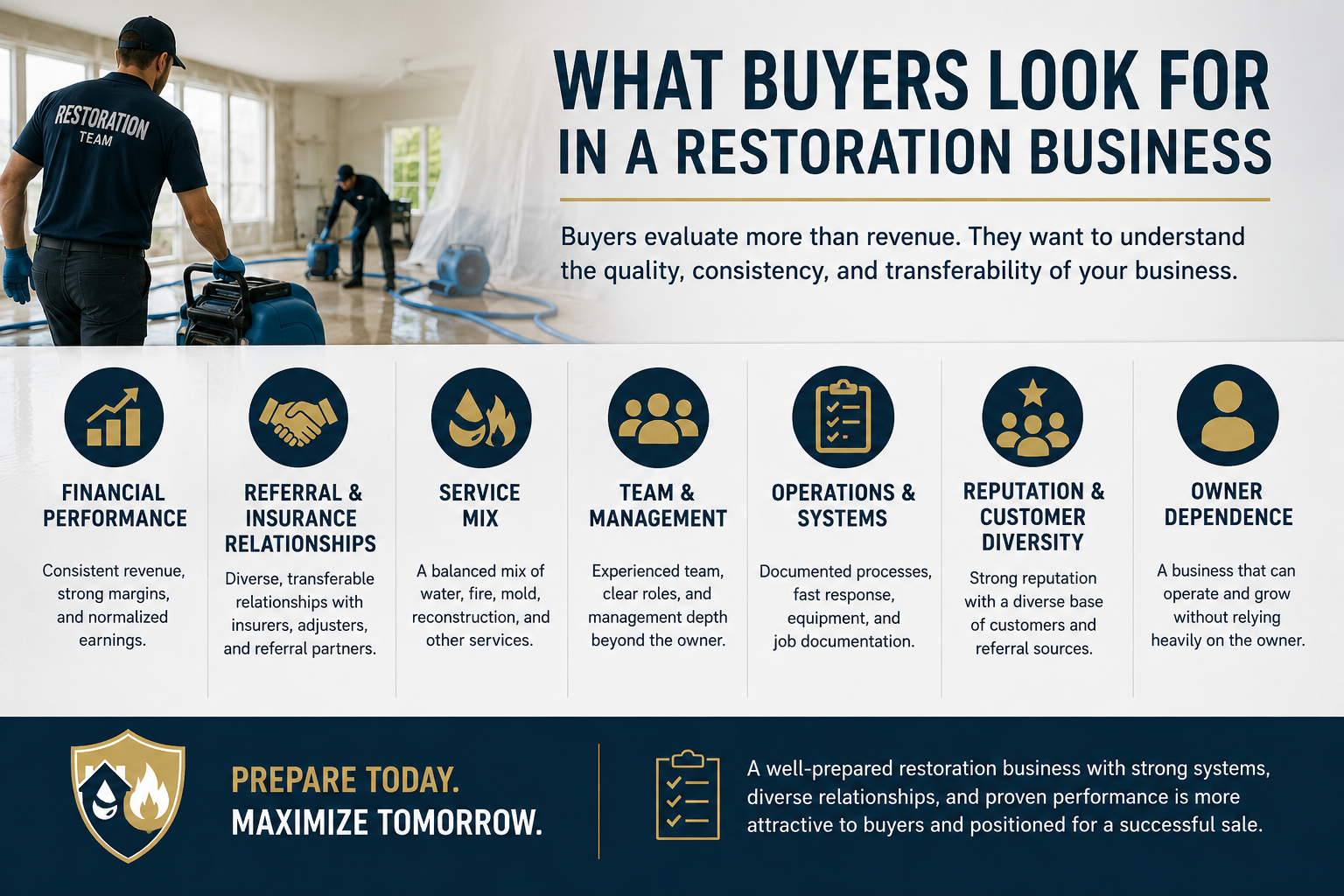
Buyers generally look beyond top-line revenue when evaluating a restoration company. They want to understand how reliably the business generates work, how efficiently jobs are completed, whether key relationships will transfer, and how dependent day-to-day operations are on the current owner.
Consistent Financial Performance
Historical revenue, gross margins, normalized earnings, working capital requirements, and year-over-year performance help buyers understand the financial quality of the business. Consistency can be particularly important in an industry where severe weather and catastrophic events may create fluctuations in demand.
Referral and Insurance Relationships
Restoration companies may receive work through plumbers, property managers, insurance professionals, contractors, adjusters, third-party programs, digital marketing, and direct customer referrals. Buyers may evaluate how diversified and transferable those lead sources are and whether any significant relationships depend personally on the owner.
Service Mix
The balance between water mitigation, fire and smoke restoration, mold remediation, reconstruction, contents work, commercial restoration, and other services can affect margins, staffing requirements, and revenue predictability. Buyers often want to understand which services drive the strongest earnings and where future growth may come from.
Workforce and Management Depth
Experienced technicians, project managers, estimators, coordinators, sales staff, and operations leaders can make a restoration business more transferable. Buyers may also examine employee tenure, certifications, recruiting needs, compensation, and whether the company has enough management depth to operate without the seller.
Response Capabilities and Operating Systems
Restoration businesses frequently depend on fast response times, scheduling discipline, job documentation, estimating systems, equipment tracking, customer communication, and billing processes. Documented workflows and capable operational staff can reduce transition risk for a buyer.
Customer and Referral Concentration
Heavy dependence on one referral partner, property-management group, insurance relationship, or commercial account can increase perceived risk. A more diversified source of projects can make future revenue easier for a buyer to evaluate.
Owner Dependence
If the owner personally controls estimating, referral relationships, emergency calls, project oversight, hiring, or major customer relationships, a buyer may require a more involved transition. Companies with established management, documented procedures, and transferable relationships may be easier to operate after a sale.
What Do Buyers Look for in a Restoration Company?
Buyers typically want to determine whether the company can continue generating, completing, documenting, and collecting on profitable restoration work after ownership changes. Financial performance matters, but so do the systems and relationships supporting those earnings.
| Buyer Focus | What They May Review | Why It Matters |
|---|---|---|
| Financial Performance | Revenue trends, margins, normalized EBITDA or SDE, cash flow | Provides the financial foundation for valuation and deal structure. |
| Lead Sources | Referrals, insurance relationships, digital leads, commercial accounts | Shows whether future opportunities depend on repeatable and transferable channels. |
| Service Mix | Water, fire, mold, reconstruction, contents, commercial work | Helps buyers understand margins, complexity, and revenue diversification. |
| Team | Technicians, estimators, project managers, office staff, leadership | Indicates whether operations can continue without the seller. |
| Operations | Response times, documentation, estimating, equipment, scheduling | Shows how repeatable and scalable the company's processes are. |
| Owner Role | Sales, relationships, estimating, operations, emergency response | Helps buyers assess transition requirements and key-person risk. |
How to Prepare a Restoration Business for Sale
Preparing before the company goes to market can make buyer review more efficient and give you time to address issues that might otherwise appear during negotiations or due diligence.
- Organize financial records. Prepare historical profit-and-loss statements, balance sheets, tax returns, working-capital information, and documentation supporting owner add-backs.
- Document lead and referral sources. Identify where jobs originate and how much revenue depends on major referral partners or commercial relationships.
- Break down the service mix. Show revenue and profitability across water mitigation, fire restoration, mold, reconstruction, commercial work, and other major services where possible.
- Document your team. Prepare information on technicians, estimators, project managers, leadership, compensation, tenure, and relevant certifications.
- Review equipment and assets. Organize information about drying equipment, vehicles, tools, facilities, leases, software, and other material operating assets.
- Clarify the owner's responsibilities. Identify important relationships, sales responsibilities, operational duties, and decisions that will need to transfer.
What Does the Sale Process Look Like?
Selling a restoration company typically involves several stages, from determining value and preparing information to evaluating buyers, navigating due diligence, and completing the transition.
1. Define Your Exit Goals
Consider your desired timing, financial objectives, transition preferences, employee concerns, and whether you are willing to remain involved after closing.
2. Understand What the Business May Be Worth
A valuation can help establish realistic expectations and identify factors that may influence buyer interest, deal structure, or timing.
3. Prepare for Buyer Review
Organize financial statements, referral data, customer information, equipment schedules, employee records, service-line information, and operating documentation before serious buyer discussions begin.
4. Market the Opportunity Confidentially
A controlled marketing process can help identify qualified buyers while reducing unnecessary disclosure to employees, customers, competitors, and referral partners.
5. Evaluate Offers and Complete Due Diligence
Buyers may review financial, operational, employee, legal, insurance, customer, referral, and equipment information before finalizing the transaction. Price is important, but financing, contingencies, working capital, transition requirements, and closing certainty also matter.
6. Close and Transition
After due diligence and definitive agreements are completed, the transaction proceeds toward closing and the seller begins the agreed transition to the new owner.
Considering Selling Your Restoration Business?
Legacy ETA helps owners understand what their business may be worth, prepare for the market, identify qualified buyers, and navigate the transaction from initial planning through closing.
Talk With Legacy ETAHow Is a Restoration Business Valued?
Restoration businesses are generally evaluated using normalized earnings together with the quality, durability, and transferability of those earnings. There is no single valuation multiple that applies to every company.
Buyers may consider historical growth, margins, referral concentration, insurance relationships, service mix, workforce stability, management depth, response capabilities, working-capital needs, equipment requirements, owner dependence, and the quality of financial reporting.
Important: Two restoration companies generating similar revenue can have very different values. Buyers are evaluating the quality and risk of the earnings they expect to inherit, not revenue alone.
How Legacy ETA Helps Restoration Business Owners
A successful business sale requires more than finding someone willing to make an offer. Legacy ETA helps owners prepare the business, understand value, protect confidentiality, evaluate buyers, navigate negotiations, coordinate due diligence, and work toward a successful closing.
- Business valuation and market-readiness guidance
- Preparation of financial and operating information
- Confidential buyer outreach and screening
- Offer evaluation and negotiation support
- Due diligence coordination
- Closing and transition support
Frequently Asked Questions
How do I sell my restoration business?
Start by understanding what the company may be worth and preparing the financial, operational, employee, referral, and equipment information buyers are likely to review. The process generally includes valuation, preparation, confidential marketing, buyer screening, negotiations, due diligence, closing, and transition.
How is a restoration company valued?
Valuation generally begins with normalized earnings and then considers factors such as growth, margins, referral relationships, service mix, management depth, workforce stability, working-capital needs, owner dependence, and the ability of the business to continue performing after ownership changes.
What makes a restoration business attractive to buyers?
Buyers may favor restoration companies with consistent earnings, diversified referral channels, strong margins, experienced technicians and project managers, documented operating processes, a good reputation, and limited dependence on the current owner.
Do insurance relationships affect the value of a restoration company?
They can. Buyers may evaluate how much revenue depends on insurance-related work, specific programs, adjuster relationships, referral partners, or other channels. Diversification and transferability can be important when assessing the risk associated with those relationships.
Can I sell my restoration company if I still manage most of the business?
Yes, but significant owner involvement may increase transition risk from a buyer's perspective. Developing management coverage, documenting processes, and transferring important relationships to the broader team can make the business easier to evaluate.
What documents should I prepare before selling a restoration business?
Buyers commonly request financial statements, tax returns, payroll information, employee records, referral and customer information, equipment schedules, service-line data, insurance information, leases, contracts, and documentation supporting owner add-backs or other normalization adjustments.
Can the sale of my restoration business remain confidential?
A controlled process can limit the disclosure of sensitive information until prospective buyers have been screened and appropriate confidentiality protections are in place. This can reduce unnecessary disruption with employees, customers, referral partners, vendors, and competitors.