.jpeg?width=1000&height=563&name=AdobeStock_1653722498%20(1).jpeg)
What Drives the Value of a Music or Entertainment Business?
Buyers evaluating a music, event, or entertainment business are purchasing more than equipment, creative capabilities, or a recognizable name. They are acquiring an operating business that must continue winning projects, serving clients, coordinating teams, managing vendors, and producing sustainable earnings after ownership changes.
The strongest businesses generally combine healthy financial performance with repeat clients, clear contracts, reliable project execution, a capable team or contractor network, organized systems, and limited dependence on the owner.
Profitability and Project Margins
Revenue can vary significantly from project to project, so buyers want to understand how consistently the business converts events, productions, contracts, or services into sustainable profit.
Buyers may review normalized earnings, gross margins, labor, contractor costs, equipment rentals, travel, venue expenses, commissions, production costs, and other project-related expenses.
Repeat Clients and Contracted Revenue
Repeat customers, annual events, recurring contracts, preferred-vendor relationships, and ongoing production agreements can provide greater visibility into future demand.
Buyers may review client tenure, renewal behavior, event frequency, contract terms, repeat project history, and the percentage of revenue generated from established relationships.
Client Concentration
A major client can generate significant revenue, but excessive dependence on one customer, agency, venue, or organization can increase buyer risk.
Buyers may review revenue and gross profit by client, relationship history, contract terms, repeat work, and how easily lost business could be replaced.
Venue, Agency, and Partner Relationships
Relationships with venues, promoters, agencies, corporate clients, planners, production partners, vendors, and other organizations can be important sources of recurring work and referrals.
Buyers want to understand whether those relationships belong to the business itself or depend primarily on the owner's personal network.
Team and Contractor Network
Producers, project managers, technicians, coordinators, designers, marketers, performers, logistics personnel, and trusted contractors can be central to reliable project delivery.
Buyers may evaluate tenure, responsibilities, availability, compensation, contractor relationships, leadership depth, and whether key people are likely to remain after the sale.
Service Mix
Entertainment-related businesses may combine production, logistics, event management, audio and visual services, marketing, talent services, rentals, creative work, or other offerings.
Buyers want to understand which services generate the strongest margins, which are most repeatable, and whether the company is overly dependent on one service category.
Project History and Pipeline
A well-documented history of completed projects can help buyers understand the company's capabilities, customer relationships, average project size, margins, and operating consistency.
Buyers may also review booked events, signed contracts, qualified opportunities, expected margins, and future scheduling to understand near-term revenue visibility.
Operating and Project Systems
Organized systems can make a project-driven business easier to transfer. Buyers may review estimating, proposals, contracting, scheduling, production planning, vendor coordination, project management, invoicing, and post-event follow-up.
Documented procedures help demonstrate that successful execution does not depend entirely on informal knowledge held by the owner.
Equipment and Production Assets
Audio, lighting, staging, video, transportation, production equipment, instruments, specialty gear, and other assets may represent meaningful operating capacity and future capital requirements.
Buyers may review age, condition, utilization, ownership, maintenance, financing, rental dependence, and expected replacement needs.
Growth Opportunities
Buyers may consider opportunities to add service lines, pursue larger events, expand geographically, deepen agency or venue relationships, improve recurring contracts, or build a larger sales team.
Growth opportunities are generally most compelling when the existing company already demonstrates reliable execution and healthy project economics.
Owner Dependence
Music and entertainment businesses can become highly dependent on owners who maintain client relationships, sell projects, produce events, negotiate with venues, manage contractors, or personally hold important industry relationships.
Buyers generally prefer businesses where client relationships, production responsibilities, sales activity, and operating knowledge are distributed across a capable team and supported by documented systems.
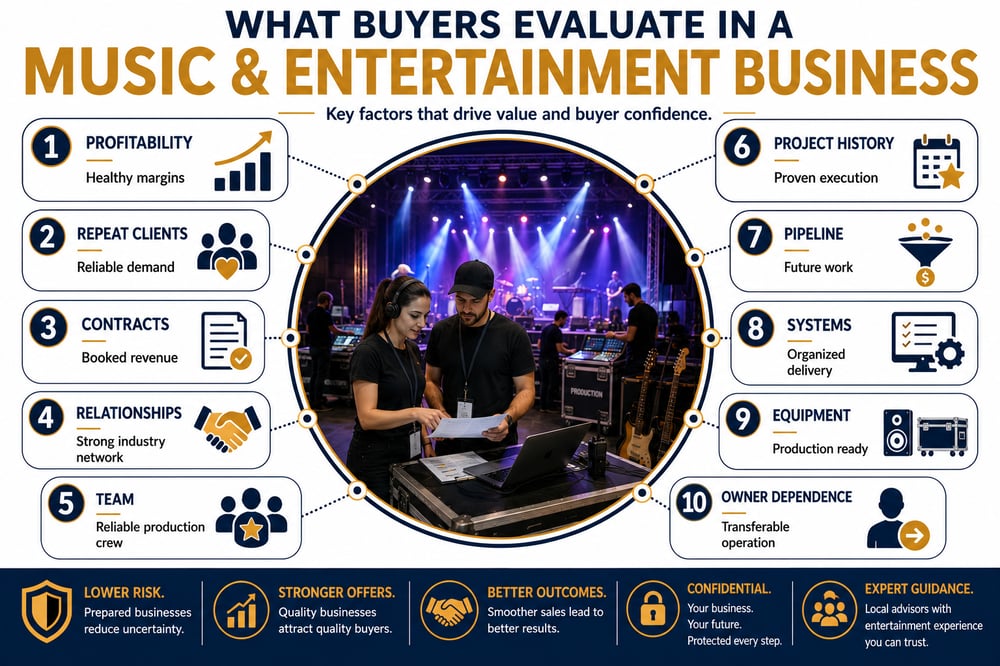
What Do Buyers Look for in a Music or Entertainment Business?
Buyers evaluate entertainment-related businesses through both a financial and operational lens. They want confidence that clients, projects, teams, and relationships can remain stable after ownership changes.
| Area Buyers Review | What They Evaluate | Why It Matters |
|---|---|---|
| Financial Performance | Revenue, normalized earnings, project margins, labor, contractors, and operating costs | Helps buyers assess sustainable earning power. |
| Clients & Contracts | Repeat clients, contracts, concentration, renewals, and project history | Shows whether future demand is durable and predictable. |
| Relationships | Venues, agencies, planners, vendors, promoters, and referral partners | Helps buyers assess the transferability of the network. |
| Team & Contractors | Project managers, technicians, producers, coordinators, contractors, and leadership | Indicates whether project delivery can continue after a sale. |
| Project Pipeline | Booked events, signed contracts, qualified opportunities, schedules, and expected margins | Provides visibility into future work. |
| Systems & Equipment | Estimating, scheduling, project management, vendor coordination, gear, and production assets | Shows whether operations are repeatable and scalable. |
| Owner Role | Sales, production, client relationships, partnerships, and strategic decisions | Helps buyers assess transition risk. |
Common Issues That Can Complicate an Entertainment Business Sale
Music and entertainment businesses can be attractive to buyers, but project-driven revenue and relationship-heavy operations can be difficult to evaluate if they are not documented clearly.
- Positioning the company too narrowly. Buyers need to understand the business model, revenue streams, contracts, clients, and operating structure.
- Repeat clients and contracts are not clearly documented. Historical relationships should be supported with project and revenue data.
- Disorganized project and financial reporting. Buyers need a clear view of project margins, historical performance, booked work, and operating costs.
- Heavy dependence on the owner's personal network. Buyers may see additional risk if clients, agencies, venues, or vendors primarily follow the owner.
- Unclear contractor relationships. Key project personnel, vendors, and contractor arrangements should be organized and easy to understand.
- Poor confidentiality. Premature disclosure can create uncertainty among employees, contractors, clients, venues, agencies, and partners.
How to Prepare a Music or Entertainment Business for Sale
Preparing before buyers begin due diligence gives you time to clarify the revenue model, document repeat relationships, organize project history, and reduce unnecessary dependence on the owner.
- Organize financial records. Prepare tax returns, profit-and-loss statements, balance sheets, project reports, and support for owner adjustments.
- Document repeat clients and contracts. Organize customer history, event frequency, renewal patterns, agreements, and recurring relationships.
- Review customer concentration. Understand revenue and gross profit by major client and identify relationships that depend heavily on the owner.
- Organize project history and pipeline. Document completed projects, margins, booked events, signed contracts, and qualified future opportunities.
- Document team and contractor relationships. Clarify responsibilities, compensation, agreements, leadership, and availability of key people.
- Document operating systems. Organize estimating, proposals, contracts, scheduling, project management, vendor coordination, and billing procedures.
- Create an equipment schedule. Document major production assets, ownership, condition, maintenance, utilization, and replacement needs.
- Reduce owner dependence. Transfer sales, client, venue, vendor, and production responsibilities where practical.
What Does the Music & Entertainment Business Sale Process Look Like?
Every entertainment-related transaction is different, but most sales move through a similar sequence. Clear project, client, contractor, and revenue documentation can make the business easier for buyers to evaluate.
1. Define Your Exit Goals
Determine your preferred timing, financial objectives, team considerations, transition expectations, and desired involvement after the sale.
2. Understand the Business's Value
Review earnings, repeat clients, contracts, project margins, concentration, relationships, team depth, systems, equipment, growth, and owner dependence.
3. Prepare the Business for Market
Organize financial records, customer history, project data, contracts, contractor information, equipment schedules, and operating procedures.
4. Identify and Qualify Buyers
Potential buyers may include strategic event companies, production groups, agencies, regional service companies, individual operators, or investors seeking established project-based businesses.
5. Negotiate and Complete Due Diligence
Once an acceptable proposal is reached, the buyer typically reviews financial, client, contract, project, employee, contractor, equipment, legal, and operating information in detail.
6. Close and Transition the Business
Final agreements are completed and ownership transitions to the buyer. Depending on the transaction, the seller may remain involved for a defined period to transfer client relationships, venue and agency connections, production knowledge, or team responsibilities.
Considering Selling Your Music or Entertainment Business?
A confidential conversation can help you understand your options, how buyers may evaluate your business, and which client, project, financial, or transition issues should be addressed before going to market.
Talk With Legacy ETAHow Is a Music or Entertainment Business Valued?
A music or entertainment business valuation generally begins with financial performance, but buyers also want to understand the quality, predictability, and transferability of those earnings.
Depending on the business model, buyers may analyze normalized cash flow or EBITDA alongside repeat revenue, contracted work, project margins, customer concentration, venue and agency relationships, team depth, operating systems, equipment needs, and growth opportunities.
Project-driven businesses may require additional analysis of historical project margins, booked work, contract quality, and pipeline because annual revenue can fluctuate significantly even when the underlying business is stable.
A professional valuation can help establish realistic expectations before speaking with buyers and identify the factors that may strengthen or reduce buyer confidence.
How Legacy ETA Helps Music & Entertainment Business Owners
Selling an entertainment-related business involves more than finding someone willing to purchase equipment or take over projects. Owners need to understand value, clearly communicate the revenue model, prepare information buyers can evaluate, protect confidentiality, identify qualified buyers, compare offers, manage due diligence, and plan for a smooth relationship and operational transition.
Legacy ETA helps music and entertainment business owners navigate that process with practical guidance from preparation through closing.
- Business valuation and market-positioning guidance
- Preparation of financial, client, and project information
- Confidential marketing and staged buyer disclosure
- Buyer qualification and offer evaluation
- Support through project, contract, relationship, and operational diligence
- Coordination through closing and ownership transition
Frequently Asked Questions About Selling a Music or Entertainment Business
How much is my entertainment business worth?
The value depends on factors including normalized earnings, repeat and contracted revenue, project margins, client concentration, relationships, team depth, operating systems, equipment needs, growth opportunities, and owner dependence.
What makes an entertainment business attractive to buyers?
Buyers generally look for consistent profitability, repeat clients, contracted work, strong project history, reliable teams, transferable venue and agency relationships, organized systems, and limited owner dependence.
How important are repeat clients and contracts?
Repeat clients and contracts can provide greater visibility into future demand. Buyers may review customer tenure, event frequency, contract terms, renewal history, and the percentage of revenue generated from recurring relationships.
How does client concentration affect the sale?
Heavy dependence on one client, agency, venue, or organization can increase buyer risk. Buyers want to understand revenue concentration, relationship history, contract terms, and how easily lost business could be replaced.
Do contractor relationships matter to buyers?
Yes. Reliable contractors and production partners can be important to project execution. Buyers may review responsibilities, availability, compensation, agreements, and whether key relationships can continue after closing.
Does equipment increase the value of an entertainment business?
Equipment can contribute to the transaction, but buyers also evaluate age, condition, utilization, ownership, financing, and replacement requirements. Equipment value should be considered alongside the earnings of the operating business.
Can I sell if most client relationships depend on me?
Yes, but significant owner dependence can increase transition risk. Buyers will want to understand which client, venue, agency, sales, and production relationships depend on you and how they can be transferred.
How long does it take to sell an entertainment business?
Timing varies based on preparation, buyer interest, financing, project pipeline, contracts, customer concentration, due diligence, negotiations, and transaction structure.
Should I get a valuation before selling?
A valuation can help establish realistic expectations and identify factors that may influence buyer interest before the business goes to market. It may also highlight issues such as project volatility, concentration, owner dependence, or unclear financial reporting that deserve attention.