.jpeg?width=1000&height=665&name=AdobeStock_1940291876%20(1).jpeg)
What Drives the Value of a Hospitality Business?
Buyers evaluating a hospitality business are purchasing more than a location, furniture, equipment, or recognizable concept. They are acquiring an operating business that must continue attracting guests, controlling costs, retaining employees, and delivering a consistent experience after ownership changes.
The strongest hospitality businesses generally combine healthy financial performance with dependable guest demand, a favorable location, a capable team, strong reputation, organized operating systems, and limited dependence on the owner.
Profitability and Operating Margins
Revenue alone does not tell a buyer how well a hospitality business is performing. Buyers want to understand what remains after payroll, occupancy expenses, food and beverage costs where applicable, utilities, marketing, maintenance, insurance, merchant fees, and other operating costs.
Clear financial reporting and consistent margins can make historical earnings easier to understand and help buyers distinguish sustainable performance from temporary peaks or unusually weak periods.
Guest Traffic and Repeat Demand
Buyers want to understand whether demand is dependable and how consistently guests return. Depending on the business model, they may evaluate occupancy, bookings, reservations, covers, event bookings, repeat customers, membership activity, or other indicators of ongoing demand.
A strong base of repeat guests and reliable traffic can make future revenue easier to evaluate than a business dependent primarily on occasional events or one-time visitors.
Location and Lease Terms
Location can be one of the most important operating assets in hospitality. Buyers may consider visibility, accessibility, parking, tourism activity, nearby demand generators, surrounding demographics, competition, and the suitability of the property for the concept.
If the property is leased, buyers will also want to understand rent, remaining term, renewal options, assignment provisions, guarantees, and any landlord approvals required for the business to continue operating after the sale.
Reputation and Reviews
Reputation can directly influence guest demand. Buyers may review online ratings, repeat traffic, referrals, social presence, complaint history, local recognition, and relationships with event planners, tourism partners, corporate customers, or other referral sources.
A strong reputation associated with the business rather than solely with the current owner can make customer relationships easier to transfer.
Licenses, Permits, and Operating Approvals
Hospitality businesses may depend on liquor licenses, food-service permits, occupancy approvals, health inspections, business licenses, or other operating requirements.
Buyers want to understand which approvals remain with the business, which require a new application, and what steps must be completed before or after closing. Addressing these requirements early can reduce transaction delays.
Staff and Management Depth
General managers, supervisors, front-of-house staff, kitchen leaders, event managers, housekeeping teams, and other employees may be critical to maintaining service quality during an ownership transition.
Buyers may review employee tenure, turnover, compensation, scheduling, training, responsibilities, and whether capable managers can operate the business without constant owner involvement.
Equipment and Facility Condition
Kitchen equipment, furniture, fixtures, HVAC systems, POS systems, guest rooms, event infrastructure, laundry equipment, and other assets may require meaningful future investment.
Buyers may review age, condition, maintenance history, ownership, financing, and expected replacement needs so they can understand future capital requirements.
Seasonality and Revenue Patterns
Hospitality revenue may vary with tourism, local events, weather, conventions, holidays, and other seasonal patterns. Buyers generally want enough historical information to understand what normal performance looks like throughout the year.
Clear monthly reporting can help buyers distinguish sustainable earning power from temporary peaks or seasonal slowdowns.
Growth Opportunities
Buyers may consider opportunities to improve occupancy, add seating, expand catering, increase event bookings, optimize pricing, introduce new services, or open additional locations.
Growth opportunities tend to be more compelling when the existing business already demonstrates healthy economics, strong demand, and disciplined operations.
Owner Dependence
Hospitality businesses can become closely tied to owners who manage staff, greet guests, oversee vendors, handle marketing, approve purchasing, manage events, or personally shape the customer experience.
Buyers generally prefer businesses where capable managers, employees, and documented systems can maintain operations without the seller's daily presence.
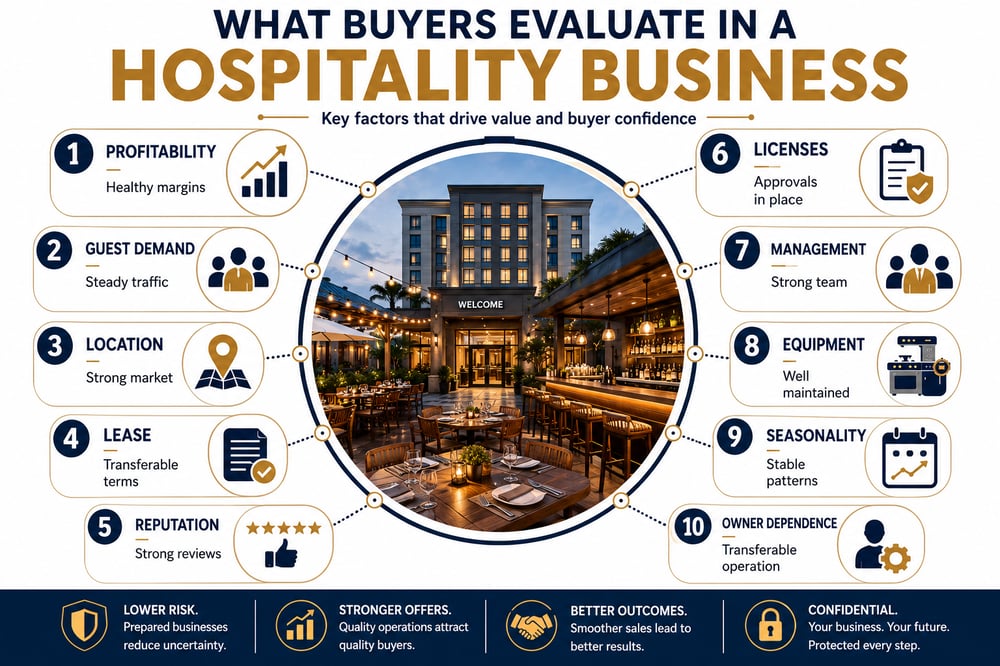
What Do Buyers Look for in a Hospitality Business?
Buyers evaluate hospitality businesses through both a financial and operational lens. They want confidence that guest demand will continue, employees can maintain service quality, required approvals can be addressed, and the business can generate sustainable earnings after ownership changes.
| Area Buyers Review | What They Evaluate | Why It Matters |
|---|---|---|
| Financial Performance | Revenue, normalized earnings, margins, payroll, occupancy costs, and historical trends | Helps buyers assess sustainable earning power. |
| Guest Demand | Traffic, bookings, occupancy, repeat guests, reservations, events, and reviews | Shows whether customer demand is durable and transferable. |
| Location & Lease | Rent, lease term, renewal rights, assignment, access, parking, and local demand | Determines whether the business can continue operating from an attractive location. |
| Licenses & Permits | Liquor, food service, occupancy, health, business, and other approvals | Helps identify requirements that may affect closing or continuity. |
| Management & Staff | Managers, key employees, tenure, turnover, training, and responsibilities | Shows whether operations can continue without the owner. |
| Equipment & Facility | Condition, age, maintenance, ownership, and replacement requirements | Helps buyers estimate future capital needs. |
| Owner Role | Operations, staffing, guests, vendors, marketing, events, and daily management | Helps buyers assess transition risk. |
Common Issues That Can Complicate a Hospitality Business Sale
Hospitality transactions often involve more moving parts than buyers can see from the outside. Addressing these issues before going to market can make due diligence more efficient and reduce avoidable uncertainty.
- Incomplete or inconsistent financial records. Buyers need reliable documentation to understand historical earning power.
- Unclear lease-transfer requirements. Landlord approval, remaining lease term, renewal rights, and assignment provisions should be understood before negotiations advance.
- Licensing timelines addressed too late. Required applications and approvals can affect closing if they are not identified early.
- Heavy dependence on the owner. Buyers may become concerned if guest relationships, staffing, vendor management, or daily operations cannot continue without the seller.
- Seasonal performance presented without context. Monthly historical reporting can help buyers understand normal business cycles rather than focus on one strong or weak period.
How to Prepare a Hospitality Business for Sale
Preparing before buyers begin due diligence gives you more time to organize financial records, review lease and licensing requirements, document your team, and explain historical operating patterns clearly.
- Organize your financial records. Prepare tax returns, profit-and-loss statements, balance sheets, POS reports, payroll information, and supporting schedules.
- Reconcile sales activity. Make sure reported sales can be supported by reliable records and that unusual revenue or expense patterns can be explained.
- Review the lease. Confirm rent, remaining term, renewal options, assignment rights, guarantees, and any landlord approvals required for a transfer.
- Review licenses and permits. Identify which approvals require transfer, renewal, or a new application and understand the expected timing.
- Document managers and key employees. Clarify responsibilities, tenure, compensation, and which employees are important to maintaining guest experience.
- Create an equipment schedule. Document major assets, age, condition, ownership, maintenance history, and expected replacement needs.
- Document seasonality and guest trends. Prepare monthly historical reporting for bookings, occupancy, traffic, events, or other relevant demand indicators.
- Reduce unnecessary owner dependence. Identify guest, staffing, vendor, marketing, and operational responsibilities that can be transferred to managers or documented systems.
What Does the Hospitality Business Sale Process Look Like?
Every transaction is different, but most hospitality business sales move through a similar sequence. Lease assignments, licenses, employees, and operating continuity often need to be coordinated alongside the financial and legal aspects of the sale.
1. Define Your Exit Goals
Determine your preferred timeline, financial objectives, employee considerations, transition expectations, and desired involvement after the sale.
2. Understand the Business's Value
Review financial performance, guest demand, margins, location, lease terms, reputation, licenses, equipment, management depth, seasonality, and owner dependence.
3. Prepare the Business for Market
Organize financial statements, lease documents, permits, employee information, equipment schedules, guest-demand data, and operating records.
4. Identify and Qualify Buyers
Potential buyers may include experienced hospitality operators, multi-location groups, individual entrepreneurs, strategic buyers, or investors seeking an established guest-facing business.
5. Negotiate and Complete Due Diligence
Once an acceptable proposal is reached, the buyer typically reviews financial, lease, licensing, employee, equipment, legal, customer, and operational information in detail.
6. Close and Transition the Business
Final agreements and required approvals are completed and ownership transitions to the buyer. The seller may remain involved for a defined period to introduce key employees, transfer vendor relationships, explain operating systems, and help maintain continuity.
Considering Selling Your Hospitality Business?
A confidential conversation can help you understand your options, how buyers may evaluate your business, and which financial, lease, licensing, or operating issues should be addressed before going to market.
Talk With Legacy ETAHow Is a Hospitality Business Valued?
A hospitality business valuation generally begins with financial performance, but buyers also want to understand the quality and durability of those earnings.
Depending on the business model, buyers may analyze normalized cash flow or EBITDA alongside guest demand, operating margins, lease terms, location, reputation, licenses, management depth, equipment requirements, seasonality, and growth opportunities.
Historical performance should generally be reviewed across multiple periods so buyers can understand normal operating patterns rather than rely on one unusually strong or weak season.
A professional valuation can help establish realistic expectations before speaking with buyers and identify the factors that may strengthen or reduce buyer confidence.
How Legacy ETA Helps Hospitality Business Owners
Selling a hospitality business involves more than finding someone willing to take over the location. Owners need to understand value, prepare information buyers can evaluate, protect confidentiality, coordinate lease and licensing requirements, compare offers, manage due diligence, and plan for a smooth transition.
Legacy ETA helps hospitality business owners navigate that process with practical guidance from preparation through closing.
- Business valuation and market-positioning guidance
- Preparation of financial and operational information
- Confidential marketing and buyer outreach
- Buyer qualification and offer evaluation
- Support through lease, licensing, and due diligence matters
- Coordination through closing and ownership transition
Frequently Asked Questions About Selling a Hospitality Business
How much is my hospitality business worth?
The value of a hospitality business depends on factors including normalized earnings, guest demand, operating margins, location, lease terms, reputation, licenses, management depth, equipment, seasonality, and owner dependence. A valuation should reflect the specific operating model rather than rely on a generic industry multiple.
What makes a hospitality business attractive to buyers?
Buyers generally look for consistent profitability, steady guest demand, a strong location, favorable lease terms, good reviews, required operating approvals, capable management, well-maintained equipment, and operations that are not overly dependent on the owner.
Can I sell a hospitality business if the property is leased?
Yes. Buyers will typically review rent, remaining lease term, renewal options, assignment provisions, guarantees, and any landlord approval required to continue operating from the property.
What happens to liquor licenses or operating permits when the business is sold?
Requirements vary based on the type of approval, jurisdiction, and transaction structure. Sellers should identify required applications, transfers, renewals, and approval timelines early in the process.
How does seasonality affect a hospitality business sale?
Buyers generally want to understand normal monthly and seasonal patterns so they can distinguish sustainable performance from temporary peaks or slow periods. Clear historical reporting can make those patterns easier to explain.
Can I sell my hospitality business if I am heavily involved every day?
Yes, but significant owner dependence can increase transition risk. Buyers will want to understand which staffing, guest, vendor, marketing, event, and operational responsibilities depend on you and how those responsibilities can be transferred.
How long does it take to sell a hospitality business?
The timeline varies based on preparation, buyer interest, financing, lease matters, licensing, due diligence, negotiations, and transaction structure. Organizing documentation and understanding required approvals before going to market can reduce avoidable delays.
Should I get a valuation before selling my hospitality business?
A valuation can help establish realistic expectations and identify factors that may influence buyer interest before you begin an active sale process. It may also highlight issues such as seasonality, margins, lease terms, licensing, equipment requirements, or owner dependence that deserve attention before going to market.