.jpeg?width=1000&height=667&name=AdobeStock_841143223%20(1).jpeg)
What Drives the Value of a Franchise Business?
Buyers evaluating a franchise are purchasing more than a recognizable brand name. They are acquiring the right to operate an established business model within the requirements of a franchise agreement, along with the employees, customers, systems, location, and earnings associated with the existing operation.
Strong franchise businesses generally combine consistent unit-level profitability with a transferable agreement, capable management, documented systems, a favorable territory, and limited dependence on the current owner.
Unit-Level Profitability
Buyers want to understand the economics of the specific franchise operation rather than relying only on the strength of the larger brand. They may review revenue, normalized earnings, gross margins, payroll, occupancy costs, royalties, advertising fees, and other operating expenses.
Clean unit-level reporting can make it easier for buyers to separate the performance of the business from the costs associated with the franchise system.
Franchise Agreement and Remaining Term
Buyers want to know how long the existing franchise rights remain in place and what will be required to continue operating after the transaction. Remaining term, renewal rights, transfer provisions, required upgrades, and other agreement conditions may affect buyer confidence.
Understanding these provisions early can help prevent agreement-related issues from emerging late in the sale process.
Franchisor Approval and Transfer Requirements
A franchise sale commonly requires more coordination than a traditional independent business sale because the franchisor may have its own transfer procedures and buyer qualifications.
Buyers and sellers should understand the approval process, required documentation, training requirements, transfer fees, timing, and other conditions early enough to incorporate them into the transaction.
Royalties, Fees, and Ongoing Obligations
Royalties, advertising contributions, technology charges, renewal fees, and other franchise costs can materially affect unit economics.
Buyers want a clear picture of the fees required to operate the franchise and how those obligations affect cash flow after ownership changes.
Brand Strength and Franchisor Support
A recognizable brand and established operating model can reduce some of the uncertainty associated with building a business from scratch.
Buyers may consider the strength of the local brand presence, franchisor training, marketing support, technology, purchasing programs, operating standards, and other resources provided through the system.
Management and Employee Depth
A trained general manager and experienced employees can make a franchise significantly easier to transition. Buyers want to understand who manages scheduling, customer service, hiring, inventory, reporting, and daily operations.
A business that can operate through an established management structure may present less transition risk than one requiring daily owner involvement.
Territory Rights and Local Market
Territory protections, service boundaries, demographics, local competition, and market penetration can influence the future opportunity available to a buyer.
Buyers may also want to understand whether additional units or territories can be developed under the franchise relationship.
Single-Unit vs. Multi-Unit Operations
A single location and a multi-unit franchise portfolio can present very different operating and buyer considerations. Multi-unit owners may have shared management, centralized administrative functions, geographic diversification, or opportunities to spread fixed costs across locations.
Buyers will typically want unit-level financial information alongside consolidated results so they can understand the contribution of each location.
Growth and Expansion Opportunities
Buyers may consider opportunities to improve sales at existing units, add locations, expand into additional territories, improve staffing, or make better use of franchisor marketing and operating programs.
Growth opportunities are generally most credible when the existing operation already demonstrates healthy economics and disciplined execution.
Owner Dependence
Even with a proven franchise system, an individual unit can become heavily dependent on its owner for staffing, sales, operations, local marketing, financial management, or important relationships.
Buyers generally prefer a franchise where trained managers, employees, franchisor systems, and documented processes allow the business to continue operating without the seller's daily involvement.
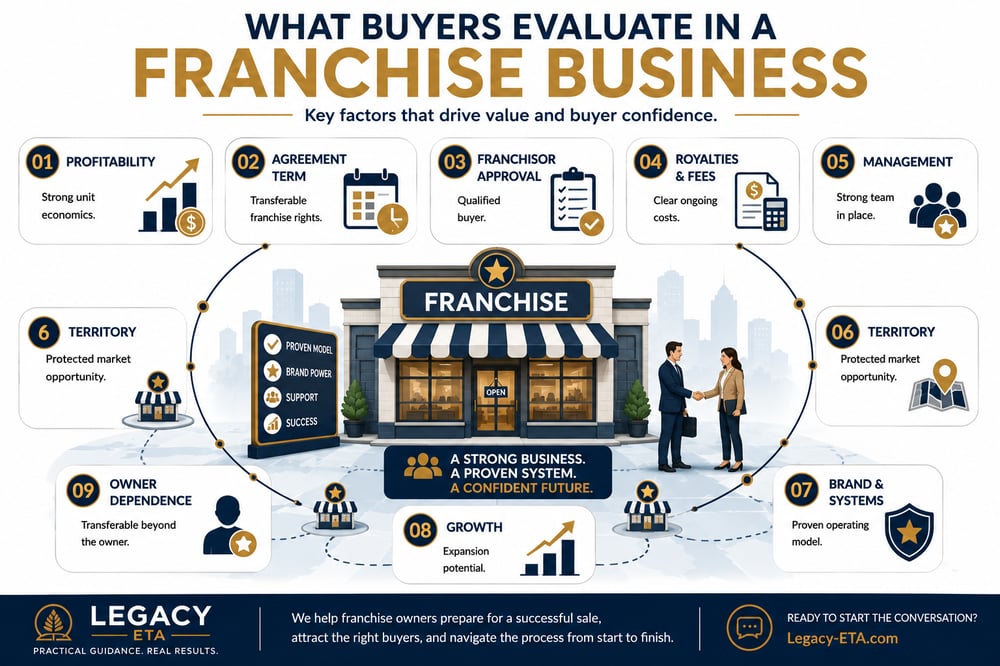
What Do Buyers Look for in a Franchise Business?
Buyers evaluate both the underlying business and the franchise relationship. They want confidence that the unit performs well financially, the agreement can support continued operation, the franchisor will approve the transfer, and the team can maintain performance after ownership changes.
| Area Buyers Review | What They Evaluate | Why It Matters |
|---|---|---|
| Unit Economics | Revenue, normalized earnings, margins, royalties, fees, and operating expenses | Shows whether the individual operation produces sustainable cash flow. |
| Franchise Agreement | Remaining term, renewal rights, transfer provisions, and required investments | Determines the buyer's ability to continue operating under the brand. |
| Transfer Process | Franchisor approval, buyer qualifications, training, documentation, and transfer fees | Can directly affect transaction timing and buyer eligibility. |
| Management | General manager, employees, training, retention, and operating responsibilities | Shows whether the business can operate without the seller. |
| Territory | Geographic rights, demographics, competition, market penetration, and expansion rights | Helps buyers understand the long-term market opportunity. |
| Systems & Brand | Training, procedures, technology, marketing, purchasing, and brand support | Helps buyers assess the strength of the operating platform. |
| Owner Role | Staffing, local marketing, operations, financial oversight, and customer relationships | Helps buyers assess transition risk. |
How to Prepare a Franchise Business for Sale
Franchise sales involve an additional stakeholder: the franchisor. Preparing early gives you time to organize financial records, understand transfer requirements, and identify issues that could affect buyer approval or transaction timing.
- Organize unit-level financial records. Prepare tax returns, profit-and-loss statements, balance sheets, sales reports, and supporting schedules for each location.
- Review the franchise agreement. Understand remaining term, renewal provisions, transfer restrictions, required upgrades, and obligations that may affect a buyer.
- Understand franchisor approval requirements. Identify buyer qualifications, required training, applications, transfer fees, and expected approval timelines.
- Separate royalties and franchise costs clearly. Make recurring fees and franchisor-related expenses easy for buyers to understand when evaluating unit economics.
- Document your management team. Clarify manager and employee responsibilities and identify which people are important to maintaining operations after the sale.
- Document territory and growth rights. Organize relevant information regarding territory protection, development rights, or additional-unit opportunities.
- Prepare multi-unit reporting where applicable. Provide both consolidated results and individual unit-level performance so buyers can evaluate the portfolio accurately.
- Clarify the owner's role. Identify operational, staffing, marketing, financial, and relationship responsibilities that depend on you personally.
What Does the Franchise Sale Process Look Like?
A franchise sale generally follows the same major stages as other business transactions, but franchisor approval and transfer requirements must be incorporated into the process.
1. Define Your Exit Goals
Determine your preferred timing, financial objectives, transition expectations, and whether you intend to sell one unit or an entire portfolio.
2. Understand the Business's Value
Review unit-level earnings, franchise fees, agreement terms, management, territory rights, growth opportunities, and owner dependence.
3. Prepare for the Market and Transfer Process
Organize financial records and franchise documentation while identifying transfer requirements, buyer qualifications, and approval procedures.
4. Identify Qualified Buyers
Buyers should be evaluated not only for financial ability and transaction fit but also for their ability to meet applicable franchisor requirements.
5. Complete Due Diligence and Franchisor Approval
The buyer reviews financial and operational information while the parties coordinate required franchise applications, training, documentation, and approvals.
6. Close and Transition the Franchise
Once transaction and franchise requirements are satisfied, ownership transfers to the buyer and the operational transition begins.
Considering Selling Your Franchise Business?
A confidential conversation can help you understand your options, how buyers may evaluate your franchise, and what transfer requirements should be addressed before going to market.
Talk With Legacy ETAHow Is a Franchise Business Valued?
A franchise valuation generally begins with the financial performance of the individual unit or portfolio, but buyers also evaluate the terms and durability of the franchise relationship.
Depending on the operation, buyers may analyze normalized cash flow or EBITDA alongside royalties and fees, agreement term, unit-level trends, management depth, territory economics, required capital spending, expansion opportunities, and owner dependence.
Multi-unit franchises may require additional analysis because buyers often evaluate both consolidated earnings and the individual performance of each location.
A professional valuation can help establish realistic expectations before speaking with buyers and identify issues that may affect both buyer interest and the franchise-transfer process.
How Legacy ETA Helps Franchise Owners
Selling a franchise involves coordinating the normal financial, operational, and transaction requirements of a business sale with the additional requirements of the franchisor relationship.
Legacy ETA helps franchise owners navigate that process from preparation through closing.
- Business valuation and unit-level analysis
- Review of franchise transfer considerations
- Preparation of financial and operating information
- Confidential marketing and buyer outreach
- Buyer qualification and offer evaluation
- Support through due diligence, approval, and closing
Frequently Asked Questions About Selling a Franchise
How much is my franchise business worth?
The value of a franchise depends on factors including normalized earnings, unit-level performance, royalties and fees, remaining agreement term, territory economics, management depth, growth opportunities, and owner dependence. Multi-unit operations may also be evaluated on both individual location performance and consolidated results.
Does the franchisor have to approve the buyer?
Franchise transfers may be subject to franchisor approval and buyer qualification requirements. Owners should understand the applicable process early so potential buyers can be screened with those requirements in mind.
What happens to my franchise agreement when I sell?
The treatment of the franchise agreement depends on its terms and the franchisor's transfer process. Buyers and sellers should review remaining term, assignment or transfer provisions, renewal requirements, and any required new agreements before closing.
Are franchise transfer fees part of the sale?
Franchise agreements may include transfer-related fees or other obligations. The parties should understand those costs and who is responsible for them before finalizing the transaction structure.
Is selling a multi-unit franchise different from selling one location?
Yes. Multi-unit transactions often require buyers to evaluate each location's financial performance alongside consolidated results, management infrastructure, territory rights, shared costs, and development obligations.
Can I sell my franchise if I still manage the business every day?
Yes, but significant owner involvement can create transition risk. Buyers will want to understand which staffing, operational, financial, marketing, and customer responsibilities depend on you and whether those duties can transition to managers or the buyer.
How long does it take to sell a franchise?
Timing varies based on preparation, buyer interest, financing, due diligence, negotiations, and the franchisor's transfer and approval process. Addressing franchise requirements early can help reduce avoidable delays.
Should I get a valuation before selling my franchise?
A valuation can help establish realistic expectations and identify the factors that may influence buyer interest before the business goes to market. It can also help distinguish unit-level operating performance from royalties, franchise fees, and other system-related expenses.